
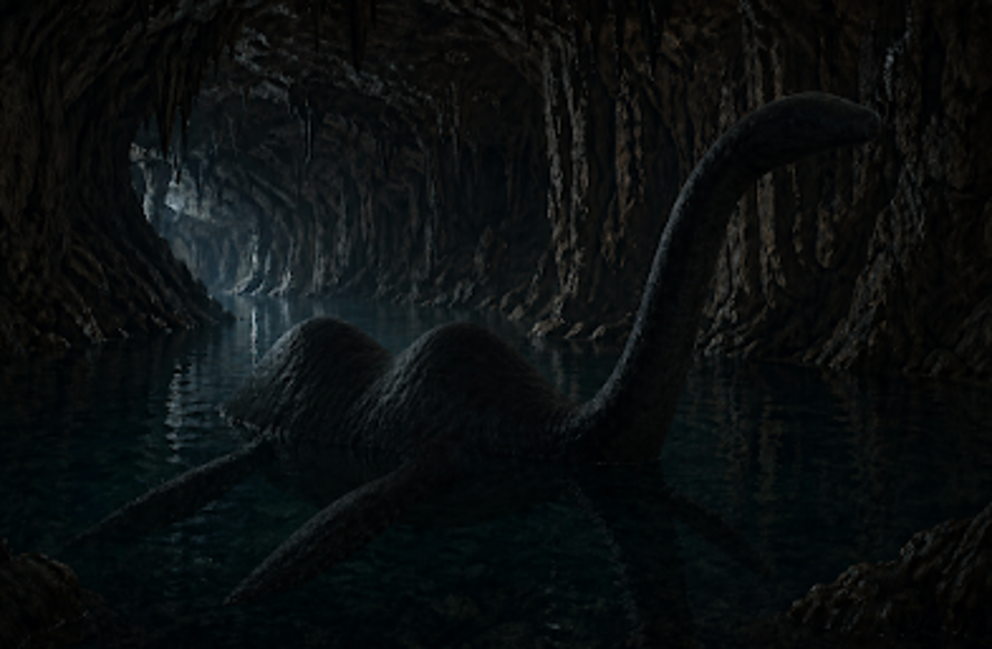
Underground channels in Loch Ness
There is a story perhaps as old as the Loch Ness Monster itself and that is the legend of an underground channel leading out of Loch Ness to a distant coastline exit to the sea, either to the west or the north east and which it is said the creature travels along to enter or exit the loch. This story goes right back to the first important book on the monster by Rupert Gould in 1934 where he states:
Credulous persons in the neighbourhood, and elsewhere, occasionally avow a belief, or at least a suspicion, that a subterranean tunnel exists, connecting Loch Ness with the sea - its distal end being usually located in Loch Hourn.
The subject was further taken up by Constance Whyte twenty three years later in her own magnus opus but neither did she give it much credence. The argument against it was stated by Gould himself from his same work, "The Loch Ness Monster and Others":
Unfortunately, the facts of the case forbid such a supposition. If a tunnel existed, the surface of the Loch would be at sea-level, and not a permanent 50 feet, or so, higher - furthermore, the waters of the Loch would rise and fall with the tides, and would be at least brackish, if not definitely salt.
That argument has been pretty much repeated by others throughout the decades and Gould's experience as a maritime man was taken to lend credence to the argument. However, one man was not convinced that this was the end of the matter and his name was Herman Cockrell. In an article for his local "Dumfries and Galloway Standard" newspaper in April 1958, he stated that:
So far the arguments adduced by experts against the possibility of an underground connection between Loch Ness and the sea, have been summed up by the late Commander R. T. Gould, R.N., in his book of careful recordings, "The Loch Ness Monster," 1934, and amplified in "More Than A Legend," by Constance Whyte, M.B., B.S., 1957.
I consider both these books to be of the highest merit; they are painstaking and impartial and it is only on this point about an underground connection that so far I have found them blindly following the majority. Apparently they were unable to find any convincing argument in favour, in spite of a special search, though this appears incredible.
I'm afraid the Commander must be mostly to blame as he was an expert on the movements of water and a noted navigator and his word therefore carried a lot of weight.
If Cockrell's name sounds familiar then it is because of his photograph (below) of the Loch Ness Monster taken later in 1958 when he mounted a one man kayak expedition and which I covered in a previous article here.
For the rest of this article please use source link below