The myth of the fragile public: Why UFO disclosure (most likely) won’t break society
One of the most persistent assumptions surrounding UFOs and UAP has remarkably little evidence behind it. Ask why governments might conceal evidence of non-human intelligence (NHI) (of the more outré variety, mind you, not the regular ol’ NHIs we encounter every day like dogs, cats, particularly clever crows, etc.) and you’ll frequently hear reference to society wide ‘ontological shock’ or in less fancy terms…the public would panic.
This idea that so-called “Disclosure” would inevitably trigger social collapse, religious crises, or widespread disorder has become so deeply embedded in popular culture that it is rarely examined. It appears in congressional hearings, intelligence community speculation, science fiction, documentaries, and countless late-night internet discussions. Surely it seems self evident that confirmation that humanity is not alone at the top of the cosmic food chain would produce civilizational vertigo.
The thing is, these assumptions might just tell us more about our institutions than it does about the public. What if “the public would panic” is less an empirical observation than a recurring story that governments, experts, and media organizations tell themselves whenever they confront the prospect of losing informational control?
By shifting the conversation away from whether UAP represent NHI and toward why institutions keep assuming the public cannot cope with uncertainty, we find ourselves standing on some rather fertile historical and sociological ground.
The Fake Radio War
History suggests we should be profoundly skeptical of the fragile-public narrative. Whenever commentators discuss how humanity might respond to confirmation of NHI, they almost invariably invoke the same historical anecdote: Orson Welles’ 1938 Mercury Theatre on the Air Halloween adaptation of H.G. Wells’ War of the Worlds and the supposed nationwide panic it unleashed.
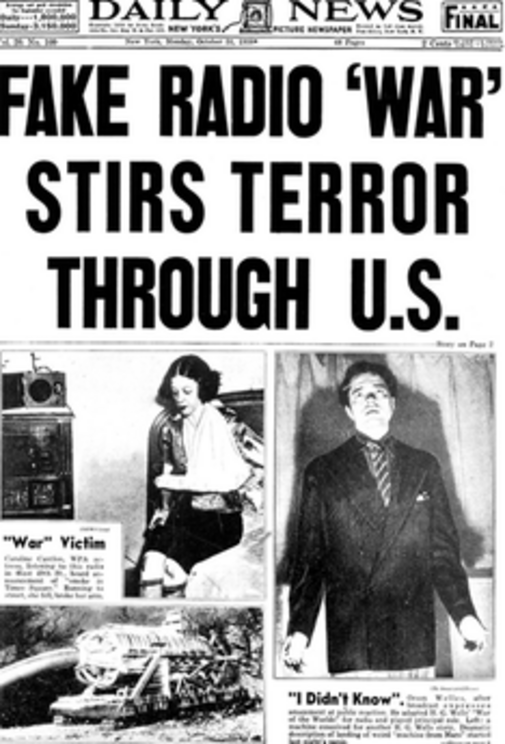
Daily News Front page October 31, 1938
The story has become contemporary folklore. Millions allegedly fled their homes. Churches overflowed with terrified worshippers. Highways clogged with refugees escaping invading Martians.
Except… almost none of that actually happened.
Media historians have spent decades dismantling the legend, demonstrating that reports of mass hysteria were wildly exaggerated. Radio audiences that night were far smaller than commonly assumed, most listeners recognized the program as fiction, and newspaper accounts dramatically inflated isolated incidents into a national crisis. There were even Letters to the Editor from the time reacting to stories of the alleged panic from people who disputed the claims with eye witness testimony that indicated nothing actually happened.
As Jefferson Pooley and Michael J. Socolow observed in their 2013 Slate article reassessing the broadcast:
“How did the story of panicked listeners begin? Blame America’s newspapers. Radio had siphoned off advertising revenue from print during the Depression, badly damaging the newspaper industry. So the papers seized the opportunity presented by Welles’ program to discredit radio as a source of news.”
In short, newspapers responded to a disruptive new technology by portraying radio listeners as gullible dupes incapable of distinguishing entertainment from reality. One of our foundational stories about why people cannot be trusted with extraordinary information was itself manufactured through ordinary media competition. The panic wasn’t a psychological reaction to Martians; it was a public relations campaign designed to protect an informational monopoly. One that, ironically, probably did more to bolster readers interest in radio than persuading them of its dangers. As a consummate showman, I’m sure that Welles loved the publicity all this ballyhoo produced.
Predicting Panic Has a Poor Track Record
The problem runs much deeper than one famous radio broadcast. Throughout modern history, institutions have repeatedly predicted that ordinary people would respond catastrophically to disruptive, paradigm-shifting events. Again and again, those predictions have proven remarkably wrong.
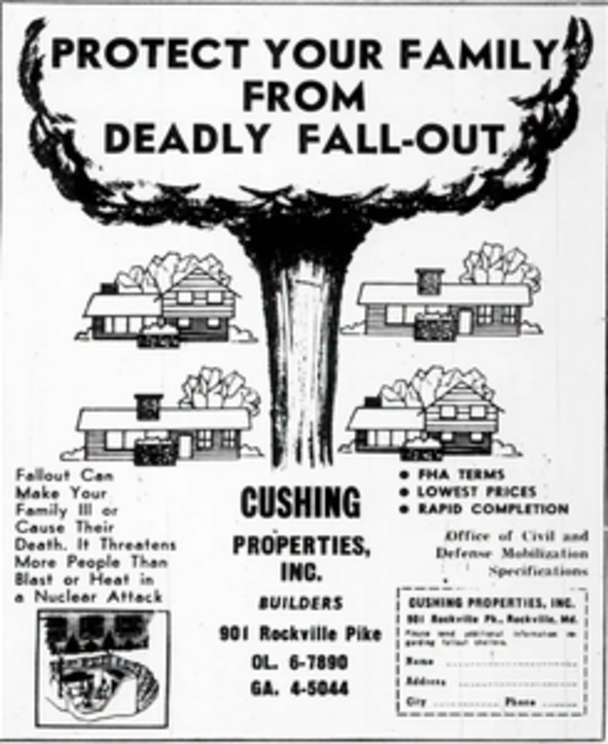
The Dawn of the Atomic Age: When the atomic bomb was revealed, commentators feared civilization-wide nihilism and psychological collapse. Instead, society integrated the grim reality into the background noise of daily life. It even became a lucrative commercial opportunity for those selling fall-out shelters and other protective measures.
The Cosmic Perspective: When the first photographs of Earth from space transformed humanity’s understanding of its place in the cosmos, there was no existential collapse. People bought posters of the “Blue Marble” and kept going to work.
Geopolitical Shocks: The end of the Cold War overturned decades of deeply ingrained geopolitical assumptions almost overnight. The world changed, but daily life adjusted without a hitch.
Modern Disruptions: Even events that genuinely shocked global consciousness like the September 11 attacks, the COVID-19 pandemic, or the sudden, exponential rise of generative artificial intelligence, certainly generated fear and friction. But they did not produce the civilizational resets that alarmists initially imagined. I mean, even the work-from-home mandate which aligned with some of the early promises of digital connectivity got nixed as soon as corporations realized they were going to loose real estate investments.
Humans, it turns out, are quite good at incorporating extraordinary realities into ordinary routines, particularly at at societal and cultural level. This capacity for rapid adaptation may be one of our defining evolutionary traits.
The Reality Check: What the Current Data Actually Says
If we step away from institutional speculation and simply ask people how they think they would respond to Disclosure, the narrative of the fragile citizen crumbles completely.
Data from a recent BIG DATA POLL offers a nice little empirical test of the Disclosure Panic Hypothesis. When respondents were asked how official confirmation of non-human intelligence would affect society, the overwhelming majority anticipated stability rather than collapse:
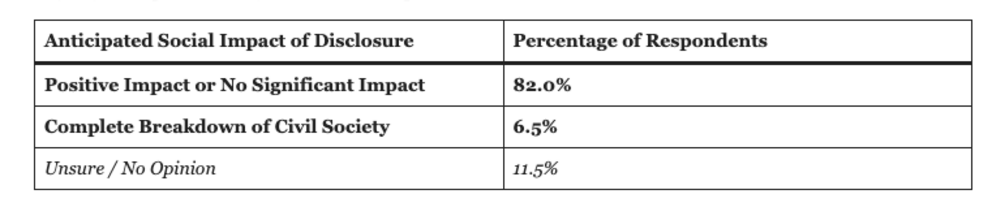
For decades, the taboo surrounding official recognition and study of UFOs has often been justified and explained (explicitly or implicitly) by pointing to public psychological vulnerability. Yet the available evidence suggests the opposite. Most people appear remarkably resilient. They expect curiosity, scientific excitement and religious reflection. Very few envision civilization descending into chaos.
“There is a lot to unpack from this study both in terms of the data collected for this study and potential contributions it may make to future studies on the subject,” BIG DATA POLL Director Rich Baris, said in a statement. “However, the data painted a clear enough picture to state with confidence that stereotypical assumptions are wrong, and previous doomsday predictions in the event of a hypothetical Alien Disclosure scenario, are outdated.”
Obviously, standard caveats on the accuracy of public polling apply, but it might just be that the average citizen has already been preparing for this possibility through decades of science fiction, astronomy breakthroughs, and an increasingly pluralistic understanding of the universe. The notion that intelligent life might exist elsewhere no longer feels like a reality-shattering revelation. In a way, it kind of feels…expected.
For the rest of this article please use source link below