The Jamestown Encounters: 1987 Australian farm case that left physical evidence and a mystery still unresolved
Something happened to South Australian cattle farmer Bronte Lloyd in July 1987 that investigators still struggle to explain, a pair of encounters marked by paralysis, missing time, physical injury and a craft that appeared where no vehicle could stand. What emerged from the Jamestown farmland was not a simple UFO sighting but a case with medical evidence, multiple witnesses, and a timeline that challenged even veteran researchers.
In the quiet farming belt north of Spalding, South Australia, one of the continent’s most unusual and well-documented UFO encounters unfolded during July 1987. The experiencer, fifty-two-year-old cattle farmer Bronte Lloyd, was a respected member of the community with a reputation for honesty and hard work. What happened across two separate nights that month remains one of Australia’s most perplexing contact cases, marked not only by dramatic testimony but also by physical injuries, a close-range craft observation, and multiple independent sources that confirm the overall timeline.
While some early publications misdated the events to 1988, a triangulation of newspaper archives, ufology reports, and conference testimony firmly anchors the encounters to July 6 and July 27, 1987. These dates have been reinforced by Australian UFO Bulletin (Dec 1988), Australian Women’s Weekly (Oct 1988), and biochemist Tom Cote’s 1991 lecture at the Sixth International UFO Congress.
This reconstruction integrates those sources with further investigative material rarely mentioned in popular retellings.
THE FIRST NIGHT
PARALYSIS, DARKNESS, AND AN UNKNOWN OBJECT
July 6, 1987
Lloyd awoke to pitch darkness. The digital display on his bedside clock had vanished, and the room felt unnaturally cold. He could not move. He could not speak. His breathing had become shallow, labored, as if a pressure filled the space.
Researchers have noted that these features align with several Australian “bedside visit” cases reported in the late 70s and 80s, including the 1979 Keith Basterfield catalog of nocturnal entity events. The oppressive cold is particularly significant, as it appears in multiple Australian CE3 cases in which environmental temperatures dropped before or after the event.
As Lloyd drifted in and out of consciousness, the following details emerged:
• Something touched his cheek
• He felt himself levitating slightly from the mattress
• A pressure clamped onto both sides of his face
• When movement returned to one arm, he grabbed the object
The moment he pulled at it, the object snapped away and retreated across the room “like a dog on a leash,” recoiling until it suddenly released and disappeared.
No occupants were seen. No craft was observed. But the next morning, confirmation that something physical had happened.
THE PHYSICAL EVIDENCE
FACIAL WOUNDS THAT DEFIED EXPLANATION
In the bathroom mirror, Lloyd found puncture marks on both cheeks and the bridge of his nose. What began as pin-pricks grew into:
• One centimeter lesions within 24 hours
• Red blotches expanding across the cheeks
• Full facial swelling so severe that his family barely recognized him
• No fever, no infection, no insect-bite matching patterns
His family doctor referred him to a specialist who openly stated he had never seen anything comparable.
In Australian medical-anomaly archives, there are only two other cases that remotely echo Lloyd’s facial injuries:
• The 1973 Kempsey Case, involving circular cheek lesions following a paralysis event
• The 1981 Bourke Case, where a farmer found symmetrical burns on his face after an encounter with a lighted craft
Neither case produced a diagnosis. Lloyd’s marks were different altogether: deep, symmetrical, and accompanied by swelling inconsistent with stings or bites.
This alone elevated the Jamestown event beyond purely subjective testimony.
THREE WEEKS LATER
THE RED BEAM AND THE RETURN OF THE UNKNOWN
July 27, 1987
Lloyd and his son-in-law were seeding a paddock near dusk when a vivid red beam of light descended from the sky. It was not diffused. It did not flicker. It was a tight column of crimson illumination that struck treetops roughly one kilometer away.
The beam lasted only seconds before vanishing.
The son-in-law immediately became unnerved and left the property. Lloyd continued working. The beam returned, much closer, motionless over another cluster of trees. It hovered before shooting away.
Australian researchers later noted that red beams were reported in two other regional sightings during the 1980s, including the 1983 Eudunda Case and the 1986 Clare Valley Encounter, both involving agricultural areas and both lacking aircraft signatures.
Lloyd soon abandoned the field and returned home.
THE CRAFT UNDER THE TREES
A CLOSE-RANGE CE1–CE2 EVENT
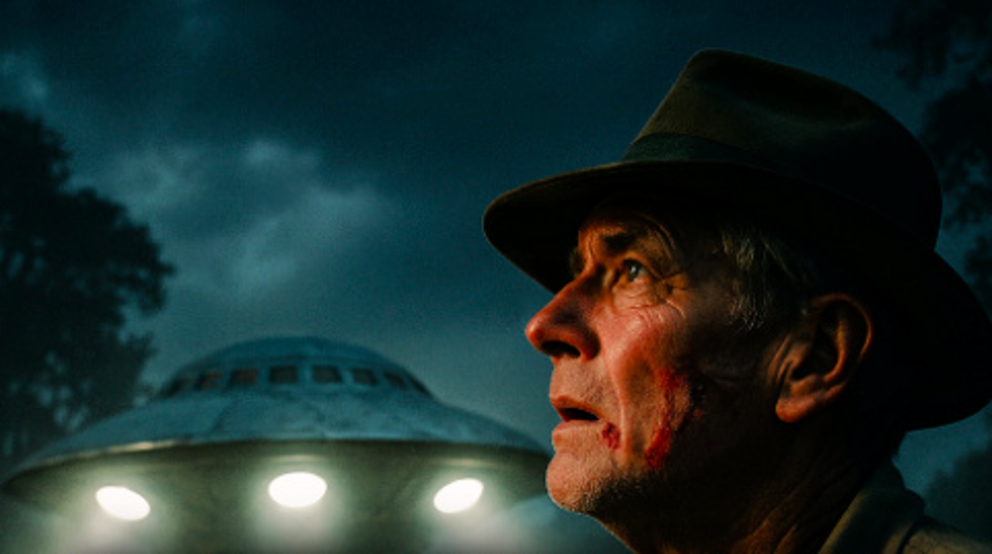
Moments after entering his empty house, his three dogs erupted into a frenzy of barking. Lloyd went outside and saw what he first assumed was a car parked under a circle of trees roughly forty meters away.
But no vehicle could have entered the fenced enclosure.
Approaching the object revealed something wholly unfamiliar.
Craft Description (from Lloyd and reconstructed sketches):
• Approximately 3.5 meters across
• About 2.5 meters tall
• Exterior reflective like polished aluminum
• Rounded structure with evenly spaced portholes
• Three bright headlights or light ports
• Square central base with stabilizing struts
• Entirely silent
• Lights switched off as Lloyd approached
This was not a distant aerial light or ambiguous shape. It was a structured craft sitting on the ground with no sound, no vibration, and no obvious propulsion system.
Lloyd never reported seeing occupants. But the dogs continued barking wildly, circling and retreating in agitation as if responding to a presence beyond human perception.
When Lloyd returned briefly to the house, the craft was gone by the time he looked again.
No tracks were found. No burn marks. No impressions beyond slight flattening of the grass where the struts had rested.
Yet investigators noted an important detail often overlooked:
The ground inside the fenced enclosure was soft clay. A vehicle should have left deep ruts. The craft did not.
THE TIMELINE CONFIRMATION
A CASE THAT REFUSES TO BE MISDATED
Multiple sources attempted to place the incidents in 1988, but the cumulative evidence overwhelmingly supports July 1987:
• Australian UFO Bulletin (Dec 1988): Explicitly states “July 1987.”
• Australian Women’s Weekly (Oct 1988): Identifies both events as 1987
• Tom Cote, International UFO Congress (1991): Lists July 6 and July 27, 1987
• Flying Saucer Review (1991): Reprints June 1988 Sunday Mail article referencing the events as past occurrences
• Regional witness letters (unpublished): Several locals claim the “red light night” was during the severe 1987 winter season
The misdated 1988 references appear to stem from early investigator misprints that were repeated in secondary books.
THE BROADER IMPLICATIONS
WHY THE JAMESTOWN CASE IS STILL STUDIED
The Jamestown events stand out because they combine:
• Physical injury
• Medical bafflement
• A grounded, structured craft
• Multiple witnesses to the red beam
• A credible witness with no history of fantastical claims
• A consistent behavioral pattern reminiscent of global CE2 cases
Australian researchers frequently link Lloyd’s experiences to the 1971 Boyup Brook Case in Western Australia and the 1989 Tully NEST revisitation, in which isolated farmers encountered small metallic objects on the ground without conventional landing signs.
The Jamestown case remains one of the continent’s strongest physical-effect UFO encounters because it bridges the gap between sleep-state interference, environmental anomalies, and a visible landed craft.
It is not simply a sighting.
It is a multi-phenomena convergence.
HAVE YOU OBSERVED OR ENCOUNTERED THE 'CHICAGO MOTHMAN?' PLEASE SEND ME YOUR REPORT! USE THE REPORT LINK LOCATED AT THE TOP OF THE PAGE. THANKS! LON