The freaky physics that explains how UFOs might fly
If UFOs are real — and these days, even the Pentagon’s not laughing — then they are breaking every known law of physics.
They accelerate from standstill to hypersonic speeds without noise or exhaust. They make right-angle turns that should pulp any occupant. They drop from 80,000 feet to sea level in under a second.
Whatever these things are, they are not just clever drones or secret planes. And that’s where two of the strangest minds in modern physics step in.
Hal Puthoff and Eric W. Davis, both veterans of fringe research programs connected to the U.S. Department of Defense, have spent years building theoretical frameworks for the impossible. They don’t say “aliens.” They say “advanced aerospace systems exploiting the deep structure of spacetime.”
In short: they’re trying to imagine how UFOs might actually work — using real (if extreme) physics.
The Architects of the Unexplained
 Hal Puthoff PhD
Hal Puthoff is a physicist who once helped develop lasers for the NSA, then swerved into psychic research and, later, the Pentagon’s Advanced Aerospace Weapon System Applications Program (AAWSAP) — the project that investigated UFOs before “UAP” became the official term.
Eric Davis, an astrophysicist, worked alongside him, writing dense, classified papers on warp drives, wormholes, and quantum vacuum propulsion. His research also appeared in the AATIP files — the Pentagon’s follow-up effort to make sense of strange encounters reported by Navy pilots.
Their shared project: to explore how a craft could do what UFOs appear to do — not as fantasy, but as physics taken to its logical, terrifying limit.
Theory One: The Engine of the Vacuum
At the centre of Puthoff’s work is a radical idea: the vacuum of space isn’t empty.
Quantum physics tells us that even in a perfect vacuum, subatomic fields never truly rest. Tiny bursts of energy — “virtual particles” — appear and vanish constantly. This sea of background energy is called the zero-point field, and to Puthoff, it’s not a curiosity. It’s a potential power source.
If you could somehow “polarise” the vacuum — tweak its electromagnetic properties — you could, in theory, extract energy from the underlying quantum foam. Puthoff calls this engineering the vacuum.
That energy could be used to do something even stranger: manipulate the structure of spacetime itself.
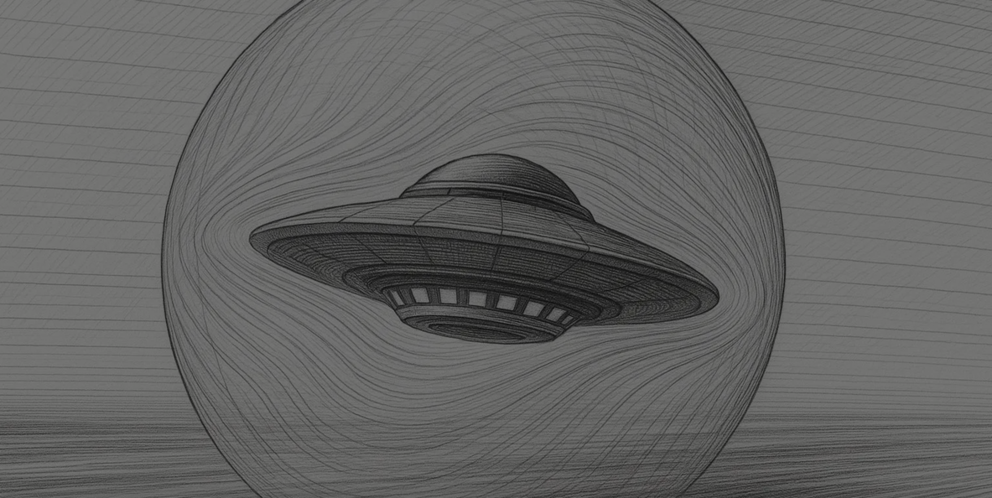
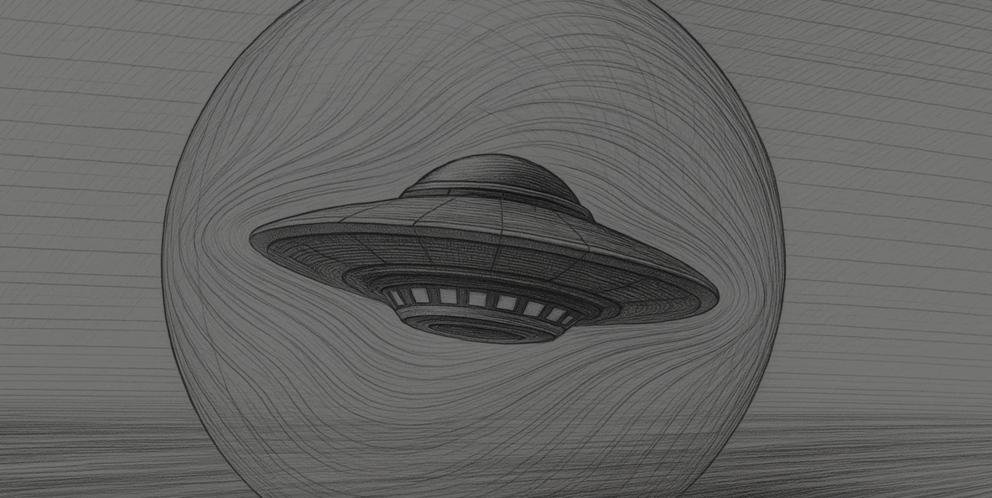
In his models, a craft might generate intense electromagnetic fields to distort the local vacuum, forming a kind of spacetime bubble. Inside that bubble, the usual rules of inertia and gravity would no longer apply. The ship wouldn’t push against air or gravity — it would move the universe around itself.
To outside observers, it would appear to defy physics: no sonic boom, no heat trail, no visible propulsion. But inside the bubble, the passengers would feel nothing at all — a perfectly calm ride through warped spacetime.
Puthoff’s space-time bubble theory is an audacious concept that blends Einstein’s relativity with quantum field theory. But the energy required to warp space on that scale is, by any human measure, obscene — far beyond our current capabilities.
Still, as Puthoff likes to point out: the equations don’t forbid it.
Theory Two: Entanglement and the Cosmic Network
If Puthoff’s obsession is the engine, Eric Davis’s fascination is the control system.
Davis has explored how UFOs might exploit quantum entanglement — the mysterious linkage between particles that remain connected even when separated by vast distances.
Entanglement can’t send energy or information faster than light (at least, not according to today’s physics). But Davis speculates that an advanced intelligence might use it in ways we don’t yet understand — as a mechanism for instantaneous communication, navigation, or even propulsion control.
He imagines a kind of quantum coherence enveloping the craft — a field that keeps all its systems in perfect synchrony. The ship might be connected to a remote energy source or network through entangled states, allowing it to receive power or coordinate movement in real time across interstellar distances.
In this view, the UFO isn’t just a flying machine — it’s part of a larger quantum architecture, an intelligent system using the universe’s own connectivity as its operating network.
It sounds wild. And it is. But Davis argues that quantum theory already allows effects that feel like magic; we just don’t know how to scale them up.
Beyond Jets and Rockets
Both scientists reject the idea that UFOs, if real, are just faster versions of our technology.
Jets, rockets, and propellers all obey Newton’s third law — push against something, get thrust. UFOs, by contrast, seem to bypass that rule entirely.
Instead of pushing through air, a Puthoff–Davis craft might modify spacetime itself to move effortlessly through any medium — water, air, vacuum — by creating a zone of altered physics around it.
This could explain reports of objects entering the ocean without a splash, or accelerating to incredible speeds without heat signatures. The craft wouldn’t be cutting through resistance; it would be sliding through a pocket of its own making.
If you think that sounds like science fiction — you’re right. But that hasn’t stopped real funding. Between 2007 and 2012, the Pentagon reportedly spent millions on theoretical studies of warp drives, antigravity propulsion, and traversable wormholes — many authored by Puthoff and Davis.
Officially, these were “defence research” papers. Unofficially, they were an attempt to understand the technology behind unidentified aerial phenomena — in case it wasn’t ours.
What the Skeptics Say
Mainstream physicists are, to put it mildly, unimpressed.
The energy requirements for spacetime manipulation are astronomical — enough to vaporise planets. The materials needed to contain such fields don’t exist. And quantum entanglement, while real, can’t transmit power or usable information.
To most scientists, these theories are elegant thought experiments — intellectual gymnastics for the curious mind, not blueprints for real craft.
But even the skeptics acknowledge something interesting: neither theory breaks the laws of physics outright. They just operate in the deep end of the pool, where we haven’t learned to swim yet.
The Pentagon Connection
What makes this story more than armchair speculation is that both men worked within official government research programs.
The Defense Intelligence Agency quietly commissioned their papers under the heading “Advanced Aerospace Weapon Concepts.” These documents — now public — explored warp metrics, vacuum energy extraction, and the feasibility of spacetime manipulation.
In short, the U.S. government once paid two physicists to explain how UFOs might work — just in case someone out there had already built one.
It’s the kind of bureaucratic madness that could only happen in a country simultaneously terrified of aliens and desperate to beat them to market.
The Edge of the Possible
Whether you see Puthoff and Davis as visionaries or fabulists depends on your appetite for strangeness.
Their theories, wildly speculative though they are, do something valuable: they remind us that physics isn’t finished. That between the particles and the planets lies a wilderness of unknown mechanisms waiting to be uncovered — or imagined.
Maybe UFOs are misread data, black-budget tech, or tricks of the eye. Or maybe, as Puthoff and Davis propose, they are real machines operating on principles we haven’t yet mastered.
In that case, the universe itself might be the power source, the network, and the road.
If their ideas sound improbable, that’s because they are. But history loves the improbable.
Once, heavier-than-air flight was absurd. Once, splitting the atom was myth. Once, the Earth stood still.
Perhaps, in some future century, we’ll look back at the vacuum and entanglement speculations of Puthoff and Davis not as pseudoscience — but as the first rough blueprints for humanity’s next engine.
Until then, the question remains as electric as ever:
If UFOs are real — are they not just visitors from elsewhere,
but students of a universe that still has secrets left to teach us?