
The 3I Atlas Enigma: A psychological, sociological, and scientific exploration
Introduction
The discovery of 3I/Atlas on July 1, 2025, by the ATLAS telescope in Chile has opened one of the most intriguing chapters yet in the study of interstellar visitors. Only the third confirmed interstellar object ever observed—after ‘1I/ Oumuamua and 2/I Borisov—3I Atlas displays characteristics that are both comet-like and anomalous. Its hyperbolic trajectory confirms it came from outside the solar system, yet its composition and behavior challenge conventional expectations.
For the UFO/UAP research community, 3I Atlas has become a compelling case study. Not because it is alien, but because it highlights how scientific uncertainty intersects with public fascination, expert hypotheses, and the psychology of belief.
1. What We Know About 3I Atlas
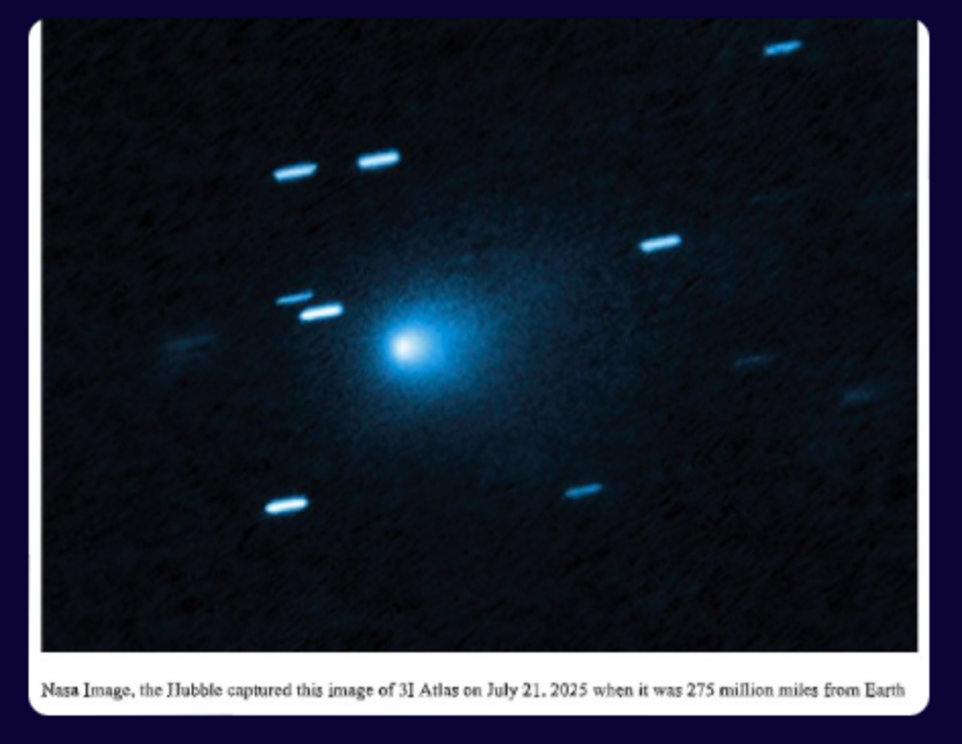
3I Atlas exhibits a coma and a tail, suggesting active outgassing, though unusually high CO₂ levels dominate it. It's extremely fast, and an unbound orbit confirms its interstellar origin.
Most scientists interpret 3I Atlas as an icy body ejected from another star system, likely a fragment of a distant planetary system disrupted long ago.
Still, the combination of CO₂-dominance, high speed, and non-gravitational movement leaves room for debate—and curiosity.
This NASA image shows the trajectory as the 3I Atlas travels through the solar system
2. Why Speculation Has Flourished
Speculation thrives when:
- The data is incomplete
- The object is distant
- Prior interstellar objects exhibited anomalies
- Experts publicly entertain alternative possibilities
3I Atlas checks all four boxes.
Adding to the intrigue, Harvard astrophysicist Avi Loeb has proposed that 3I Atlas could be an extraterrestrial artifact, though he emphasizes this as a hypothesis, not a conclusion. The UFO
community naturally pays attention when credible scientists discuss technological possibilities.
3. What the Experts Are Saying
Avi Loeb
Loeb suggests that the object #39's unusual trajectory could be consistent with a reverse Solar Oberth maneuver, a technique advantageous for a probe using the Sun’s gravity for
acceleration. He also notes that the jet-like features might be consistent with technological thrusters.
However, Loeb repeatedly clarifies:
“By far, the most likely explanation is that 3I Atlas is a natural interstellar comet.”
Steven Greer
Greer urges caution. He suggests that 3I Atlas is more likely a stray asteroid or rock, though he does not rule out the possibility of extraterrestrial debris. He warns that narratives around the object could be leveraged to generate unnecessary fear.
Richard Dolan
Dolan considers Loeb’s hypothesis plausible enough for serious inquiry, noting the object's alignment with the ecliptic plane and unusual trajectory. He stresses that while the object is not proven to be technological, the anomalies justify close study.
Marc Dantonio (MUFON Chief Photo Analyst)
Dantonio’s analysis emphasizes solid data: high CO₂ content, water ice, carbon monoxide, carbonyl sulfide, and possible cyanogen. He urges against sensationalism, focusing on what is known, rather than speculation.
Michio Kaku
Kaku shocked many when he stated the newest images show:
- No tail or outgassing, despite a close approach to the Sun
- Apparent acceleration
- No visible mass loss
-An unexplained orbital shift
These observations have prompted some astronomers to ask whether 3I Atlas might be something constructed, not natural.
4. Why People Want 3I Atlas to Be Manufactured
Curiosity about 3I Atlas reveals deep psychological dynamics:
-Humans seek patterns and threat detection—a survival instinct.
-Uncertainty creates discomfort, pushing people toward definitive explanations.
- Believing in non-human intelligence gives life meaning, wonder, and purpose.
-Conspiracy narratives offer order in a chaotic world.
-UAPs fill a cultural space once occupied by traditional belief systems.
-Witnessing or believing in anomalies gives individuals a sense of belonging to a select group.
3I Atlas becomes a symbol - of mystery, potential, and our collective desire to understand our place in the cosmos.
5. Group Dynamics and the Pull Toward Negativity
UAP communities often form around high-intensity, ambiguous subjects. This fosters:
- Group bonding through shared threat narratives
-Polarization, where groups amplify their dominant emotion
-Worst-case thinking fueled by uncertainty
-Rumor and mistrust in the absence of transparent data
These patterns are natural—but they must be recognized and managed to maintain scientific integrity.
6. Worst-Case Scenarios: Reality vs. Imagination
Hollywood has shaped public imagination for decades, presenting aliens as invaders. Films like Independence Day, Alien, The Thing, Signs, and War of the Worlds fuel fears that extraterrestrial technology equals danger.
In reality, the likelihood that 3I Atlas is:
- A piloted craft
-A deliberate probe
- Or a threat to Earth
is extremely small.
A more grounded concern would be a close approach generating increased meteor activity.
The greater risks lie in public reaction—panic, misinformation, secrecy, or premature conclusions.
7. Final Thoughts: Why This Mystery Matters
My involvement began through the MUFON Photo Analysis Team. While others focus on the hard science, my contribution is more a psychological and sociological context surrounding our fascination with 3I Atlas.
This case reminds us that:
- Curiosity is healthy
- Speculation can inspire scientific breakthroughs
- Data, not fear, should guide us
- Wonder fuels discovery
Even if 3I Atlas turns out to be entirely natural, the process of studying it enriches astronomy, interdisciplinary sciences, and the UAP field.
The journey matters—and it moves humanity forward.