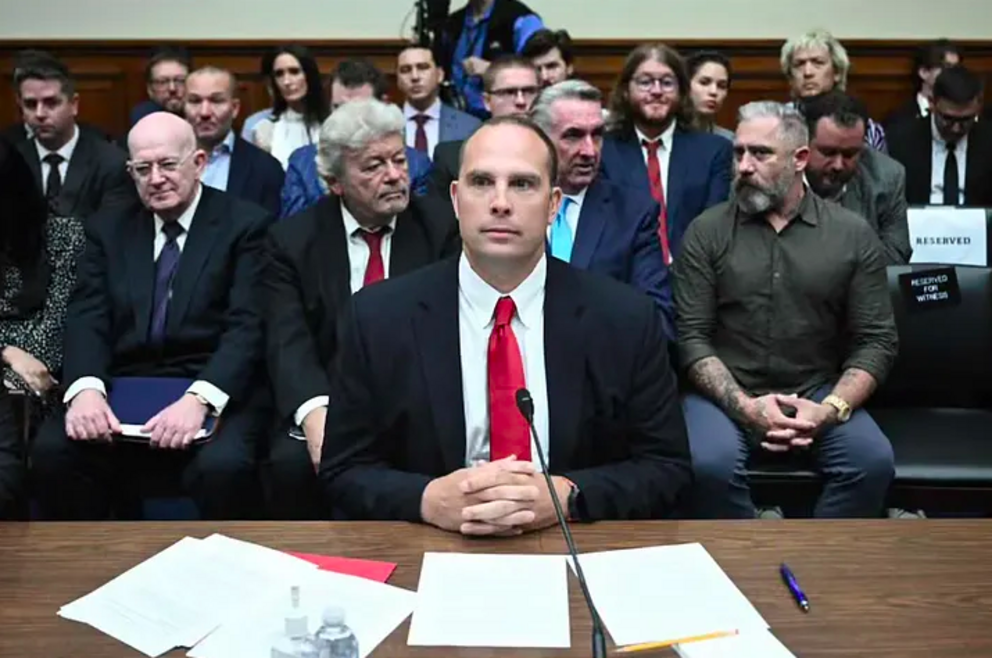
David Grusch: Whistleblower reprisals or national security liability?
If you have paid any attention to the UFO topic for the past three years, you have no doubt heard the name David Grusch. He is probably heralded as the most influential UFO “whistleblower” since Bob Lazar, and in many ways, surpasses Lue Elizondo in terms of credibility to most in the community. That really isn’t that hard to do given that Lue Elizondo has been caught twice now, introducing images of UFOs to paying audiences and members of Congress that turned out to be pictures of 1) two crop irrigation circles side-by-side (image below) and 2) a picture of a reflection of a ceiling light through a glass balcony door, in which Elizondo stated was a “UFO mothership” and that pilots had reported seeing it. Both images were debunked within mere minutes online and continues to be a terrible stain on the credibility of the former counterintelligence agent.
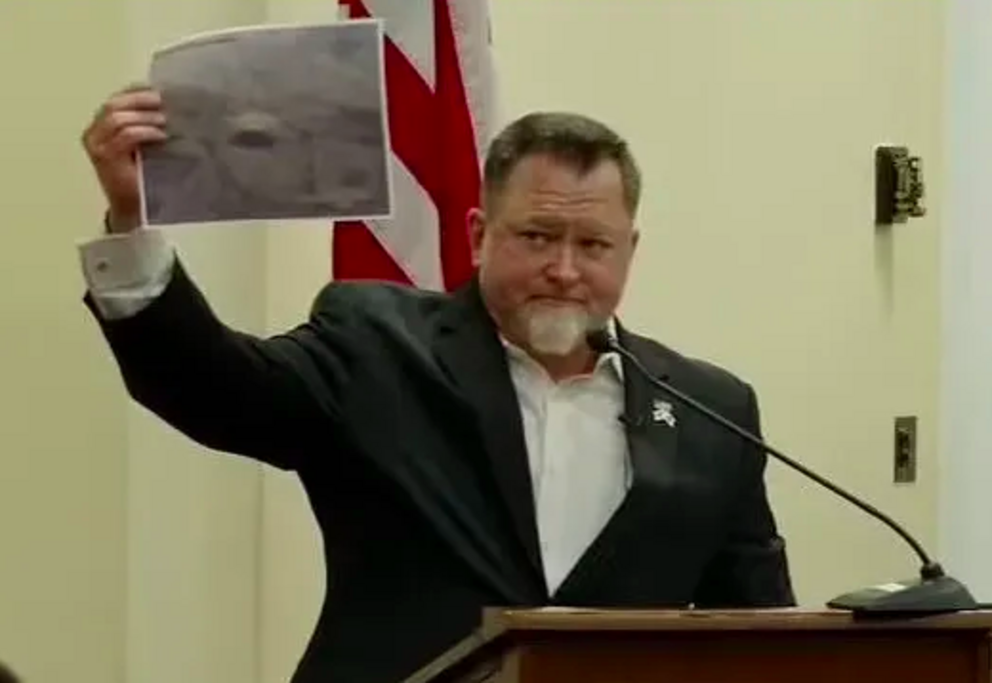 Lue Elizondo holding up a picture of a UFO that was debunked as crop irrigation circles; Image Source: DailyMail.co.uk
Despite David Grusch’s claims about the conspiracy of the United States government lying to the American people about a Legacy UFO crash retrieval program and them having in their possession the craft and bodies of non-human intelligence (NHI) without producing any evidence publicly, he still remains a more prominent figure within the UFO topic, especially given his current role as a special advisor on Representative Eric Burlison’s staff. The former United States Air Force Major and NGA employee finds himself in a decent spot to make a run at disclosure, but did he get there through honesty and integrity?
 David Grusch with a shadow box of his USAF ribbon rack, rank, and patches. Image Source: The Debrief
Central to his public narrative of this government coverup of alien spacecraft and dead bodies was another claim: after he made protected disclosures about UAP (formerly known as UFOs) programs, he suffered retaliation which included adverse security clearance actions or “whistleblower reprisals”. During the July 26, 2023 House Oversight hearing on UAP, Grusch testified under oath that he had been given information confirming a multi-decade crash retrieval program, that he was denied access to those programs, and that after reporting his concerns to the Department of Defense Inspectors General (DoD IG), he suffered retaliation. Then, separately, in his unclassified whistleblower complaint filed with the Intelligence Community Inspector General (ICIG), Grusch alleged that he had been subject to “numerous adverse security clearance actions”, his compartmented accesses were “canceled, delayed, denied, or obstructed”, and that it was directly correlated to his “UAP-related protected disclosures”. But this is where I believe evidence exists that shows Grusch has seemingly deceived the public, including members of Congress while under oath.
Thanks to great work by John Greenwald, Jr., who runs the blackvault.com, he received a reply back on his Freedom of Information Act (FOIA) for “all Inspector General complaints, reprisal investigations, threats assessments, or disciplinary communications created from January 1, 2021, to present referencing whistleblowers within the Department of Defense or Intelligence Community who reported UAP-related programs or technologies”. This narrowed the results down to Grusch’s DoD IG and ICIG complaint, with supporting documentation. And the information within this 67-page response is, in my opinion, damning to the integrity and credibility of David Grusch, who claimed multiple times publicly and under oath that his clearance issues and accesses stemmed from his UAP-related protected disclosures. But before we dive into the FOIA documents, there needs to be clarification between the DoD IG whistleblower reprisal investigation and the ICIG whistleblower reprisal complaint.
ICIG Complaint Determination: “Credible and Urgent”
The main claim to fame amongst David Grusch’s fanbase in the UFO community is that his ICIG complaint, filed in 2022 through Compass Rose, was found “credible and urgent”, which means that ICIG found that Grusch was telling the truth! But that is not what the “credible and urgent” label means.
When a complaint is labeled “credible and urgent”, “credible” means the ICIG found:
- The complaint not frivolous.
- The allegations were plausible on their face.
- The complaint had sufficient access or basis to raise the concern.
- The matter warranted further review.
It does not mean:
- The allegations were proven true.
- Misconduct was established.
- Criminal wrongdoing was confirmed.
It’s just a threshold determination on whether it warrants further investigation, not that it is a final ruling. “Urgent Concern” generally refers to matters involving:
- A serious or flagrant problem
- Abuse, violation of law, or deficiency
- Relating to intelligence activities
- Those that affects national security
If the complaint is deemed “urgent”, the ICIG must forward the complaint to the Director of National Intelligence (DNI), who then transmits it to the Congressional Intelligence Committees. Basically, the “urgent” label triggers mandatory congressional notification. The finding means that the complaint meets the legal criteria for an investigation, but it does not prove reprisals occurred. Since the complaint met the threshold, it was labeled “credible and urgent” to push forward with an investigation into the complaint, but it is not a ruling verifying Grusch’s claims. Important distinction and very relevant when put it into context with what the Department of Defense Inspectors General report revealed in their findings in 2025.
DoD IG Whistleblower Reprisal Investigation
When reading through the scope of the investigation by the DoD IG into Grusch’s claims about reprisals, a timeline of evidence starts to formulate that Grusch might have knowingly misled the public in his assertions that he experienced retaliations due to his UAP-related protected disclosures. He was, in fact, informed that his clearance and accesses had been revoked due to “security violations” and a “pattern of behavior issues” before he went public with his claims of whistleblower reprisals from UAP-related protected disclosures. The information and images from this point on will be from a timeline built off of the Blackvault’s FOIA DoD IG investigation documents and related information.
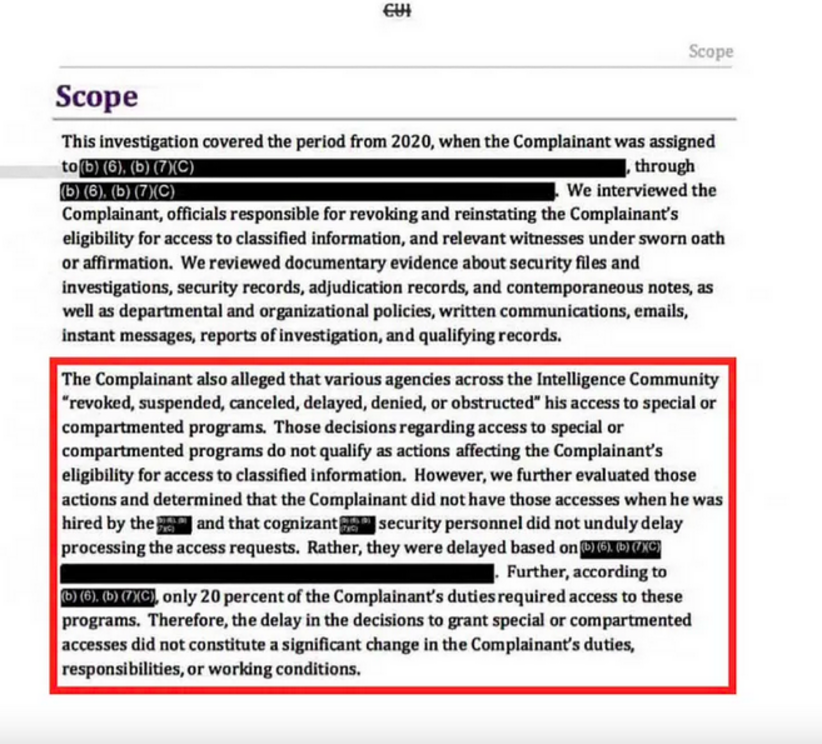
Let’s start with the Scope of the Investigation. The investigation covered a period from 2020 to an undisclosed date/timeframe. Grusch alleged that various agencies across the IC “revoked, suspended, canceled, delayed, denied, or obstructed” his access to special or compartmented programs. But it was determined that Grusch did “not have accesses when he was hired by the [redacted] and that cognizant security personnel did not unduly delay processing the access requests”. They give a reason why it was delayed but it’s redacted and it is indicated that those restrictions “did not constitute a significant change in Grusch’s duties, responsibilities, or working conditions”. In other words, he could carry out his current duties at that position within the agency.
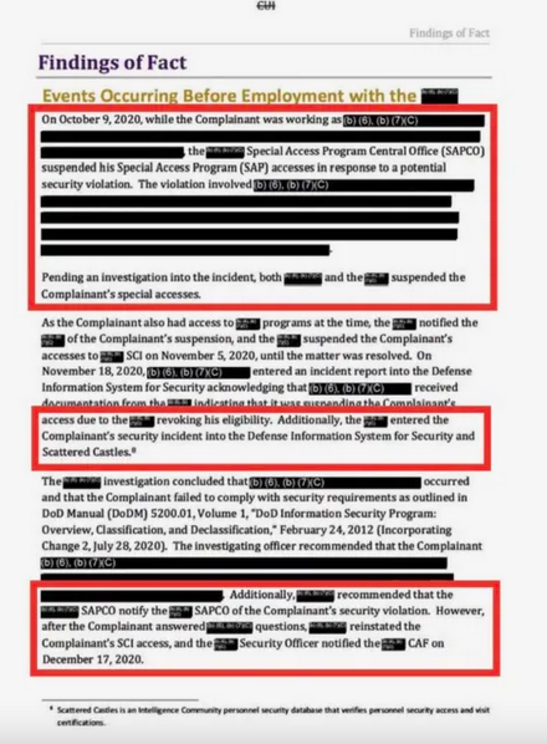
A listing of events occurring before his employment with the [redacted] (I believe this to be the NGA based off of his resume submitted to Congress) shows that on October 9, 2020, SAPCO suspended his SAP accesses in response to a “potential security violation”, which the information detailing that violation is redacted. When other’s within [redacted offices/agencies] notified of Grusch’s suspension, they suspended his SCI portion of his accesses on “November 5, 2020, until the matter was resolved”.
On November 18, 2020, an incident report of the security violation was entered into the Defense Information System for Security and Scattered Castles, which is an IC personnel security database that verifies personnel security accesses. The investigation concluded that Grusch failed to comply with security requirements and SAPCO personnel were made aware of the security violation. Eventually, Grusch was allowed to answer about the violations and his SCI access was reinstated on December 17, 2020.
The following page in the documents is mostly redacted, but it mentions that the “Security office notified [redacted] of Office of Personnel Security via a Loss of Jurisdiction memorandum on or about September 1, 2021, that the [redacted] might have an adjudicative interest in the matter with the Complainant…”, listing two fully redacted lengthy bullet points. I could only speculate that these might be additional incidents, potentially behavioral or security incidents but I cannot be certain and it would only be speculation.
For the rest of this article please use source link below