
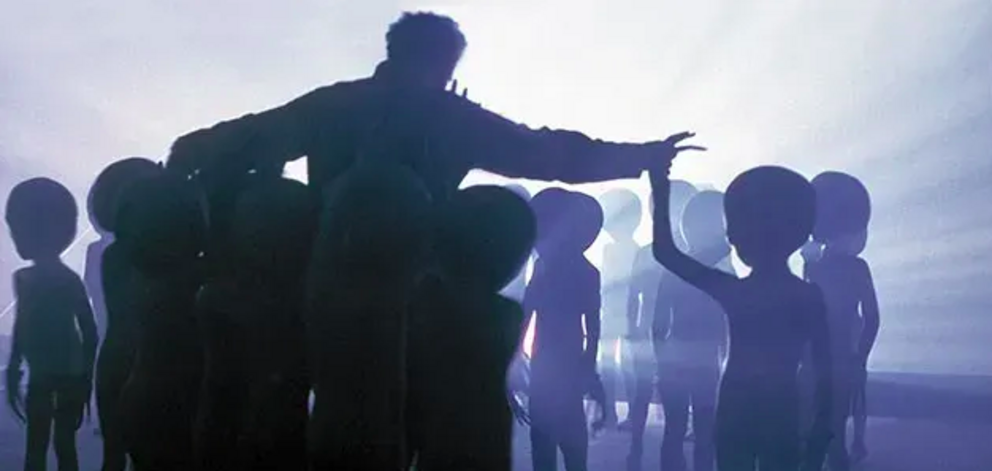
"Aliens wouldn't look anything like us!" ~ or would they?
One of the most common critiques from skeptics about close encounter or alien abduction accounts is the charge that “in a universe this large, the notion that aliens would look anything like humans is ludicrous.”
It’s an argument I heard lobbed from several quarters just recently after former intelligence insider David Grusch stood before press microphones in Washington, D.C. and referred to a spectrum of possible alien beings the U.S. government was studying, ranging from bi-pedal corporeal creatures to “plasmoid” beings of a less tangible sort.
But is that broad-brush critique I opened with really true?
At a conference outside of Chicago back in 1991, I heard a lecture by researcher Michael D. Swords* make a compelling case that the bipedal, two-armed, single-headed form is actually a quite useful one from an evolutionary standpoint, and could in fact be a natural outcome of “convergent evolution.” That is where unrelated species completely separate from one another in space or time sometimes evolve similar physical traits, behaviors, or adaptations simply because they arose in similar environments.
This is largely why you don’t see a lot of land-based, higher lifeforms sporting five legs, three arms, two heads, or so forth, moving around on Earth. (Life underwater is a different story, of course, where you find creatures like octopi swimming around, but that’s a dramatically different environment.) I would add that this may be one of the reasons robots are so often designed to mimic the human form. Yes, there are some robots which move about by means of wheels or tractor-like treads, for instance, but the five-fold, star-like form has certain obvious advantages in terms of maneuverability and survivability. Why else would so many creatures on the planet, whether walking or crawling, have evolved to possess it?
But there is another presumption in that skeptical opening argument which needs to be called out, when it suggests that humans and aliens (or non-human intelligences) almost certainly wouldn’t look similar to one another. Aside from the “convergent evolution” case, what if humans and aliens were in some way related to one another, perhaps sharing similar genetic roots? This would certainly explain a host of similarities in appearance.
Or, consider the fact that there are growing numbers of researchers who speculate that some alien species could actually be humans from the distant future, having returned to our timeline for one or another reason, either to help humanity or themselves – or both. Here as well, similarities in appearance would naturally be expected from such a scenario.
And what about the possibility (especially common in sci-fi circles, as in Carl Sagan’s story “Contact”) that the humanoid bodies of some aliens is simply a form that alien intelligences have taken on to make themselves more relatable or less frightening to us?
 Scene from the film adaptation of Sagan’s novel “Contact,” where Jodie Foster’s character meets an alien being disguised as her deceased father.
To be clear, I’m not arguing for any of these scenarios to be true, simply calling attention to the pitfalls of unexamined presumptions when looking into a subject as complex and multi-faceted as this. These aren’t conventional phenomena we’re talking about, and may require something other than conventional assumptions to be grasped. Business as usual, this ain’t.
* Thanks to David Metcalfe for helping track down Michael D. Swords’ name.