
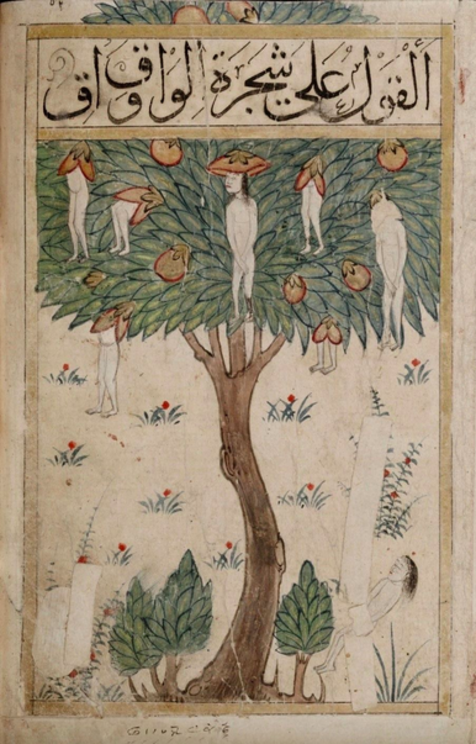
The land where women grow on trees
The Wāq Wāq Tree, a weird and disturbing Arab legend recorded in the 11th century.
“The Book of Curiosities” was written in Arabic by an anonymous author in 11th Century Fatimid Egypt (North Africa and West Asia). It is an educational, entertaining treatise containing beautifully illustrated maps of the Earth and heavens, along with several chapters focused on bizarre animals and plants found in foreign lands. Oxford University’s Bodleian Library purchased one of the only surviving copies in 2002 and has since published it digitally alongside English annotations.
There are numerous shockingly strange flora and fauna described in “The Book of Curiosities.” Among them are Wāq Wāq Trees, said to reside on Wāq-Wāq Island. This nation is said to border on “Sofalah, one of the Islands of the Zanj” (coastal Southeast Africa). The Wāq Wāq Tree bears fruit that resemble women, suspended by their hair as if by green cords.
According to the book, “They have breasts, female sexual organs, and curvaceous bodies, and they scream ‘wāq wāq’. When one of them is cut off the tree, it falls down dead and does not talk any more. Their insides and outsides, their faces and their limbs, are entirely made of something resembling the down of a feather. When a person advances further into the island, he finds a tree with more attractive fruits with plumper posteriors, bosoms, genitalia, and faces, which scream louder than the ones described above. If this fruit is cut off, it survives for a day or part of a day before it stops talking and screaming. The person who cuts down this second type of fruit may sometimes have sexual intercourse with it and derive pleasure from it.”
Wāq-Wāq Island appears throughout medieval Arabic geographical and imaginative literature. Like Themiscyra, Wāq-Wāq Island was said to be ruled by a queen and populated exclusively by women. In this context, the Wāq Wāq Tree explains how the residents of Wāq-Wāq Island asexually perpetuated themselves.
Scholars have identified the people of this island, the Waqwaq or Wakwak, as possibly being, in reality, the Javanese or the Malay of the Srivijaya empire (who were based on Sumatra but began migrating to Madagascar in the 9th Century). One of these groups is thought to have invaded the coast of Tanganyika and Mozambique in 945–946 AD, inspiring myths about the Wāq-Wāq Island nation. The tale of a mysterious tree growing in that location fittingly dovetails with Java and Madagascar being home to the most legendary Cryptobotanical trees of all time, the Poison Upas and Crinoida Dajeeana, respectively.
This article is an excerpt from my latest book, "The Unnatural History of Man-Eating Plants," available now on Amazon.