
How to make primitive arrows – the basics
If you’ve ever tried to catch wild game with your bare hands you already know that the ability to hunt at a distance can mean the difference between a meal and disappointment. Most of the time anyway.
I have an old Vermonter neighbor that routinely brags that he hunts deer with a knife. He has a lot of stories, and this one seemed about as believable as any of them when he told it.
I’ve tried to approach the deer on our land, and I was amazed that moving slowly, most of the year I can get within 20-30 feet before they skitter off. They usually only bound a dozen yards before looking back to see if I’m chasing and then resuming their meal. We have some very trusting deer, and clearly, there are not enough hunters in our neck of the woods to put the fear of the freezer into their minds.
Even at 20-30 feet away, with our very trusting deer, I’m not fast enough to hunt one with a knife. At that range, even the most primitive bow and arrow would be mighty handy. Fortunately, homemade arrows can be made surprisingly quickly with very few tools.
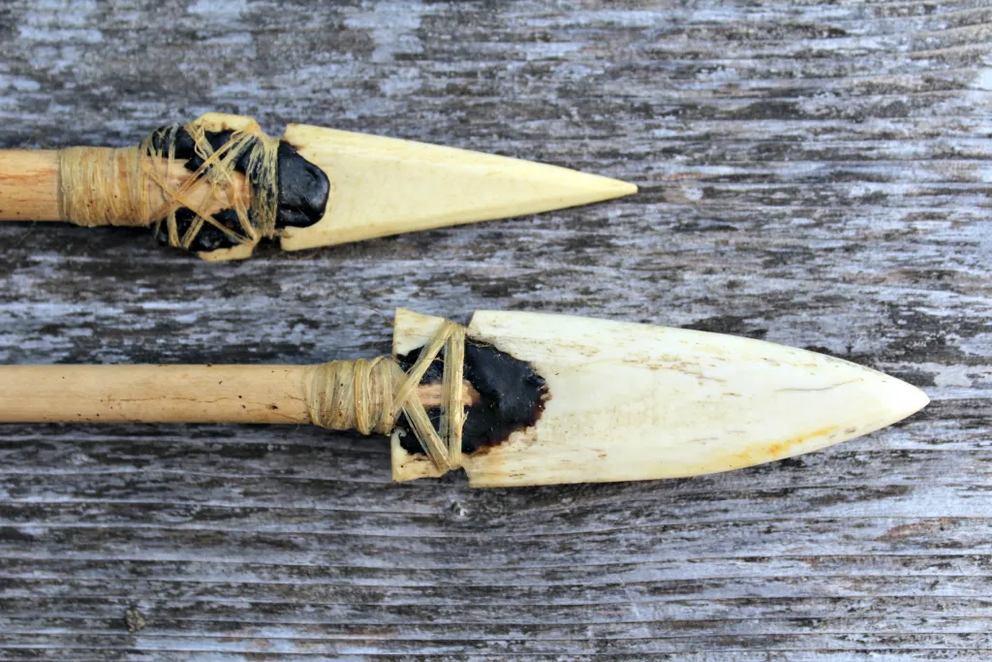
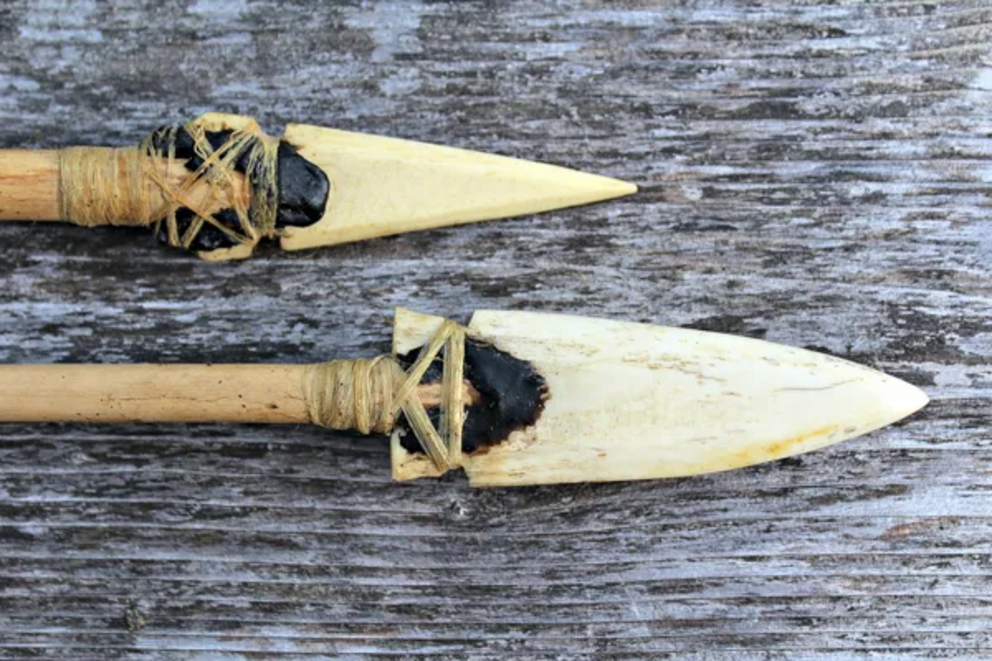 Two homemade Bone primitive arrowheads attached with pine pitch and sinew.
How to Make Arrowheads
Arrowheads can be made out of just about anything workable and durable, including glass, scrap metal, coins, rock or bone. Flintknapping rock requires both the correct type of rock and a great deal of skill and time.
Glass can also be flint knapped if treated like obsidian, and while it’s widely available, it still requires a great deal of skill to learn to shape successfully. Metal or coin-based designs often require power tools, high heat or specialized hand tools.
One of the simplest and most durable designs is made from bone, worked against a rock for shaping, no special tools required.
Start with a relatively large broad bone, such as a pelvic bone or shoulder blade. These should be accessible from a local butcher for a cow or pig, or by finding a large road-killed animal like a deer.
Clean the bone as best you can, and then leave it outside for a few days to a few weeks to allow insects to do the rest. It’s best to cage the bone in some way to prevent it from being carried off by large animals but in such a way as to still allow small beetles and ants to work off all the flesh and debris. Try setting it in a “have a heart trap” with the door closed.
Once nature has completely cleaned the bone for you, it needs to be broken into reasonably sized pieces. This can be done by bashing it between a few large rocks, or with a hacksaw or band saw if you have one available.
Mentally plan out your arrowhead, ensuring a good taper to a point, as well as space for notches near the base to attach your arrowhead to a shaft.
Begin working your piece of bone against a large stone, using a bit of water as a lubricant. You’ll be surprised at how easily and quickly you’re able to shape the bone into just about any size of an arrowhead. Both of the arrowheads above were made in about an hour each.
 Primitive Arrows
How to Make an Arrow Shaft
Arrow shafts are simple to make, especially if you have access to the right type and size of wood. Thin, straight saplings make excellent arrows.
Recently cut trees will often coppice, meaning that they’ll send up small quick shoots trying to regrow. The stump of an ash tree cut in late winter or early spring may send up a dozen arrow shaft sized coppices, each reaching several feet long by summer’s end.
Other good materials include saplings, Red Osier Dogwood, Blueberry Shoots, Elderberry shoots and many other readily available natural plant materials.
Regardless of the natural material you find, it’ll need to be:
- Clear of knots and twists
- Straight grained
- Long and Straight
- Free of insect damage
Start with the straightest piece you can find, and gently peel off the bark with a knife. Rub it down with some form of oil or fat, and then hold it over a fire. Your goal is to warm it to make it more pliable so you can work it straight.
The oil helps the wood heat without drying out and keeps it pliable. Gently heat your arrow shaft, and work it against a convenient surface (table, rock or your leg) until it’s completely straight. This is by far the most time-intensive part of arrow making.
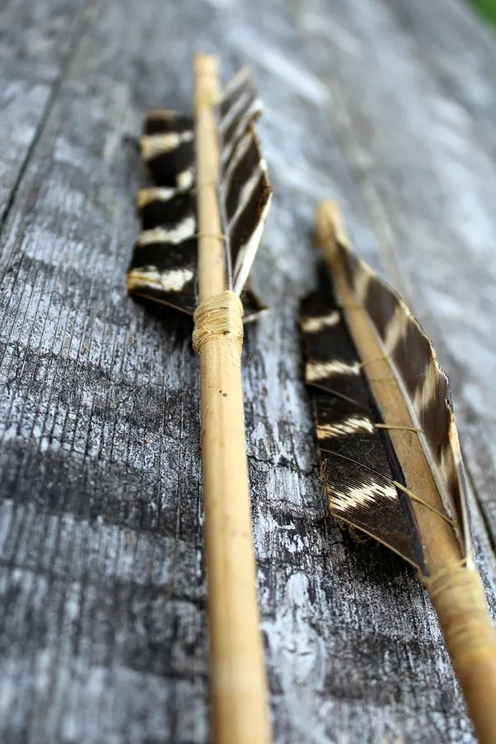
You’ll notice that the shafts in the picture above are not completely straight. These arrows were made a few years ago, and arrow shafts gradually warp over time. Historically, a hunter would have honed his arrow shafts over the fire each night after the hunt, correcting minor imperfections and helping to ensure a successful hunt the next day.
How to Fletch an Arrow
Fletching your arrow is relatively simple. Split feathers will be wrapped onto the shaft with a thin piece of animal sinew. The sinew itself is naturally sticky if you moisten it with your saliva.
The trick is, to have a piece of sinew, you need to have already had a successful hunt. It’s a bit of a chicken and egg problem when you’re building your first arrow.
If you’re looking for practice creating arrows, you can start with a bit of artificial sinew which will get you a lot of arrow practice for just a few bucks long before you’ve had your first successful hunt.
Start with a large primary flight feather, and use a very sharp knife to split it down the middle vein (We use this one). Line up three similarly sized feathers at equal distances around your arrow, and wrap in a spiral pattern with a piece of sinew.
Before you begin wrapping, moisten the sinew by chewing on it for a bit. The enzymes in your saliva help to break down the sinew slightly, making it sticky on the outside.
Wrap the sinew around 10-20 times at the base of each feather (arrowhead side) and then work slowly to the back end of the arrow, gently sliding it through the feather fibers in a spiral pattern. Finish with another 10-20 wraps around the arrow shaft. The tackiness of the sinew moistened with your saliva should glue it in place.
Final Arrow Assembly
To complete your arrow, carve a knock into the tail end so that it can rest on your bowstring. You’ll also need to carve a U-shaped notch into the head of the shaft to allow the arrowhead to attach. The size of your notch will vary depending on the size of your arrowhead, but it should be roughly 1 centimeter deep and about as thick as your arrowhead.
The arrowhead will be attached with sinew and pine pitch resin, which is a glue made by melting pine sap and mixing it with a small amount of charcoal. Apply a dab of hot pine pitch glue inside your notch and insert your arrowhead. Add a bit more pine pitch glue and make sure it’s firmly attached.
Wrap sinew around the notches and around the head of your arrow shaft. Be sure you’ve chewed the sinew to moisten it and make it sticky so that when you finish with a final twist around the shaft, it glues down to itself to finish your arrow.