
World's first synthetic cell with a complete life cycle could revolutionize biological engineering
edited by Lisa Lock, reviewed by Robert Egan
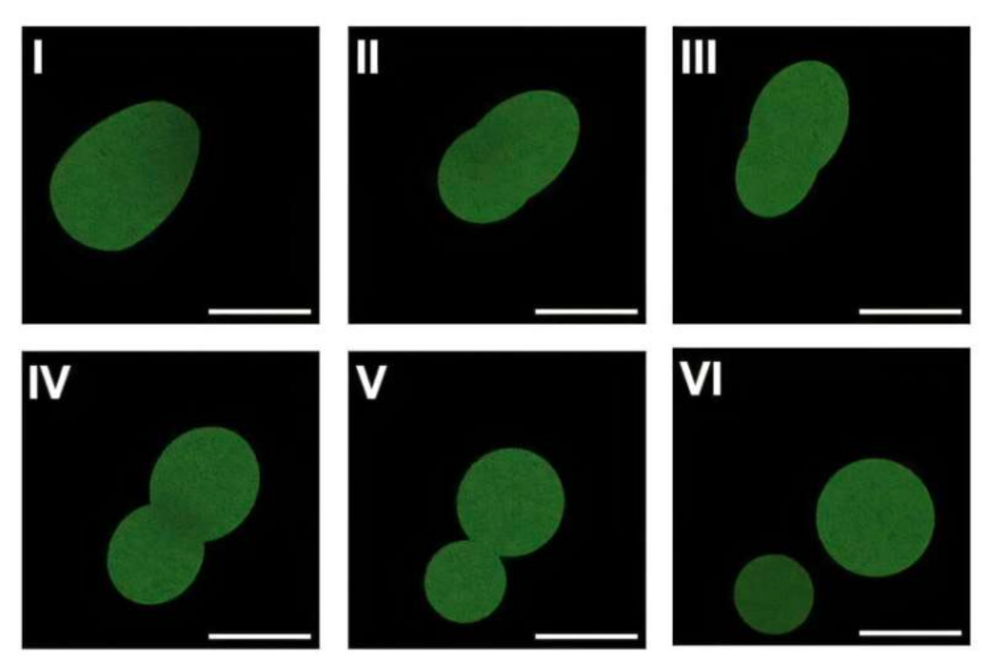
Fluorescent microscopy of SpudCell—a synthetic cell assembled entirely from non-living chemical components—undergoing division. Credit: Kate Adamala, Adamala Lab
While many of life's mysteries remain unsolved, every biologist can describe the basic processes performed by a living organism, including energy use, reproduction, growth and development. While these characteristics can be replicated in isolation in a lab, the idea of a completely synthetic biological organism has long been relegated to science fiction.
University of Minnesota associate professors Kate Adamala and Aaron Engelhart and their teams have developed the world's first synthetic cell with a complete life cycle, built entirely from nonliving chemical components, and described it in a new paper. The project, called SpudCell, marks a major breakthrough in biological engineering. In time, it may provide solutions to some of our most challenging problems in medicine and engineering.
"This is likely the most exciting project I've ever worked on," said Adamala. "We've replicated in chemistry what only used to be possible in biology: the complete set of behaviors of a cell. It proves that the most fundamental functions of life, like growth and replication, do not need a mysterious magical spark."
Among the characteristics of SpudCell:
- Replicates a biological cell's life cycle: SpudCell is capable of selection, genome replication, growth, resource acquisition via feeding and genetically encoded division.
- Cell division without a cytoskeleton: Natural cells divide using internal scaffolding called a cytoskeleton, which has been a bottleneck in synthetic cell research. SpudCell sidesteps the need for a cytoskeleton with proteins that crowd together on the membrane surface until the mechanical stress makes the membrane split.
- Selection and competition: Researchers introduced a genetic change that increased production of the fusion protein, resulting in cells that grew faster and produced more offspring. After five generations, the faster-growing variant had outcompeted the original. Under nutrient scarcity, the advantage increased, demonstrating selection and competition operating in a fully synthetic chemical system.
A minimal genome by design
DNA is the program for all living organisms. A human genome is roughly 3 million kilobase pairs (kbp) in size. Biologists had speculated that the genome for a living cell could be as small as 113 kbp, but SpudCell's genome is even smaller, at 90 kbp. Rather than a single chromosome, the genome is split across seven separate DNA plasmids. This modular structure allows the team to "program" various functions of the cell independently. With continued development, SpudCell and its successors will be capable of increasingly complex functions and behaviors.
With the release of the paper, Adamala and partners outside the university are launching Biotic, a public-benefit research and engineering institution that aims to build the shared technical infrastructure for synthetic cell engineering and to keep it open for the participation of researchers around the world.
"This work is just the beginning," Adamala added. "We are showing it's possible to engineer the basic functions of the cell. To fully realize the promise of this technology—to make it robust and practical—we need combined international effort. The role of Biotic is to focus engineering efforts and make them compatible with a shared chassis. SpudCell is that chassis, and with Biotic setting the protocols for collaboration, we are eager to start applying this technology to serious challenges."
Discover the latest in science, tech, and space with over 100,000 subscribers who rely on Phys.org for daily insights. Sign up for our free newsletter and get updates on breakthroughs, innovations, and research that matter—daily or weekly.
The push for shared standards
Much work remains to turn the construction of individual SpudCells into a true engineering pipeline. The cell's seven DNA plasmids need to be consolidated into a single, more stable genome, and further molecular machinery needs to be built. Adamala and her colleagues believe there is also an infrastructure challenge, since different labs do not have shared standards for a working cell.
"This was exceptionally difficult work to scale," said Adamala. "The knowledge in this space is very hard to explain, so we had collaborators on the project fly in for in-person demonstrations just to get particular techniques working. That's not scalable. Any engineering discipline needs modularity. In our case, we believe those modules must be built in the open: an infrastructure foundation built privately just gives someone a toll booth."
From harsh chemistry to living factories
Most of the manufactured products we depend on—medicines, materials, industrial chemicals—require molecular transformations we currently make happen by co-opting natural cells or using harsh industrial chemistry with huge energy costs. Cells built from scratch could perform molecular transformations industrial chemistry cannot.
That could first transform molecular medicine, building precise therapeutic molecules, including drugs incorporating amino acids evolution never used. We could see materials that are grown, rather than synthesized, and manufacturing approaches that operate at biological temperatures, not industrial ones. Underneath it is a truly engineerable platform, which SpudCell provides for the first time.
More information
Paper: A Chemically Defined Synthetic Cell Capable of Growth and Replication
Key concepts
cell biologyBiomolecular & subcellular processesCellsGenomesXenobiology
Provided by University of Minnesota
Who's behind this story?
BA art history, MA material culture. Former museum editor, paramedic, and transplant coordinator. Editing for Science X since 2021. Full profile →
Bachelor's in mathematical biology, Master's in creative writing. Well-traveled with unique perspectives on science and language. Full profile →