
Uncommon thinkers: How Portal’s Jeff Thornburg plans to harness the heat of the sun in the cold of space
BOTHELL, Wash. — Before he became the CEO of Portal Space Systems, Jeff Thornburg worked for two of the world’s most innovative space-minded billionaires. Now he’s working on an idea those billionaires never thought to pursue: building a spacecraft powered by the heat of focused sunlight.
Thornburg and his teammates are aiming to make Bothell-based Portal the first commercial venture to capitalize on solar thermal propulsion, a technology studied decades ago by NASA and the U.S. Air Force. The concept involves sending a propellant through a heat exchanger, where the heat gathered up from sunlight causes it to expand and produce thrust, like steam whistling out of a teakettle.
The technology is more fuel-efficient than traditional chemical propulsion — and faster-acting than solar electric propulsion, which uses solar arrays to turn sunlight into electricity to power an ion drive. Solar thermal propulsion nicely fills a niche between those two methods to move a spacecraft between orbits. But neither NASA nor the Air Force followed up on the concept.
“They didn’t abandon it for technical reasons,” Thornburg said. At the time, it just didn’t make economic or strategic sense to take the concept any further.
What’s changed?
“Lower launch costs, coupled with additive manufacturing, are the major unlocks to bring the tech to life, and make it affordable and in line with commercial development,” Thornburg said.
Thornburg argues that it’s the right time for Portal’s spacecraft to fill a gap in America’s national security posture on the high frontier. “There was no imperative for rapid movement on orbit in the 1990s,” he said. “Only recently have the threats from our adversaries highlighted the weaknesses in current electric propulsion systems, in that they have so little thrust and can’t enable rapid mobility.”
Portal’s vision has attracted interest — and financial support — from investors and potential customers. Since its founding in 2021, the startup has raised more than $20 million in venture capital. In 2024, Portal won a commitment for $45 million in public-private funding from SpaceWERX, the innovation arm of the U.S. Space Force. And next year, Portal is due to demonstrate its hardware for the first time in orbit.
So, how did Thornburg hit upon the idea of turning a decades-old idea into reality?
The path to propulsion
Thornburg, who’s now 52 years old, has focused on making things fly for most of his career. It all started when he was a college student in Missouri in the early 1990s, earning his aerospace engineering degree with an ROTC scholarship from the Air Force. He recalled a conversation he had with an instructor who was an old F-4 fighter pilot.
“With my nearsightedness, I was out of the game from a pilot standpoint,” Thornburg said. “But he said, ‘Thornburg, if you can’t fly the planes, go be as close to them as you can.'”
Thornburg signed up for a program that fast-tracked him into an aircraft maintenance role. He traveled around the world with KC-135 cargo planes, supporting missions that included the NATO-led air campaign against Yugoslavia in 1999. During his time as a flight commander and aircraft maintenance officer at MacDill Air Force Base in Florida, “I had a couple of hundred enlisted people who worked hard to keep me out of trouble,” he said.
The Air Force is where he earned his master’s degree in aerospace engineering. “My adviser had a friend that worked at the Air Force Research Lab,” Thornburg recalled. “He called him and said, ‘The Air Force is about to send this guy to do something with airplanes, but I’m pretty sure he’s going to be disappointed if he can’t come out and work on rocket engines.'”
Sure enough, Thornburg was soon working on rocket propulsion development, including a project to create what’s known as a full-flow staged combustion cycle engine. “We made what people thought was not possible possible with that program,” Thornburg said.
In 2004, Thornburg left the Air Force to work on rocket propulsion systems at Exquadrum, Aerojet and NASA. Then, in 2011, he took a phone call from SpaceX’s billionaire founder, Elon Musk. “We talked for about an hour, hour and a half on the phone — and he said, ‘I’ve got a project I want to talk to you about,'” Thornburg said.
That project led to the development of SpaceX’s methane-fueled Raptor rocket engine, which leveraged the technology that Thornburg helped pioneer at the Air Force. “That was a wild ride, because that felt like about 15 or 20 years of experience in a five-year time period,” he recalled.
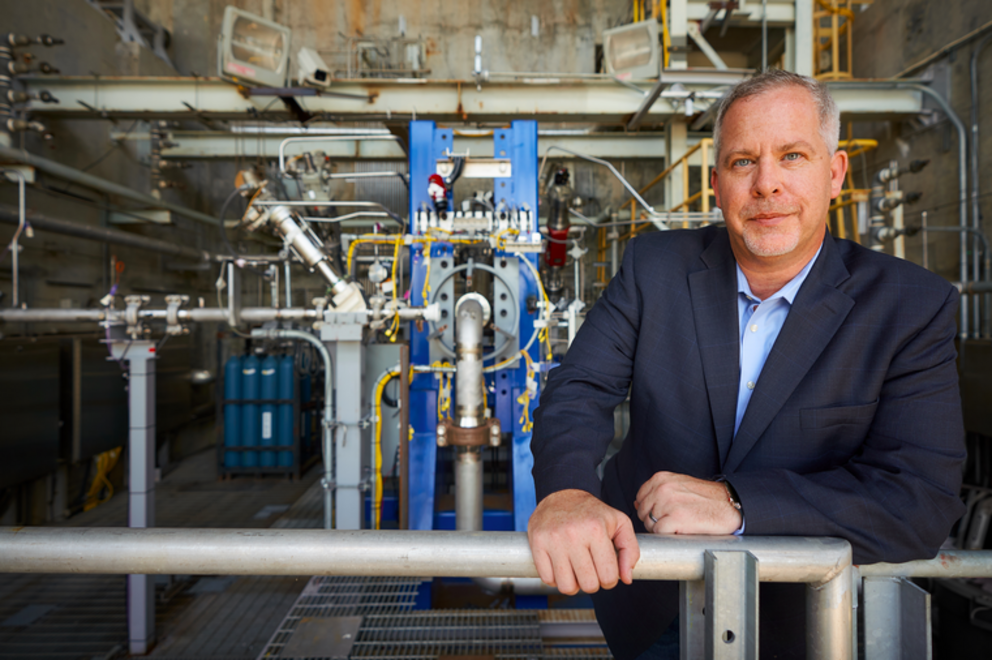
Jeff Thornburg strikes a pose in front of a test stand at NASA’s Stennis Space Center during his time as vice president of propulsion engineering at Stratolaunch. (Stratolaunch Systems Photo / 2018)
After five years at SpaceX, Thornburg needed to wind down. He decided to do some consulting at his home base in Huntsville, Alabama, also known as Rocket City. “About six months in, I’m like, I need a real job again,” he said. “And some friends of mine introduced me to, ultimately, Paul Allen. Paul called me and said, ‘Can you come out to my Seattle office?'”
The Microsoft co-founder and software billionaire enlisted Thornburg to become the head of rocket propulsion development for Stratolaunch, Allen’s space venture. Thornburg led the effort to create a liquid rocket engine known as the PGA — which stood for “Paul G. Allen.”
Unfortunately, Allen passed away in 2018, just one month after the engine was unveiled. Under new ownership, Stratolaunch pivoted to hypersonic testing, and the PGA project fell by the wayside. Once again, Thornburg and his family hunkered down in Huntsville.
For the rest of this article please use source link below