
Northern lights may be visible from several US states Friday and Saturday as giant hole opens up in sun's atmosphere
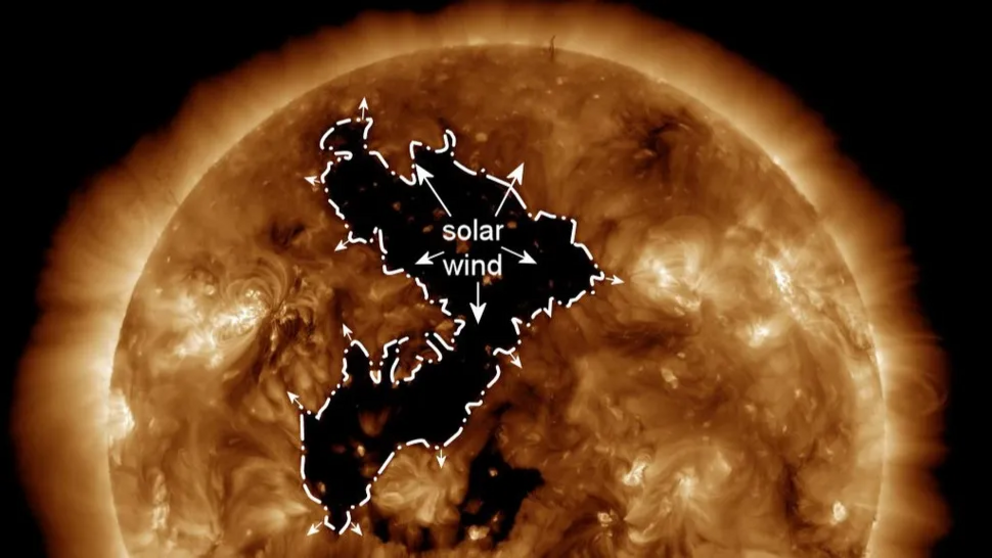
The Coronal Hole in the sun that opened up this week.
A large hole opened up in the sun's atmosphere this week, spewing high-speed solar winds that will paint northern lights displays across several U.S. states this weekend.
Skywatchers are in for a treat this week as the northern lights are predicted to grace skies across several northern U.S. states — and it's all thanks to a large hole that has opened up in the sun's atmosphere.
Auroras may be visible as far south as Idaho and New York Friday night (April 17) and early Saturday morning (April 18), the National Oceanic and Atmospheric Administration's (NOAA) Space Weather Prediction Center shared in a Facebook post.
Also known as the aurora borealis, the northern lights are an atmospheric phenomenon caused by the knotting of magnetic-field lines on the surface of the sun. When these lines snap, they send huge clouds of electrically-charged particles, called solar wind, into space. Some of these particles eventually reach Earth, the Royal Observatory Greenwich explains.
Most of the particles are deflected by the geomagnetic shield that surrounds our planet. However, some get swept into Earth's magnetic field before traveling down toward the North and South poles.
Once there, the particles collide with atoms and molecules in the atmosphere, causing them to heat up and fluoresce to create the colorful light displays we know as the northern lights.
This week, a large hole appeared in the sun's corona, the outermost part of its atmosphere. "Coronal holes" such as this are regions where the sun's magnetic fields open up, enabling fast-moving solar wind to escape into space, according to Spaceweather.com.
The resulting high-speed winds also may interact with slower solar winds ahead of them, causing these clouds of charged particles to pile up. This creates a shock zone called a corotating interaction region (CIR) that can have a more dramatic impact on the particles in Earth's atmosphere.
This week's high-speed solar winds and the accompanying CIR are expected to reach Earth on April 17 and 18, after which they will likely cause a temporary disturbance in the planet's magnetic field, known as a geomagnetic storm, according to NOAA's three-day forecast released April 16. Moderate (G2) storm conditions are expected from 5 p.m. EDT (9 p.m. GMT) Friday until roughly 2 a.m. EDT (6 a.m. GMT) Saturday and could trigger minor to moderate radio blackouts and strong auroras.
Auroras resulting from this class of geomagnetic storm are often visible from Alaska, Idaho, Maine, Michigan, Minnesota, Montana, North and South Dakota, Washington and Wisconsin, according to NOAA. Skywatchers in Illinois, Indiana, Iowa, Nebraska, New Hampshire, New York, Ohio, Oregon, Vermont and Wyoming also have a chance of seeing one of nature's best light shows.
A new moon Friday will also allow for better viewing conditions amid darker skies.
If you're on the hunt for auroras, make sure to check NOAA's n aurora dashboard for live updates, as space weather forecasts are subject to change.