
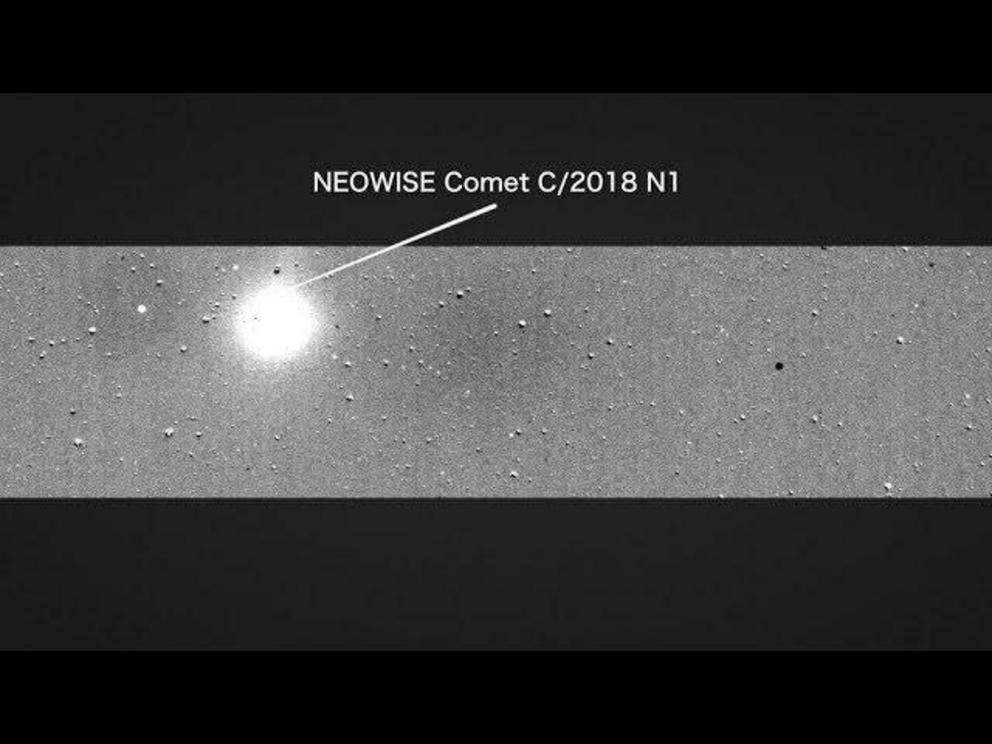
NASA's brand new planet-hunting telescope already captured this insane footage of a passing comet
NASA's new planet-hunting space telescope TESS has been inserted into its orbit around Earth, and has just started its job of scanning the skies to look for planets beyond the Solar System.
But before it even started work, NASA turned it on to do a few test observations - and it just so happened to catch a perfectly little comet in the act of streaking across the sky.
On July 25, TESS took 17 hours' worth of observations. This was to test its ability to collect a "prolonged set of stable periodic images covering a broad region of the sky," NASA wrote.
During these observations, TESS managed to snap a series of images of a comet named C/2018 N1 - first discovered less than a month earlier, on June 29.
The comet is located about 48 million kilometres (29 million miles) from Earth, and in the images taken by TESS, it's seen moving across the southern constellation Piscis Austrinus. Its comet tail can be seen extending towards the top of the image.
You may also notice the stars appearing to shift between black and white. This is a result of image processing, and it helps highlight variable stars, which change in brightness because of their rapid rotation, pulsation, or eclipsing binary companions.
The white dots are asteroids, and a "wave" of light moving across the image from left to right at the end of the sequence is caused by light reflecting off Mars, which is outside the frame. The entire sequence shows just a small fraction of TESS' field of view.
This ability to stare at wide regions of the sky for long periods of time is the key TESS will rely on as it looks for planets. This is because of the method it uses - the clue is in the telescope's name, the Transiting Exoplanet Survey Satellite.
It hunts for exoplanets using what is called the transit method. This is because when an orbiting planet moves between us and its star, it causes a slight dip in the star's light. By staring for long periods at the sky, TESS will be able to capture these changes.
It only works for systems in which the orbital plane is aligned the correct way - if the flat side of the plane is facing us, rather than its edge, there are other detection methods available - but the transit method is really effective. It led to the detection of thousands of exoplanets by TESS' predecessor, Kepler.
TESS is more sensitive than Kepler, so it's expected that it will bring home some serious exoplanet bacon.
Immediately after taking these observations, TESS' science operations started, so hopefully we'll start seeing some cool exoplanet news soon.
You can read more about TESS on its NASA website, and follow its news on Twitter.