
Making bendable ice by growing single-crystal microfibers
A team of researchers working at Zhejiang University in China has developed a way to grow water ice that is elastic and bendable. In their paper published in the journal Science, the group describes how they grew their single-crystal microfibers and suggest possible uses for them. Erland Schulson with Dartmouth College, has published a Perspective piece in the same journal issue outlining the work done by the team in China.
Water ice, the researchers note, is hard and brittle; it does not give much. Attempts to bend, lengthen or straighten samples lead to breaks. This, the researchers also note, is due to very small imperfections such as surface irregularities, pores and tiny cracks in the crystal structure. Without such imperfections, water ice has been estimated to have a theoretical elastic strain limit of 15 percent. In this new effort, the researchers have attempted to test these theories by growing tiny bits of ice that do not have imperfections.
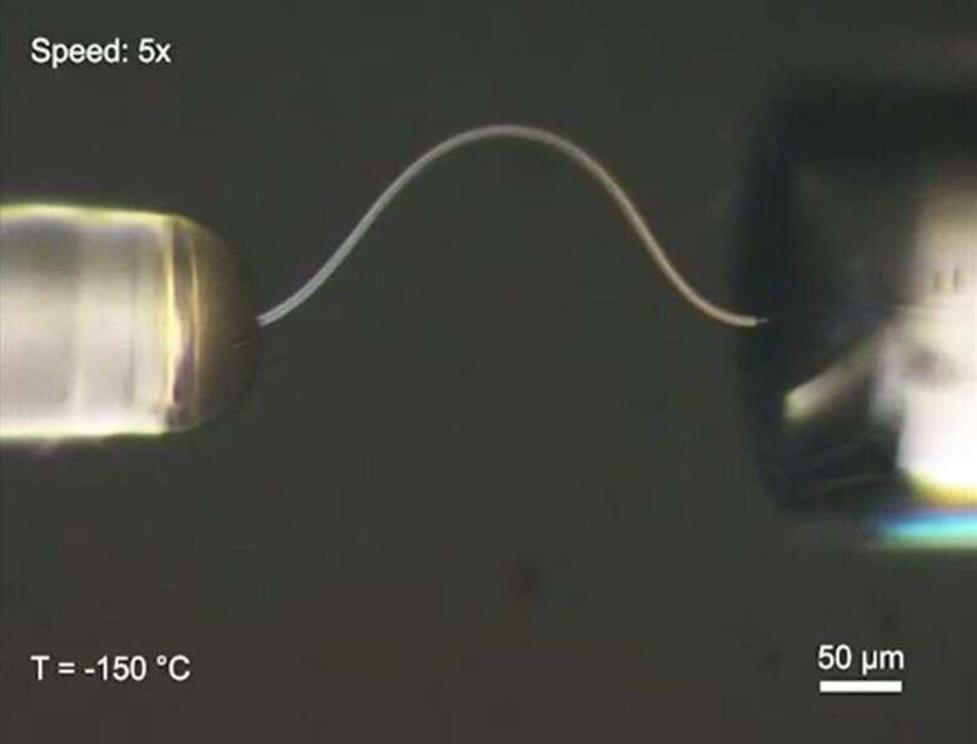
To create the ice, the researchers piped water vapor into a small electrified chamber set at -50 degrees Celsius. The electric field attracted water molecules to a tungsten pin that had been set into the center of the chamber. As the water molecules clung to the pin, crystals of ice began to form into fibers just a few micrometers in diameter. The researchers then chilled the ice to temperatures ranging from -70 to -150 degrees Celsius, measuring the elastic range at each temperature. It came to 10.9 percent on average, much more bendable than regular ice which averages just 0.3 percent. They also found that the fibers could be bent and stretched. At one point, they discovered that they were able to bend a crystal strand almost into a circle. They noted that after bending or stretching, all of the samples snapped back to their original shape.
Bending an ice microfiber into an Ω shape with micromanipulators.
In studying the ice fibers in close detail, the researchers found that they were actually made of two different kinds of ice, one slightly denser than the other. They also noted that due to the purity and flawlessness of the crystals, the ice samples were extremely transparent, which could mean that they might be capable of transporting light.
Bending an ice microfiber with gloved fingers. The fluctuating liquid beneath the microfiber is liquid nitrogen.
More information: Peizhen Xu et al, Elastic ice microfibers, Science (2021). DOI: 10.1126/science.abh3754
Erland M. Schulson, A flexible and springy form of ice, Science (2021). DOI: 10.1126/science.abj4441
Journal information: Science
Video can be accessed at source link below.