

Evidence of ancient life found buried under an asteroid crater
Somehow, on this beautiful blue marble we call Earth, the astonishing phenomenon we call life emerged long ago, spreading until it covered nearly every corner of the planet.
One school of thought proposes that the intense asteroid bombardment Earth endured around 4 billion years ago played a role in that process – that without all those space rocks crashing into our world, we might not be here today.
Now, a new discovery in South Korea suggests that the asteroid effect may have been even more complex than we realized.
Beneath a crater gouged by a massive impact around 42,000 years ago, a team led by geologist Jaesoo Lim of the Korea Institute of Geoscience and Mineral Resources (KIGAM) has identified several stromatolites.
Stromatolites are layered structures built by microbial mats, similar to some of the oldest known evidence of life on Earth.
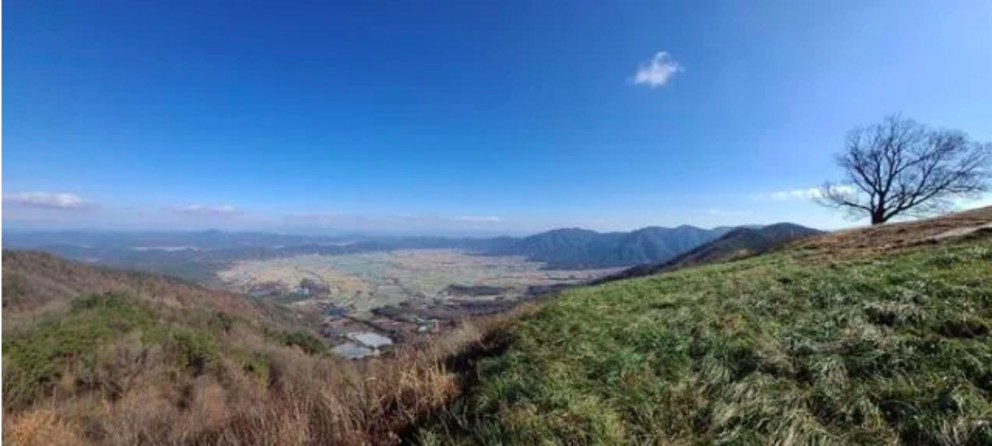 A view of the crater. (KIGAM)
This discovery suggests that the heat generated by the impact may have created a long-lasting hydrothermal environment similar to hot springs, where microbial communities could thrive.
It's possible that during the era of heavy bombardment, billions of years ago, impact craters like these may have created countless temporary refuges for early life across the young Earth.
The story of life's origins is a murky one; it remains unclear exactly when and how non-living components came together in a way that triggered the processes that define biology.
One major clue, however, can be found in stromatolites.
In several places around the world, these structures – the layered mineral scaffolding built by microbes such as cyanobacteria and other microorganisms, similar to the calcium-carbonate bones of corals – have been found dating back as far as 3.5 billion years ago.
That's some of the oldest evidence for life our planet has proffered.
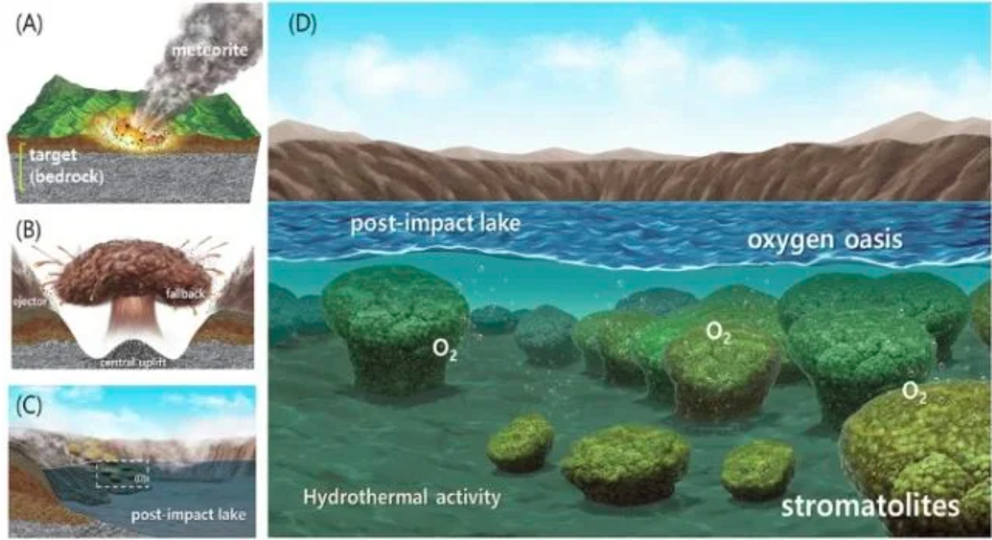
A diagram illustrating how the impact may have created the conditions for stromatolite growth. (Lim et al., Commun. Earth Environ., 2026)
But there's a lot we don't know about how these communities emerged and spread. Figuring that out is sort of like trying to mentally picture a 1,000-piece puzzle with only seven pieces.
The Jeokjung-Chogye Basin in Hapcheon may have just added another handful of pieces by contextualizing discoveries linked to impact craters such as Chicxulub, where evidence of microbial mats had been interpreted as material swept into the crater rather than communities that formed there naturally.
Although the basin is a well-known bowl-shaped feature in the landscape of the Korean peninsula, its identity as an impact structure wasn't known until relatively recently, as revealed in a 2021 paper.
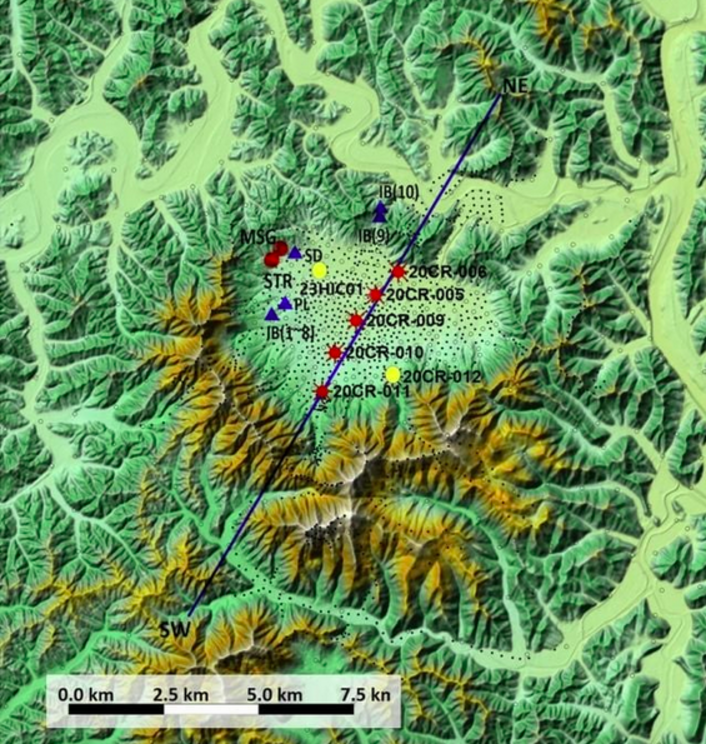
A map of the Jeokjung-Chogye Basin, with the studied sites marked. (Lim et al., Commun. Earth Environ., 2026)
Subsequent analyses showed the mineral signatures of meteoritic material merging with the terrestrial material in the basin, reverse-engineered its shape to understand how the impact took place, used radiocarbon techniques to figure out when it formed, and determined that it once held a vast body of water.
Now, digging under the northwestern part of the crater, Lim and his colleagues found multiple stromatolites, measuring between 10 and 20 centimeters (4 to 8 inches) in diameter.
It has already been established that an impact crater can shatter and heat Earth's crust where it falls, creating a system where the slowly dissipating residual heat warms water that fills the basin left behind – a hydrothermal impact lake.
These stromatolites, the researchers found, probably formed in just such an environment.
For the rest of this article please use source link below