Cosmologists try a new way to measure the shape of the universe
Is the universe flat and infinite, or something more complex? We can’t say for sure, but a new search strategy is mapping out the subtle signals that could reveal if the universe had a shape.
Is the universe infinite, Aristotle asked in 350 BCE, “or is this an impossibility? The decision … is … all-important to our search for the truth.” The Greek philosopher opined that “the heavens” (meaning the moon, planets, sun and other stars) travel around the Earth in circles, and that a “body which moves in a circle is not endless or infinite, but has its limit.” Moreover, he assumed that Earth sits at the center of the universe. In that case, the universe must be finite, Aristotle reasoned, for otherwise it could not have a center. With that, he’d apparently resolved an issue that had confounded both his predecessors and his contemporaries.
Circular as Aristotle’s logic was, his conclusion could still be correct. More than two millennia later, we still can’t be sure if the universe is finite or infinite. The universe could be boundless, continuing in all directions without end, or it could be sealed up in a compact shape such as a sphere or doughnut.
Of course, modern scientists have wondered about this issue as well. They’ve devised strategies to investigate the universe’s overall topology, using methods more rigorous than Aristotle’s. The first tests, conducted about two decades ago, linked a range of possible topologies to signals that might have been spotted in astronomical data. Efforts to find those signals have come up short, but hope may be on the horizon.
Recently, a group of about 15 scientists from seven countries known as the Compact collaboration has devised a new way of finding topological clues. They’re taking advantage of computational capabilities that weren’t available a decade ago, buoyed by the conviction — as they wrote in Physical Review Letters in April 2024 (opens a new tab) — that “prior searches for topology have far from exhausted the potentially significant possibilities. Much more can be done to discover, or constrain, the topology of space.”
“The size and shape of the universe is absolutely one of the most basic and important questions we could ask,” said Neil Cornish (opens a new tab), a Montana State University astrophysicist who is not part of Compact. Given that a substantial amount of relevant data is already available, he said, “it makes sense to expend the effort to do the most complete analysis possible.”
Circles in the Sky
The Compact collaboration builds on work from more than 25 years ago. In 1998, Cornish, Glenn Starkman (opens a new tab), a theoretical physicist at Case Western Reserve University who unofficially leads Compact, and David Spergel (opens a new tab), who at the time was at Princeton University1, published “Circles in the Sky (opens a new tab),” a road map for probing our cosmic topology.

Glen Starkman, a leader of the Compact collaboration, is mapping the signals that a universe with an interesting shape would produce. David Hintz/Case Western Reserve University
The technique that the three researchers introduced would work if a few assumptions fell into place. Most important, the universe’s topology would have to allow light, traveling for almost the entire age of the universe, to take two totally different routes to get to us, in much the same way that an airplane traveling from Spain to New Zealand can fly either east across Asia or west over the Americas.
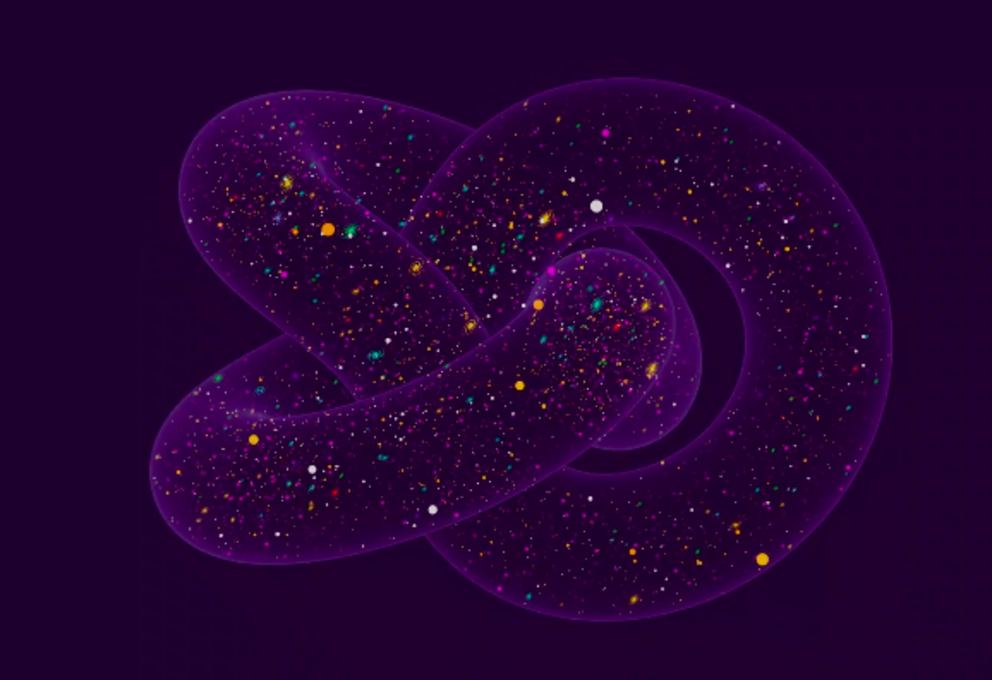
The surface of the Earth is like a sphere, but other shapes are possible for the universe as a whole. Consider, for instance, a doughnut-like torus. In this case, there are multiple ways for a light ray to travel around the surface of the torus and return to the same point. The light can loop around the outside of the doughnut, or loop through the central hole. Either way, it makes it back to where it started from.
It’s much harder to picture a torus with a three-dimensional surface (rather than our two-dimensional example), but it can be modeled by a cube — albeit one with some unusual properties. Imagine living inside a special kind of cube where each face is somehow connected to (or “identified with”) its opposite side. If you were to walk out the left-hand face of the cube, you’d emerge on the right. Similarly, you would pass from top to bottom and from front to back.
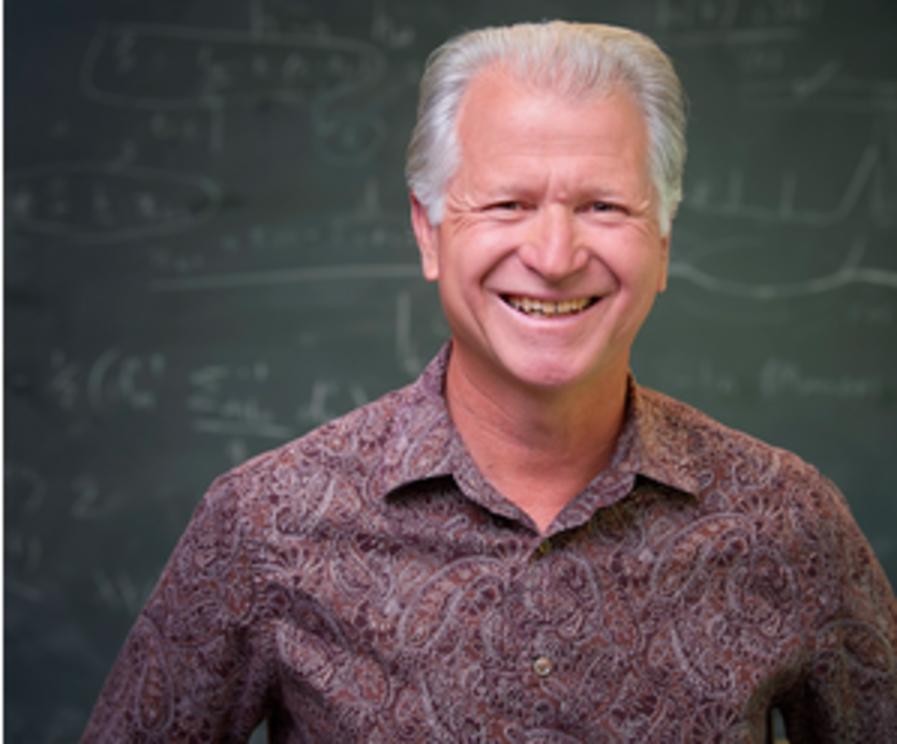
Neil Cornish views the effort to map the overall topology of the universe as a “low-probability, high-reward” proposition. Colter Peterson/Montana State University
In “Circles in the Sky,” Cornish, Spergel and Starkman explained how cosmological data might reveal that our universe has topology like that of a 3D torus (one of many shapes they considered). They proposed looking for this evidence in the cosmic microwave background (CMB), a steady stream of photons from the early universe that reaches us from all directions. The CMB tells us how the universe looked just 380,000 years after the Big Bang, when light was first able to travel through the cosmos unimpeded. By observing these photons today, we can map a spherical surface called the last scattering surface (LSS) — a snapshot of the universe at that early time. The brightness and temperature throughout the surface appear to be remarkably uniform, with variations of just one part in 100,000 from one spot to another.
That sphere, the LSS, is essentially the farthest thing we can see. Cornish, Spergel and Starkman imagined our universe as a 3D torus, depicted (figuratively) as a rectangular box. Now imagine: What if we put the LSS sphere in the middle of the box, but it didn’t quite fit? It would be like squeezing a basketball into a shoebox.
In that case, the sphere would pop out of the sides of the box. If we look at the places where the sphere intersects the box, we’ll find two circles on opposite sides. And since opposite sides of the box are identical — remember, the box is our 3D torus stand-in — those two circles will be identical as well.
With this in mind, you can search for features on opposite ends of the CMB sky that appear to be identical circles.
For the rest of this article please use source link below