Cosmic paradox reveals the awful consequence of an observer-free universe
Encouraged by successes in understanding black holes, theoretical physicists are applying what they’ve learned to whole universes. What they’re finding has them questioning fundamental assumptions about how physics ought to be done
Tinkering at their desks with the mathematics of quantum space and time, physicists have discovered a puzzling conundrum. The arcane rules of quantum theory and gravity let them imagine many different kinds of universes in precise detail, enabling powerful thought experiments that in recent years have addressed long-standing mysteries swirling around black holes.
But when a group of researchers examined a universe intriguingly like our own in 2019, they found a paradox: The theoretical universe seemed to admit only a single possible state. It appeared so simple that its contents could be described without conveying even a single bit of data, not even a choice of a zero or a one. This result clashed with the fact that this type of universe should be capable of hosting black holes, stars, planets — and people. Yet all those rich details were nowhere to be seen.
“We look around, and certainly the world seems more complex than that,” said Rob Myers (opens a new tab), a theoretical physicist at the Perimeter Institute for Theoretical Physics in Waterloo, Canada, who has not been directly involved in this research.
Physicists have good reason to trust the calculation, which builds on fundamental physical ideas. The math implies a universe with only one state; our universe is clearly not like that. Now a team of theorists has floated a possible answer. The paradoxical result occurred when physicists sought an objective description of the state of an entire universe. But a description like that might not be possible, even in principle. It implicitly assumes a universe that exists without an observer to observe it. And perhaps without observers, the complexity of the universe loses its meaning.
A Shocking Argument
For physicists passionate about both quantum mechanics and gravity, the two theories have proved extraordinarily difficult to combine. String theory is a putative solution to the problem, replacing particles with minuscule lengths of vibrating string to smooth over snags that doom other candidate theories. The theory’s math is challenging, however, and its implications have been tough to tease out.
But almost 30 years ago, a landmark paper (opens a new tab) by Juan Maldacena, a physicist at the Institute for Advanced Study, showed that difficult string theory calculations could sometimes be sidestepped and carried out using familiar concepts from particle physics instead. The catch is that this approach only works if the universe has an unusual “anti-de Sitter” geometry. An anti-de Sitter universe has a boundary, often illustrated to resemble a tin can. Remarkably, everything that happens inside the can, from colliding particles to spinning black holes, is revealed by shadows on the can’s outer boundary. It’s as if the 3D universe inside were equivalent to an image on a flat screen, a concept physicists call holography.
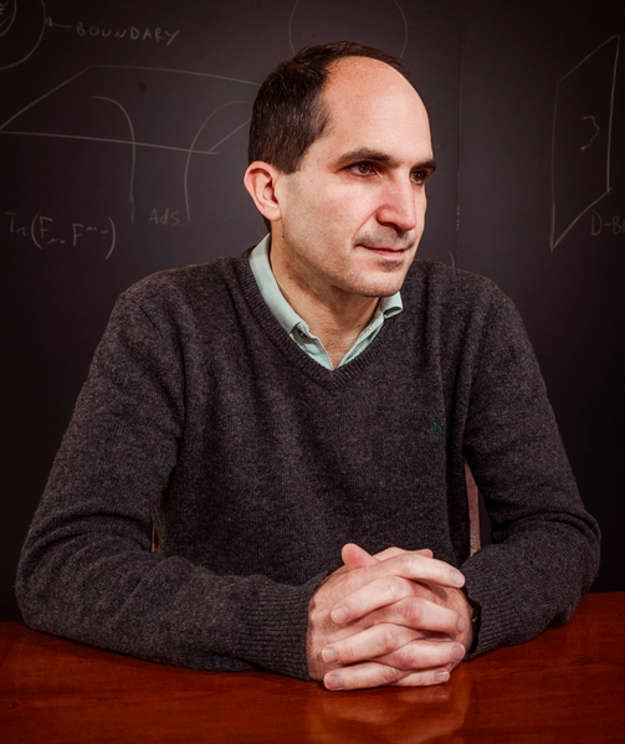
Juan Maldacena, a theoretical physicist at the Institute for Advanced Study, found an important relationship between a physical space and that space’s boundary. Sasha Maslov
Holography has delivered major breakthroughs. In 2019, Maldacena and three colleagues at IAS — Ahmed Almheiri (opens a new tab), Raghu Mahajan (opens a new tab) and Ying Zhao (opens a new tab) — used holographic thinking to better understand what happens inside a black hole. Building on earlier (opens a new tab) work (opens a new tab), they proposed the “island formula (opens a new tab),” which tracks the boundaries of different regions within a black hole. It soon helped them and others to uncover a potential explanation for a long-standing mystery: How can black holes reveal information about what has fallen into them — which quantum theory says must happen — when doing so would seem to defy the absolute nature of a black hole’s gravity? Their success gave physicists confidence that the island formula was a trustworthy way of understanding quantum gravity, and subsequent results showed that it could hold its own outside its original anti-de Sitter context.
But it was merely a warm-up.
“Black holes are a really good testing ground for ideas, but they’re not where the money is,” said Henry Maxfield (opens a new tab), a physicist at Stanford University. “The important question of quantum gravity is quantum cosmology” — the push to understand the very early universe.
The problem is that we don’t live in an anti-de Sitter tin-can cosmos. The nature of the universe’s expansion implies that it has no boundary. No matter how far you travel, you will never hit an edge.
One way for a universe to lack an edge is for it to have a “closed” geometry. In this case, a traveler moving in a straight line could eventually return to where they started, much as you would if you jumped in a jet and flew due east.
Since our universe could be closed in this way, Maldacena soon applied the island formula to a closed universe. He uncovered something his colleagues found hard to accept: The closed region seemed almost completely empty.
“I was pretty shocked by that argument,” Zhao said. “I tried to argue with him.” It would take a few years, but Zhao would eventually find a hole in Maldacena’s empty universe.
Blank Slate
The closed universes Maldacena investigated weren’t empty of mass or energy. They were empty of something even more important: information.
When physicists study quantum theories, they need to keep track of each possible state a physical system can be in. To do this, they use an abstract space called Hilbert space. Hilbert spaces, named for the early-20th-century mathematician David Hilbert, account for different quantum states by adding new mathematical dimensions. The more dimensions there are, the more information these Hilbert spaces can encode.
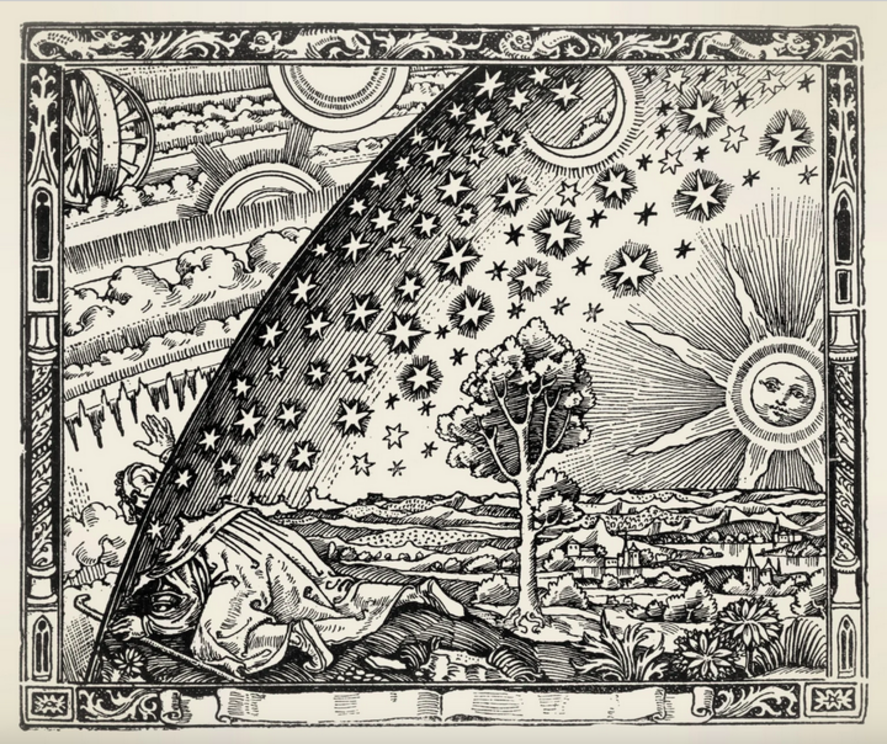
The Flammarion engraving, first published in 1888, depicts an observer pushing through the horizon “where sky and the Earth touch,” according to the original caption. There, the machinery of the universe is laid bare. Camille Flammarion
A simple system, like a computer bit that can be either zero or one, might have two dimensions.
Most quantum systems are much more complex. Take a single hydrogen atom. Its electron can reach higher and higher orbits as you give it more energy. In this case, the number of possible states is unlimited, and so its Hilbert space is infinite-dimensional. Most real quantum systems have this feature.

Edgar Shaghoulian, a physicist at the University of California, Santa Cruz, noticed a connection of the strange behavior to topological field theories. Alexa Fredston
Physicists therefore expect a whole universe to have an infinite number of states too. But when Maldacena applied the island formula to a closed universe, he found instead that it had a Hilbert space with just one dimension. There was no information to be found. The whole universe and everything in it could be in only one quantum state. It lacked even the complexity of a single bit.
This conclusion struck physicists as paradoxical, given that we too could conceivably live in a closed universe. And we clearly see far more than a single state around us.
“On my desk there are an infinite number of states,” said Edgar Shaghoulian (opens a new tab), a physicist at the University of California, Santa Cruz.
But as physicists continued to study different types of closed universes, they kept seeing the same pattern. While the IAS group considered black holes, Maxfield and his collaborator Donald Marolf looked at (opens a new tab) hypothetical quantum bubbles of space-time called baby universes. They found the same stark simplicity. Increasingly, it appeared that the barrenness of closed universes was a universal trend.
“Eventually we believed it,” Zhao said.
For the rest of this article please use source link below