
Big tech communism has arrived: amazon sidewalk joins the helium network to connect all internet of things (IoT) devices
Communism: A theoretical economic system characterized by the collective ownership of property and by the organization of labor for the common advantage of all members. (Source.)
Big Tech Communism has arrived in the United States, as the U.S. has now surpassed China and other communist countries to become the world leader in spying on its citizens.
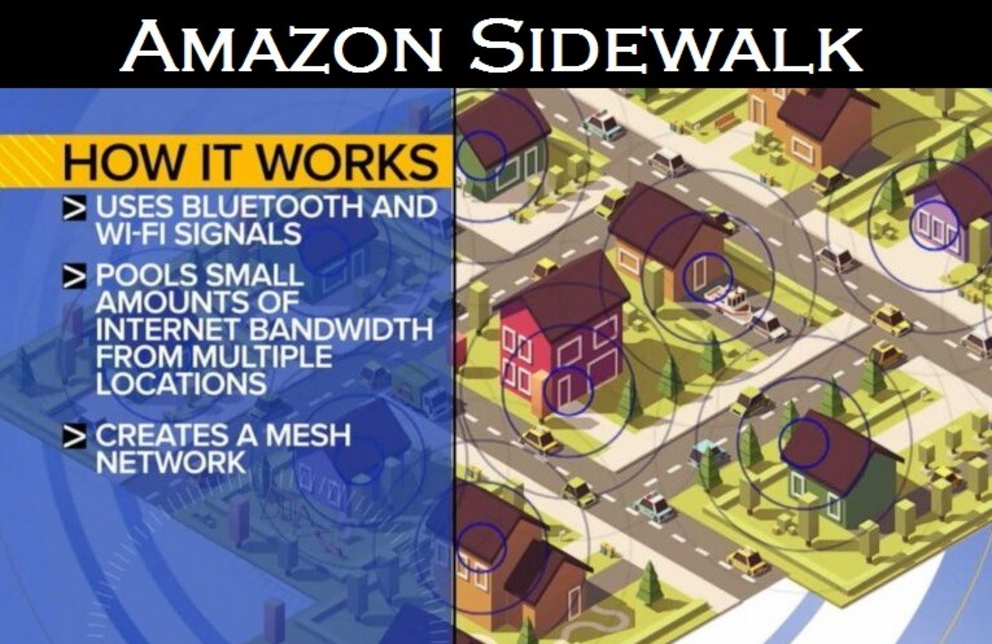
It was announced this past week that Amazon Sidewalk has now joined the Helium Network allowing all Internet of Things (IoT) devices, which are currently in the homes of almost all Americans, to be connected into one large mesh network nationwide.
The World Economic Forum’s (WEF) goals for the 4th Industrial Revolution and Great Reset where nobody will own anything and be confined into 15-minute “smart cities,” is clearly a modern day Big Tech version of communism, where the rights of the individual are sacrificed for the rights of the community.
This new system of surveillance, which is creating the ultimate police state, is well underway in the United States, which has, by far, the largest proportion of its population connected to the Internet, including cell phones, vehicles, cameras, and household appliances, than any other country in the world.
Amazon Sidewalk
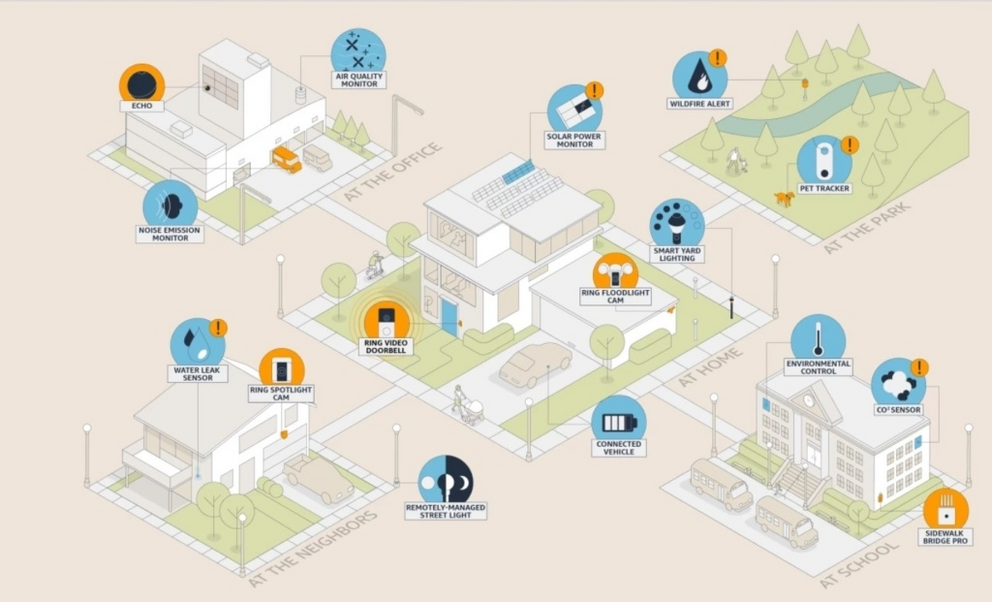
Here is the description of the new Amazon Sidewalk mesh network that was just introduced this year, from the source, Amazon.com.
Everything you need to know about Amazon Sidewalk, the secure, low-cost network that can connect devices up to half a mile away
Imagine a network that securely connects your devices to the internet for free—from nearly anywhere. It exists. It’s called Amazon Sidewalk. And it has a range farther than Wi-Fi and is less expensive than the cost of a typical cellular network. This network opens the door to the creation of new types of devices for homes, businesses, and cities, which will help people intelligently track shipments, find lost pets, remotely detect smoke from wildfires, and so much more.
Amazon Sidewalk is a secure, free-to-connect community network designed to provide reliable connectivity for billions of devices. It’s already accessible to more than 90% of the U.S. population. (Source.)
Independent investigator Neil ‘Liberty’ Radimaker, writing for The Conscious Resistance Network, published an article this past week discussing the dangers this new network by Amazon presents.
Unveiling the Privacy Perils of Amazon Sidewalk
In a time where technology continues to shape our lives, the emergence of Amazon Sidewalk has ignited a fervent debate about the balance between convenience and privacy. As an independent investigator, I feel compelled to understand the deep complexities and potential dangers of this pervasive network.
This investigative report aims to shed light on the surveillance capabilities, coverage area, and the undisclosed collaborations surrounding Amazon Sidewalk.
In this report, we dive into the alarming dangers posed by these surveillance capabilities and the implications for personal privacy and autonomy.
Audio and Video Intrusion:
One of the most concerning aspects of Amazon Sidewalk is its ability to intrude into our private spaces without our explicit consent or knowledge. By silently capturing seamless audio and video data through devices like Ring cameras, Amazon Echo and other compatible smart home technologies. Sidewalk has the potential to turn every room of our homes into a watchful eye, constantly recording and analyzing our activities. This level of surveillance undermines the sanctity of our personal lives and raises questions about the boundaries of consent and individual autonomy.
Integration with Facial Recognition:
One of the most controversial aspects of Amazon Sidewalk’s privacy invasion potential is its integration with facial recognition technology. By combining video surveillance with facial recognition algorithms, Sidewalk will have the capacity to identify individuals and track their movements with alarming accuracy. Individuals can be identified and monitored, alerting officials when a person designated as “suspicious” is caught on camera.
Behavior Profiling:
By collecting a vast amount of data about our daily routines, habits, and preferences, Amazon Sidewalk has the potential to construct detailed profiles of individuals. Through sophisticated algorithms and data analysis, Sidewalk can track our movements, monitor our online activities, and even make inferences about our behaviors and interests. This level of profiling creates a comprehensive digital portrait, encroaching upon our autonomy and raising concerns about potential manipulation or discrimination.
Room Mapping and Blueprinting:
Amazon’s acquisition of iRobot, the maker of Roomba raises concerns about data sharing and collaboration with Amazon Sidewalk. The Roomba’s advanced features, including its mapping and blueprinting capabilities, introduce interesting privacy implications. With data collection and the ability to gather detailed information about our home layouts and furnishings. The Roomba can also silently record audio and video, analyzing our activities, intruding into our most private spaces.
Overlap of Coverage Reach:
Amazon Sidewalk’s extensive network coverage raises concerns about the widespread surveillance it enables. With a vast number of interconnected devices, this creates an overlapping network of surveillance that spans entire neighborhoods and public spaces. This level of coverage infringes upon our very sense of privacy, as our movements and activities can be captured and monitored from various angles and locations privately and publicly. Amazon Sidewalk’s ambition is to establish a nationwide network, the company currently claims it now provides coverage to over 90% of the U.S. population, including those who live in moderately rural areas.
Unregulated Data Collection:
The vast amount of data collected by Amazon Sidewalk raises significant concerns about its storage, usage, and potential for misuse. With access to intimate details of our lives, including our daily routines, social interactions, and even sensitive information, the potential for abuse or unauthorized access to this data is alarming. The lack of clear regulations and safeguards heightens the risks associated with such uncontrolled data collection.
This report by Radimaker does not even discuss the health hazards from frequency radiation by all these devices.
In my own residence, I do not have any Wifi turned on at all. I also own a simple EMF detector to see what levels of EMF radiation are coming into my residence from outside, as well as check if any appliances or devices in my residence are emitting frequencies.
I recently had someone visiting who wanted to use this device to see how much EMF pollution was coming from his cell phone. He tried turning on certain features of his cell phone, and the one thing that pushed my meter’s alarms to the highest level, was when he turned on his cell phone’s Bluetooth feature, which emits a 900 MHz WiFi-type signal.
Linda Kurtz at NoDirtyElectricity.com writes about how dangerous this is:
Amazon Sidewalk Irradiates You for Half a Mile
Amazon Sidewalk is the tech giant’s vision of smart neighborhoods connected by an array of Amazon gadgets. It’s a “mesh network,” similar to a smart meter mesh network. A mesh network means constant, nonstop wireless chattering.
Bluetooth makes it much worse. Amazon Sidewalk uses Bluetooth in addition to a 900 MHz WiFi-type signal.
What’s so bad about Bluetooth?
It has an erratically pulsing signal, full of constant highs and lows much worse than what you get even from smart meters and WiFi. The Bluetooth alone will extend several hundred feet.
How many neighbors do you have within a 300-foot radius of your home? You’ll be getting blasted by erratically pulsing Bluetooth from every home that has a device. (Full article.)
The Helium Network
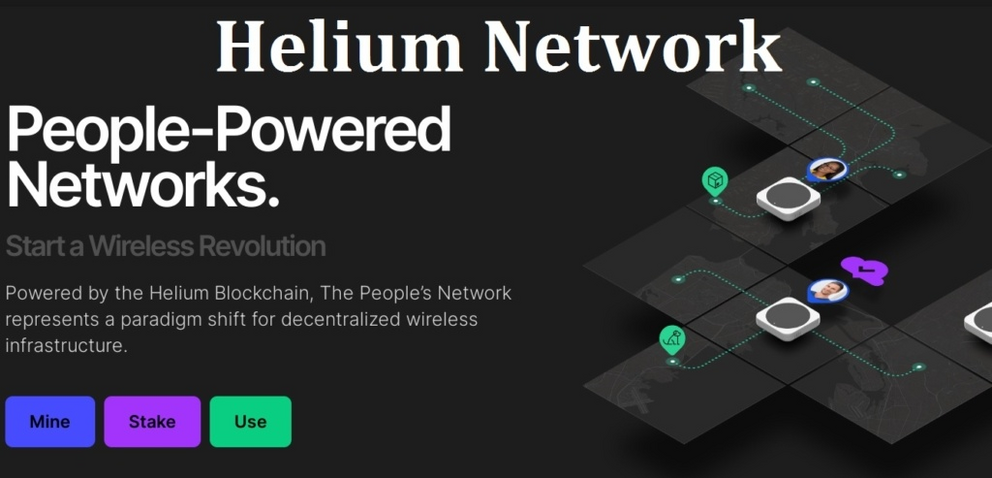
Here is the Wikipedia entry on The Helium Network:
The Helium Network is a decentralized wireless Internet of Things (IoT) network using the LoRaWAN system, tied to the cryptocurrency Helium Network Token (symbol HNT).
Nodes on the network are generally owned and placed by individuals in their homes or offices, and they are rewarded for their participation in the network in payments of HNT.
The network aims to provide connectivity to IoT sensor devices in areas where wireless or mobile coverage is minimal, or requires too much power.
The Helium Network was begun by Helium, Inc. in 2013 as a network of LoRa gateway hotspots which could be deployed throughout an area by agreements with building owners, typically paid in conventional currency.
In 2017, the company’s funds were running low, so it switched to a new strategy: offering individuals payment in cryptocurrency to operate individually owned nodes in their homes or offices.
These individually owned nodes are purchased at costs of up to $500 each, and the payments to owners vary based on data usage but can be as low as $.10 a month. Hotspot operators would also have a vote in the operation of the network.
In 2022, Helium Inc. rebranded to Nova Labs Inc. and raised $200 million in a funding round led by Tiger Global Management and Andreessen Horowitz. (Source.)
Earlier this year (2023), it was reported that “mysterious antennas” were popping up in the foothills surrounding Utah’s Salt Lake City.
Salt Lake City officials are finding mysterious antennas across the foothills of the Salt Lake City metropolitan area. The first ones were discovered nearly a year ago, but more have been popping up in recent months. These devices appear to be relaying data across a wide area.
As first reported by KSLTV 5 in Utah, the mysterious devices consist of a battery box, a solar panel, and an antenna.
“These towers have been bolted into different peaks and summits and ridges around the foothills,” Tyler Fonarow, the city’s recreational trails manager, explained, “and it started with one or two, and now it might be as much as a dozen.”
Fonarow said whoever is installing these small fiberglass antennas doesn’t have a permit for authorization on public land. His department has been seizing the devices. They found one last week and plan to remove another later this month.
More antennas have been found on property managed by the Forest Service and the University of Utah.
Fonarow speculated the devices could be part of a decentralized wireless connectivity platform:
“It might be related to cryptocurrency and relaying networks and being able to make money off that,” he said, “so that’s another reason we want to stop it now before it becomes a dumping ground for dozens and dozens of more antennas.”
Some people who replied to the Facebook post speculated the devices could be part of the Helium network.
“Probably helium network like several have posted. Or some kind of mesh network repeaters? I don’t understand why they are being torn down and huge effort to take them off public lands, when if it is a mesh network repeater, can be used by the public, and is very important in emergency/communication failure situations,” one person said.
“Those are very clearly off-grid Helium miners,” another person said.
If the speculation is correct, these mysterious antennas could be hotspots connecting to a wireless blockchain-based network for Helium. This entirely new incentive model allows people to set up hotspots that act as Helium miners and serve data to devices. People can earn money by simply buying a hotspot and plugging it in. (Full article.)
The Helium website claims that they now have 991,170 total hot spots.
Last week it was announced that The Helium Foundation has partnered with Oxit to create Oxtech Module, a product to connect Internet of Things (IoT) devices to both the decentralized wireless network, Helium, and Amazon Sidewalk. (Source.)
Helium mobile is currently in beta, and once it is launched it will be available on everyone’s cell phone which will greatly increase its coverage.
Tips on Opting Out of the New Big Tech Communist Network

The best thing you can do to avoid being watched by Big Tech is to just stop using their products, especially a cell phone.
Since I know this is too difficult for most people, here are some good articles giving tips on how to reduce your exposure to Big Tech’s monitoring of you.
For the rest of this article please go to source link below.
For full references please use source link below.