
Astronomers find planetary and stellar companions to two ultracool dwarfs in Taurus
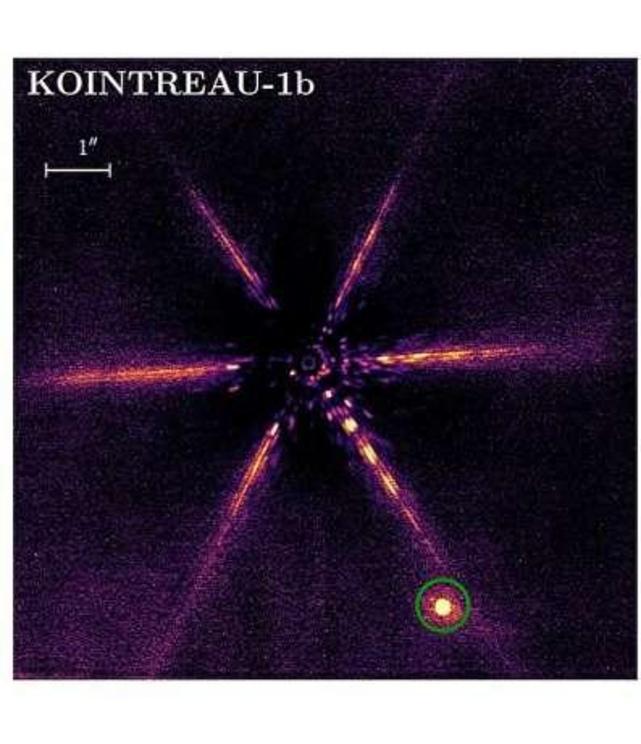
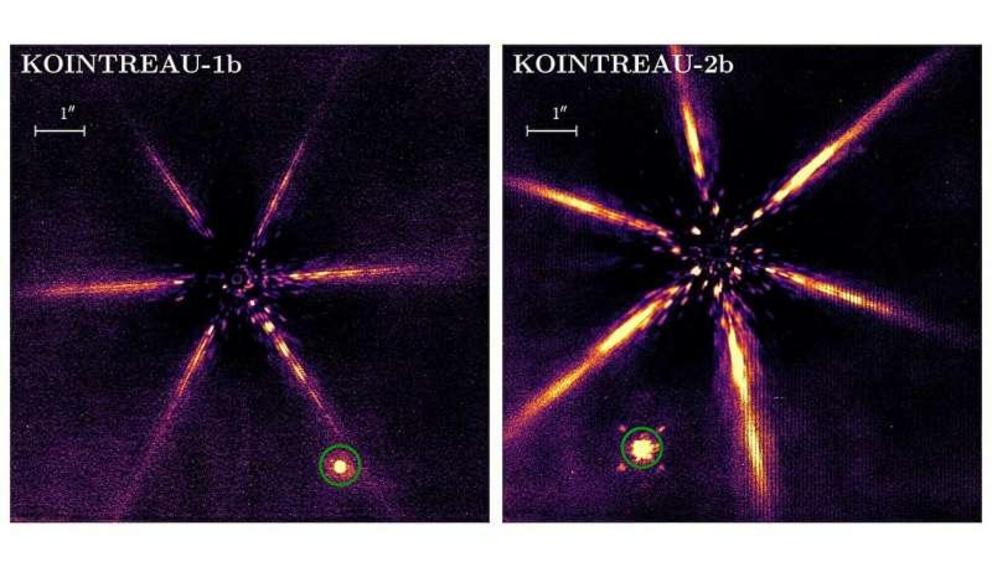 Example Keck/NIRC2 signal-to-noise maps from deep-exposure 10?? K-band image stacks of each companion. These maps are computed by subtracting the mean and normalizing by the standard deviation in successive annuli around the host star. The companions are
Astronomers from the University of Hawai'i (UH) at Manoa and elsewhere have observed the Taurus star-forming region, which resulted in the discovery of planetary-mass and stellar companions of two ultracool dwarf stars. The new finding was presented in a paper published December 4 on the pre-print server arXiv.
A stellar nursery
Taurus molecular cloud (TMC-1) is an interstellar molecular cloud hosting a stellar nursery, which contains hundreds of newly formed stars. Given that TMC-1 is located only 430 light years away from Earth, it is possibly the nearest large region of star formation.
The relatively young age of this region, estimated to be some 1–5 million years old, makes it an excellent window for astronomers into the earliest stages of wide-orbit planet and brown dwarf formation.
A group of astronomers led by UH Manoa's Samuel A. U. Walker decided to take a closer look at TMC-1, hoping to find new stars in the star-forming region. For this purpose, they used mainly Keck II and Gemini North telescopes.
"We present the first discoveries from Keck Observations in the INfrared of Taurus and ρ Oph Exoplanets And Ultracool dwarfs (KOINTREAU), an adaptive optics imaging survey of young stars in the Taurus and ρ Oph star-forming regions using the Keck infrared pyramid wavefront sensor (PyWFS)," the researchers write in the paper.
They're not alone
The observations found that two young ultracool dwarfs in Taurus, namely XEST 17-036 and XEST 13-010, have companions. The astronomers measured the movement of each companion relative to its host star, and combined with astrometry for the host stars, they established that both companions are gravitationally bound.
The companion of XEST 17-036, separated from this star by about 690 AU, received designation KOINTREAU-1b. The mass of KOINTREAU-1b was estimated to be around 10.6 Jupiter masses. This makes it the fifth planetary-mass companion discovered in Taurus.
KOINTREAU-2b is a companion of XEST 13-010. The collected data indicate that it is a stellar object with spectral type of M4.5 and is the faintest object of its spectral class in Taurus. The projected separation of KOINTREAU-2b from XEST 13-010 was measured to be 560 AU.
According to the paper, the slope of KOINTREAU-1b's spectrum varies between epochs. This may indicate either atmospheric clouds or else a disk around this object.
When it comes to the nature of KOINTREAU-2b, the researchers assume that it is a young star obscured by an edge-on disk and observed in scattered light. Moreover, hydrogen emission is not present in the star's spectra, which makes it an unusual system.
Hoping for more discoveries
Summing up the results, the authors of the study underline that the two discoveries are an important addition to the growing population of planetary-mass and disk-obscured companions in Taurus.
"As the KOINTREAU survey continues, we hope to find more planetary-mass companions in both Taurus and Ophiuchus, providing valuable anchors for the earliest stages in the evolution of substellar objects and helping to expand the study of extremely young directly imaged companions," the astronomers conclude.
More information: Samuel A. U. Walker et al, Keck Observations in the INfrared of Taurus and ρ Oph Exoplanets And Ultracool dwarfs (KOINTREAU) I: A Planetary-Mass Companion and a Disk-Obscured Stellar Companion Discovered in Taurus, arXiv (2025). DOI: 10.48550/arxiv.2512.05191
Journal information: arXiv