
Ancient genetic 'start' signal found in bacteria, archaea and eukaryotes
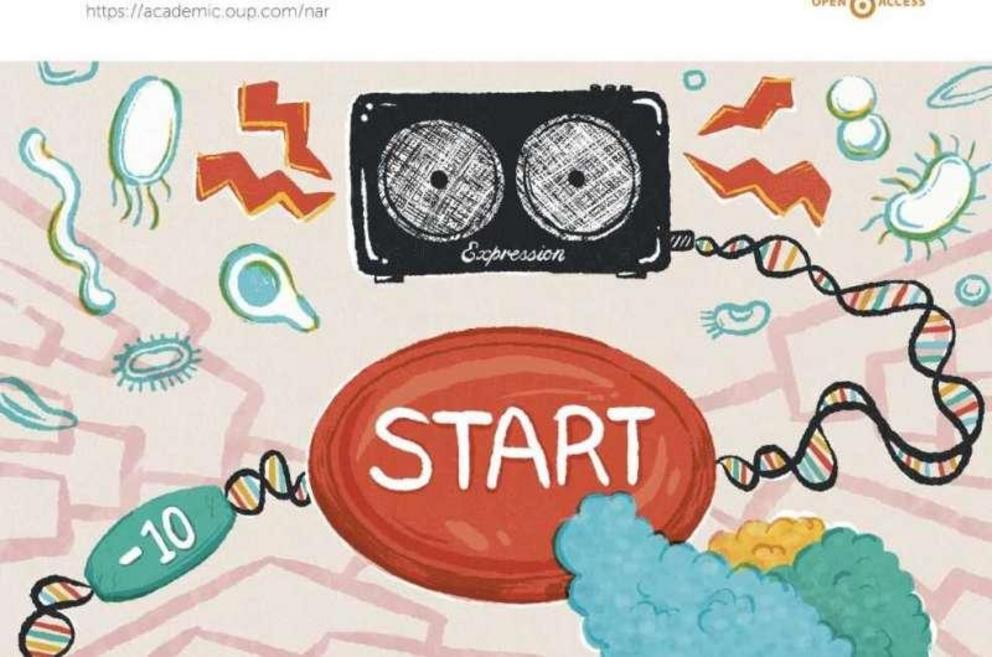
The cover image of Nucleic Acids Research (Volume 53, Issue 21–22), highlighting the discovery of a new promoter element "start" conserved across the domain Bacteria. The start element, together with the well-known −35 and −10 elements, is recognized by RNA polymerase to initiate transcription.
A newly discovered promoter element "start" points to a shared regulatory syntax for controlling transcription initiation in bacteria, archaea, and eukaryotes.
DNA is often described as the language of life. With just four nucleotides—A, T, G, and C—genomes encode thousands of genes together with the regulatory elements that govern when and how those genes are expressed. Deciphering the information embedded in DNA not only sheds light on the origin of life, but also reveals how organisms adapt to changing environments and provides knowledge essential for synthetic biology and forecasting future evolutionary trajectories.
As gene sequences follow a precise and universal rule to encode proteins, identifying them in genomes has become relatively straightforward. In contrast, regulatory elements are far more variable in length and sequence composition, making them much harder to recognize. As powerful models like AlphaFold have transformed our ability to predict protein structure and function, a major frontier in life science is now the development of computational tools capable of predicting and designing regulatory elements.
Advances in promoter research methods
Among various regulatory elements, promoters draw particular attention because they control transcription initiation, the very first step in gene expression. To decipher the rules embedded in promoter sequences, Prof. David Chou's laboratory at National Taiwan University applied high-throughput methods to construct more than 16 million promoter variants and measure their expression levels in E. coli.
The resulting dataset was used to train a computational model, which the team then applied to analyze the genomes of 49 phylogenetically distinct species across the domain Bacteria. The work is published in the journal Nucleic Acids Research.
Key findings and evolutionary implications
This systems biology approach revealed domain-wide conservation of bacterial promoter architecture, with two major findings:
- In addition to the well-known "–35" and "–10" elements, bacterial promoters contain a novel and broadly conserved element that specifies the transcription start site. Prof. Chou named this new element "start."
- The "discriminator" element, located immediately downstream of the –10 element, shows striking sequence divergence between the two major bacterial clades, Terrabacteria and Gracilicutes. This divergence reflects a functional difference: many Gracilicutes use discriminator sequences to tune promoter strength according to growth rate, whereas Terrabacteria do not utilize this regulatory mechanism.
Remarkably, the newly identified bacterial start element closely resembles the "initiator" element used by archaea and eukaryotes to define transcription start sites. This cross-domain similarity suggests that the last universal common ancestor may have already used a promoter architecture much like the one observed today, providing new clues to the ancient origin of gene regulation on Earth.
"These findings reshape our understanding of promoter evolution and lay the foundation for engineering and computationally identifying regulatory elements in diverse bacterial genomes," said Prof. Chou.
More information: Syue-Ting Kuo et al, Unraveling the start element and regulatory divergence of core promoters across the domain bacteria, Nucleic Acids Research (2025). DOI: 10.1093/nar/gkaf1310
Journal information: Nucleic Acids Research
Provided by National Taiwan University