
The Zionist Plan for a Concentration Camp in Gaza
Israel moves to intern 600,000 Palestinians in the “most moral concentration camp in the world.”
By Kurt Nimmo
Global Research, July 09, 2026
Auschwitz-Birkenau,
Treblinka,
Belzec,
Sobibor and Chełmno.
These should be destinations Israeli Jews remember and abhor, and yet we are told, by the Israeli newspaper Haaretz (PDF), that a concentration camp in the works on the ethnic cleansed ruin of Rafah is somehow not only moral, but the most moral concentration camp in the world.
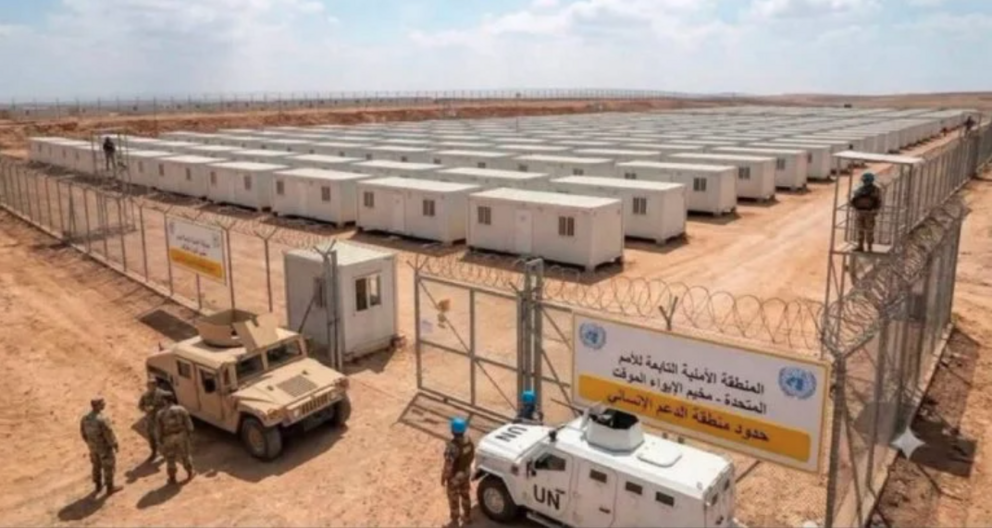
The support given by Prime Minister Benjamin Netanyahu to the criminal plan being promoted by Defense Minister Yisrael Katz, involving the construction of a “humanitarian city” on the ruins of Rafah, which would incarcerate all the enclave’s residents, is a moral and historic nadir for the State of Israel and the Jewish people. No matter how they try in Israel to wrap this move with laundered epithets, they are talking about a concentration camp.
To read this article in the following languages, click the Translate Website button below the author’s name.
Hebrew, عربي, Farsi, Türkçe, Deutsch, Русский, Español, Portugues, 中文, Français, Italiano, 日本語, 한국어, Српски. And 40 more languages.
The Zionist state, according to Katz, plans to herd 600,000 Palestinians currently forced to shelter in tents and makeshift homes within the coastal al-Mawasi area of southern Gaza to an area in the ruins of Rafah city. “Eventually, the entire civilian population of over two million in Gaza would be confined to this small ‘city,’” the Middle East Eye reports.
Katz said that once concentrated in the new city, Palestinians would be encouraged to “voluntarily” leave the Gaza Strip for other countries, as part of an “emigration plan” he said “will happen”.
In July, 2025 the US-backed Gaza Humanitarian Foundation (GHF) proposed a “Humanitarian Transit Area” where Gaza residents would “temporarily reside, deradicalise, re-integrate and prepare to relocate if they wish to do so,” Al Jazeera reported. GHF operated food distribution sites outside the United Nations system.
Humanitarian aid organizations and UN-affiliated experts say GHF previously violated humanitarian principles by directing civilians to hazardous militarized aid sites instead of establishing a neutral network. The BBC reported that more than 500 Palestinians have been killed while seeking aid since the GHF began operating in May, 2025. Oxfam and Save the Children report Israeli forces and armed groups “routinely” fired on Palestinians seeking aid. GHF ended its operation in late 2025.
In March, the RAND Corporation published Pursuing Disarmament, Demobilization, and Reintegration in Gaza: A Critical Pathway to a Durable Peace. The white paper follows a Disarmament, Demobilization, and Reintegration (DDR) three-stage strategy used by UN Peacekeeping to transition war-torn societies to peace.
The RAND report does not take into account Israeli policies of settlement expansion, collective punishment, arbitrary imprisonment, and periodically “mowing the grass,” that to say conducting violent raids into Gaza. Decades of Zionist mistreatment of Palestinians naturally perpetuates radicalization and determined resistance.
The Strategic Hamlet Program
In 1962, the administration of Ngo Dinh Diem, in collaboration with the Kennedy administration, initiated the counterinsurgency Strategic Hamlet Program in South Vietnam. This rural pacification initiative involved relocating South Vietnamese villagers into barbed-wired “protected hamlets,” distancing them from their ancestral lands and inhibiting any support for the National Liberation Front (NLF), commonly referred to as the Viet Cong. US advisors forcefully put them to work building the internment “villages.” The concept of fortifying villages and hamlets originated from the British Army. They had effectively implemented it in Malaysia. Sir Robert Thompson, the head of the British advisory team to Ngo Dinh Diem, recommended it.
The French constructed “protective villages” in Tonkin, later known as agrovilles, under commander François de Linares in 1952. The effort was underwritten by the United States and eventually interned three million Vietnamese. Vietnam War correspondent Bernard Fall said, “the French strategic hamlets resembled British [Malayan] prototypes line for line.”
The Malaysian strategic villages were established in the 1950s under the Briggs Plan, a British counterinsurgency population-control and resettlement program devised by Lt‑Gen. Sir Harold Briggs during the Malayan Emergency of 1948–1960. The villages were designed to break the link between the Min Yuen, a civilian support network, Malayan Communist Party (MCP) guerrillas.
The Briggs Plan villages led to extensive forced resettlement, identity registration, curfews, supervised relocations, coordinated civil-military administration, and the recruitment of home guards among settlers. This initiative played a significant role in the ultimate defeat of the MCP insurgency.
The exploitation experienced in Malaysia during the colonial era was closely associated with the economic extraction methods employed by the British, particularly in the rubber and tin industries. This system was characterized by oppressive labor practices, land dispossession, and legal arrangements that benefited colonial corporations and administrators.
The Strategic Hamlet Program in Vietnam failed due to its rapid implementation, inadequate defense, corruption, poor execution, and alienation of the rural population it aimed to win over. The fundamental strategic mistake was that the program prioritized physically separating people from the Viet Cong without first making the government more appealing than the communists.
.
A strategic hamlet in South Vietnam, c. 1964 (Public Domain)
.
British Concentration Camps in South Africa
During the Second Boer War in South Africa (1900-1902), the British implemented concentration camps to eliminate support for Boer guerrillas and to suppress resistance during the conflict. “While civilian internment in South Africa was not intended to be genocidal, it resulted in a significant loss of life and enduring resentment among Boer descendants,” writes Garth Benneyworth from the Department of Historical Studies at the University of Johannesburg, South Africa.
A minimum of 40 concentration camps were established, interning approximately 150,000 Boer refugees, predominantly women and children. Estimates suggest that Boer fatalities ranged from about 18,000 to 28,000, with children constituting the majority of the casualties. Overcrowding and unsanitary conditions resulted in outbreaks of diseases, including typhoid, malaria, measles, and dysentery.
The camps were created following the British failure to subdue the Boer South African Republic and the Orange Free State, as well as to gain control over the profitable Witwatersrand gold mines. In reaction to the Boers’ resistance, the British implemented a scorched earth strategy that methodically destroyed crops, contaminated water sources, burned homesteads and farms, and interned Boer and African men, women, and children.
Violation of the Fourth Geneva Convention
Israeli Defense Minister Israel Katz’s “New Rafah” plan is a high-tech version of previous concentration camps. In a similar fashion to the Strategic Hamlet Program and the Boer camps in South Africa, “New Rafah” is primarily intended to separate Palestinian civilians from Hamas and prepare for the forced migration of two million people (despite the fact few if any countries are willing to take ethnically cleansed Palestinians). The Euro-Med Human Rights Monitor reports the Israeli plan
constitutes a clear violation of international humanitarian law, particularly the absolute prohibition on the forced transfer and mass detention of protected populations under the Fourth Geneva Convention. It falls within the scope of forced displacement, persecution, and apartheid, which are patterns of policies and practices that individually amount to crimes against humanity under international law.
Zionist Israel, however, has repeatedly demonstrated its contempt for international law in regard to the protection of civilians. “Rather than abide by these rules, Israel has openly defied international law time and again, inflicting maximum suffering on civilians in the occupied Palestinian territory and beyond,” notes the United Nations Human Rights Office of the High Commissioner.
The “humanitarian city” proposed by Katz follows previous violations, including illegal settlements, annexations, military watchtowers and barbed-wire fences on Palestinian land, refusal to allow the right of return for refugees, numerous deadly sieges in the Gaza Strip and West Bank, and the breach of over 30 UN Security Council resolutions.
*
Click the share button below to email/forward this article. Follow us on Instagram and X and subscribe to our Telegram Channel. Feel free to repost Global Research articles with proper attribution.
Kurt Nimmo is a journalist, author, and geopolitical analyst, New Mexico, United States. He is a Research Associate of the Centre for Research on Globalization (CRG). Visit the author’s blog.
Featured image source
Global Research is a reader-funded media. We do not accept any funding from corporations or governments. Help us stay afloat. Click the image below to make a one-time or recurring donation.
The original source of this article is Global Research
Copyright © Kurt Nimmo, Global Research, 2026
For the rest of this article please go to source link below.