

Resistance training may help preserve aging nerves
Story at-a-glance
- Resistance training for aging nerves helps older adults improve steadiness, reaction time, and daily movement confidence by strengthening communication between nerves and muscles
- A four-week hand-grip training program from Syracuse University showed that simple, consistent resistance exercise helps speed up how quickly nerves send signals to muscles, even in older adults
- While the approach supports nerve health, it’s not a cure for neuropathy or a guaranteed fall-prevention solution. Evidence remains early and based on short-term trials
- Do two to three resistance sessions each week at a moderate effort level. Include a short, five-minute grip routine to strengthen nerve signaling and improve coordination
- Pair your training with balanced, protein-rich meals to support muscle recovery and nerve function. Make sure to also prioritize safety — use proper form and stop if you feel pain, dizziness, or unusual tingling
As you get older, movements that once felt automatic begin to feel less fluid. A quick step to catch your balance or a reflexive reach to prevent a fall depends on how efficiently your nerves and muscles communicate. When that connection slows, coordination and reaction time decline. The good news is, resistance training for aging nerves helps keep that connection strong.
A study recently published in Medicine and Science in Sports and Exercise1 examined how physical training might help maintain nerve health over time. Their findings point to structured resistance training for older adults as a practical way to preserve steadiness, strength, and confidence in movement, helping you stay active and independent over time.2
What Changes in Your Nerves as You Age
Your aging nervous system changes gradually, even when you stay active and healthy. The nerves that control movement begin to lose efficiency, and the messages they send start to travel more slowly. This decline begins with the motor neurons, the nerve cells that connect your spinal cord to your muscles. Each of these neurons controls a group of fibers known as a motor unit, and with age, some of those connections are lost through a process called denervation.3
• The body tries to repair lost connections — When denervation occurs, the body compensates through motor unit remodeling, where surviving neurons branch out to reconnect to nearby fibers. This adjustment helps you keep using those muscles but comes at the cost of precision.
The fine control that once allowed effortless movement fades as these new connections transmit signals less efficiently. These subtle shifts in neuromuscular function contribute to the slower, less coordinated movements that many people notice with age.4
• The communication point between nerve and muscle also weakens — The neuromuscular junction, which acts as the relay point that converts nerve impulses into muscle contractions, also undergoes structural and functional changes over time, reducing the efficiency of signal transmission between nerves and muscle fibers. Even when your nerves still fire properly, fewer fibers respond to each impulse.5
• Nerve signals travel more slowly with age — Another measurable effect of aging is a reduction in nerve conduction velocity (NCV), which refers to how fast electrical impulses travel from nerve to muscle. In young adults, these signals move at about 60 to 70 meters per second.6
The rate steadily declines with age due to loss of myelin, the insulating sheath around nerve fibers, and the shrinking diameter of the axon, which is responsible for transmitting electrical impulses. This slowdown causes a subtle delay between intention and movement, often noticed when reacting to sudden changes in balance or motion.7
• Research confirms how aging nerves affect performance — In the featured study, conducted by researchers at Syracuse University, NCV was measured in 48 adults ranging from 18 to 84 years old. Participants completed a short, four-week nerve health exercise using simple hand-grip resistance tools three times per week.
After training, both young and older adults showed measurable improvements in NCV, averaging about a 5.6% increase in signal speed. The improvement among older participants showed that neural function is trainable later in life, even after decades of natural decline.8
This early finding strengthens the case for resistance training for aging nerves as a realistic strategy for maintaining reaction speed and movement confidence in daily life.
How Resistance Training May Help Nerve Health
Even short, structured practice prompts measurable improvements in how your nerves communicate with your muscles. Resistance training builds on that effect by recruiting more motor units at once, sharpening timing at the neuromuscular junction, and encouraging fast motor neurons to reconnect with fibers that have fallen silent. This re-engagement, known as reinnervation, helps restore communication that weakens over time.9,10
• The Syracuse University study measured these changes directly — As shown in the Syracuse University study described earlier, consistent grip training led to measurable improvements in NCV. The same principle applies across the body — regular resistance training strengthens communication between nerves and muscles, helping maintain coordination, steadiness, and control with age.
• Grip training was chosen for its simplicity and safety — It isolates a small muscle group, allows precise measurement, and is accessible for most adults. These short, focused sessions produced measurable nerve benefits before noticeable muscle growth, showing that neural adaptation happens first. Grip work can therefore, serve as a starting point while progressing toward a full-body routine of strength training for seniors that continues the same neural practice on a larger scale.
• Quicker nerve responses translate into better control — When nerves fire more rapidly, muscles react faster to changes in balance and posture. This quicker feedback loop helps the body adjust in time to prevent stumbles or recover from slips. In this way, resistance training and fall prevention go hand in hand. As explained by Professor Jason DeFreitas, one of the lead authors:
"When you lose fast neurons, you also lose the fast muscle fibers that are activated by them, and then your power, or the speed at which you can produce force, decreases. If you can reactivate those lost neurons, you can produce force faster again and that has practical implications so that a slip or a trip doesn't become a terrible fall."11
• Balance is multifactorial — While quicker signaling helps with balance and recovery reactions, fall prevention depends on many factors, including vision, posture, and coordination. Resistance work only supports one part of that system.12
Each session of nerve health exercises for older adults reinforces that responsiveness, keeping communication between nerves and muscles clear. Over time, it becomes a maintenance practice for your body's electrical network, preserving coordination and confidence in motion.13
The Sweet Spot for Resistance Training
While the featured study used multiple weekly sessions to explore how exercise supports nerve health, broader research shows that when it comes to strength work, more isn't always better. Resistance training is an important tool for protecting muscle, bone, and brain health as we age, but evidence suggests that overdoing it may actually shorten your lifespan.14
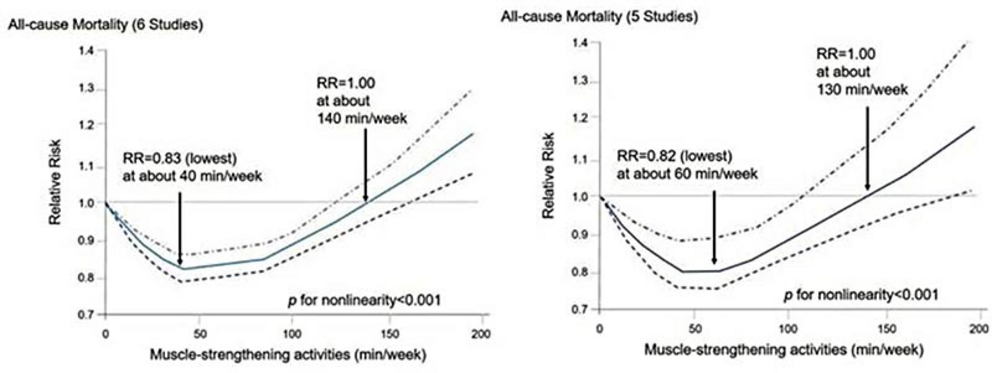
• Longevity benefits peak at 40 to 60 minutes strength training per week — In my interview with cardiologist James O'Keefe, he discussed findings from his research15 showing that vigorous exercise backfires, especially when done in high volumes. As shown in the graph below, there is a J-shaped relationship between strength training and all-cause mortality, where the benefits rise to about 40 to 60 minutes per week, then level off and eventually decline with higher volumes.
• How excessive exercise reduces your lifespan — Prolonged, high-intensity training places continuous stress on the body, increasing the risk of cardiac strain and musculoskeletal injury. Over time, this kind of overtraining interferes with recovery, leading to fatigue, lower performance, and a weakened immune response.
• Training over two hours weekly negates the advantage — When total strength training exceeds about 130 to 140 minutes per week, the longevity benefits drop to the same level as doing no strength work at all. In fact, training three to four hours a week is linked with poorer long-term survival than performing moderate amounts of resistance exercise.
• Excessive lifting leaves you worse off than being sedentary — Although regular movement is generally better than inactivity, O'Keefe's findings suggest that very high volumes of intense strength training may actually reverse the benefits.
For reasons not yet fully understood, excessive lifting appears to strain the body enough to offset the advantages of exercise, leaving outcomes worse than in those who remain sedentary.
• Aim for 20 minutes twice a week, not more — The takeaway is to keep strength training short and focused, about 20 minutes twice a week on non-consecutive days, or roughly 40 minutes once a week. Treat it as one part of a balanced exercise routine rather than the main focus. Pairing moderate resistance work with steady, moderate-intensity activity such as walking supports overall health and longevity without overstressing the body.
• Even short weekly sessions protect against aging — This moderate approach aligns with research from Brigham Young University,16 which found that even small amounts of resistance training — about 10 to 50 minutes per week — were linked to longer telomeres, a marker of slower biological aging. These brief sessions deliver measurable anti-aging benefits without the risks that come with overtraining.
A Simple 4-Week Beginner Resistance Training Plan for Seniors
Keeping the Goldilocks dose of resistance training in mind, this four-week plan combines strength, grip, and balance training to help your nerves and muscles work together more efficiently. Each session lasts about 20 to 30 minutes and can be done twice a week on non-consecutive days. Work at an effort level of about 5 to 7 on a 10-point scale — challenging but still controlled.
When you can complete the top of a repetition range with good form and your effort (Rate of Perceived Exertion or RPE) remains within that level, add a small amount of weight, one repetition, or one set. The goal is steady, repeatable practice that keeps your body responsive without pushing it to exhaustion.
Part 1 — Strength Anchors
Choose one exercise based on what you have access to, whether it’s machines at a gym, bands or dumbbells at home, or bodyweight exercises.
• Seated leg press17
1. Sit comfortably on the leg press machine with your back against the pad and your feet placed shoulder-width apart on the platform.
2. Hold the side handles for support. Press the platform away from you by straightening your legs, stopping just before your knees fully lock out.
3. Pause briefly, then lower the platform slowly and with control until your knees bend again to the starting position. Do two to three sets of eight to 10 repetitions.
• Seated row18
1. Sit tall at the seated row machine with your knees slightly bent and your feet braced against the platform.
2. Hold the handle with your arms extended and shoulders reaching slightly forward.
3. Pull the handle toward your waist, bringing your elbows back and squeezing your shoulder blades together.
4. Pause briefly, then return to the starting position in a slow, controlled motion. Do two to three sets of eight to 10 repetitions.
For the rest of this article please go to source link below.
For full references please use source link below.