
Vladimir Putin and Klaus Schwab “go way back”. Does Putin support the Covid Vaccine?
Global Research, August 12, 2024
henrymakow.com 21 December 2023
Schwab meets both Putins. In each case, Masonic thumbs get a workout.
Putin is a Rothschild boy like all world mis-leaders.
Mankind is the victim of a diabolical plot to start WW3.
“Sputnik V” Is the Model Great Reset Drug
With the Most Obvious Direct Ties to the World Economic Forum
Yet it’s the one “vaccine” that isn’t being linked to it
*
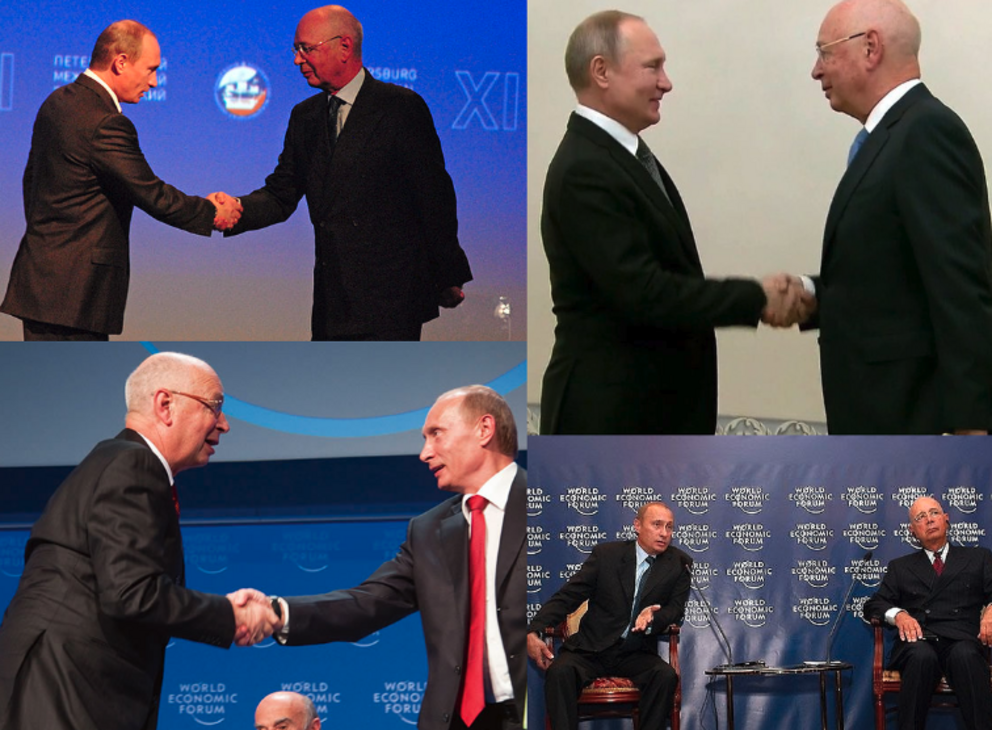
In January of 2021, Putin gave a keynote (virtual) address before the World Economic Forum. The theme: “The Great Reset.”
Beginning his speech with a warm “dear Klaus,” Putin recalled how he first met Mr. Schwab in 1992 and since then had regularly attended events organized by the Fourth Industrial Revolution visionary.
Putin used his address to urge for “expanding the scale of [COVID] testing and vaccinations” across the globe–policies that have ushered in worldwide medical apartheid.
Echoing the sentiments of western leaders, Putin also argued that the global economy would need to be rebuilt from the ground up by central banks:
[T]he key question today is how to build a program of actions in order to not only quickly restore the global and national economies affected by the pandemic, but to ensure that this recovery is sustainable in the long run, relies on a high-quality structure and helps overcome the burden of social imbalances. Clearly, with the above restrictions and macroeconomic policy in mind, economic growth will largely rely on fiscal incentives with state budgets and central banks playing the key role.
The Russian president has repeatedly stated vaccination should be voluntary—but his personal opinion has had no impact on actual policy. All 85 regions of Russia now have decrees requiring certain segments of the population to get the shot.
On December 17, 2021, Putin voiced support for a nationwide QR code law—one of the most unpopular pieces of legislation in recent Russian history. The introduction of digital health IDs would in essence make vaccination compulsory for those who want to partake in life’s most ordinary activities.
In late November, after the health ministry approved “Sputnik-M”—Russia’s COVID shot for ages 12-17—Putin suggested authorities begin “thinking about” vaccinating children starting from the age of two.
How many two-year-olds have died from COVID in Russia? (Trick question: the Russian government doesn’t disclose COVID-linked deaths by age group. In fact, the Russian government refuses to publish lots of highly important COVID-related data, including statistics on post-vaccination side effects. Why?)
Time for a Rethink?
In October, RT.com ran a provocative op-ed describing the Great Reset as a “cartoonish fantasy that will hand the global elite even more power.”
The piece lists various world leaders–including Boris Johnson, Emmanuel Macron, and Angela Merkel–as devout followers of Schwab. No mention of Russia anywhere.
The irony, of course, is that Sputnik V is practically the official vaccine of the WEF–and the Russian government is among Schwab’s biggest fans.
ANNEX
Relevant Videos (Selected by Global Research)
President Putin on the Covid Vaccine, Address to WEF, June 2021
Address by President Putin at the World Economic Forum on the Global Economy and the Pandemic
(27 January 2024)
Transcript of President Putin’s presentation to WEF
Focussing on the World Economy and the Pandemic
Introductory comments by Klaus Schwab
January 27, 2021
Klaus Schwab
0:00
russia is an important global power and this is a long-standing
0:07
tradition of russia’s participation in the world economic forum at this moment in history whereas the
0:14
world has a unique and short window of opportunity to move from an age
0:19
of confrontation to an age of cooperation the ability to hear your voice the voice
0:26
of the president of the russian federation is essential even and especially in
0:33
times characterized by differences disputes and protests constructive on honest
0:41
dialogue to address our common challenges is better than isolation and
0:46
polarization yesterday your phone exchange with president biden
0:52
and the agreement to extend the new start nuclear arms treaty in principle
0:58
i think is a very promising sign in this direction coming 19 mr president has shown
1:06
our global vulnerability and interconnectivity and like any other country
1:13
will russia will certainly also be affected and your
1:20
economic development and prospects for international cooperation of course is
1:26
of interest to all of us mr president we are keen to hear from your
1:33
perspective and from that of russia how you see the situation developing
1:39
in the third decade of the 21st century and what should be done to ensure
1:45
that people everywhere find peace and prosperity mr president the world
1:52
is waiting to hear from you
President Vladimir Putin
2:03
mr schwab dear uh dear colleagues i’ve visited davos
2:10
many times assisting uh meetings starting from the 90s mr schwartz just mentioned that we met
2:18
each other first in back in 1992. uh in sun peace and when i worked in south
2:26
beach i visited uh this for many times i’d like to thank you uh for this opportunity today uh for me
2:33
to make my statement vis-a-vis the expert community which is participating in this or thanks
2:40
to your efforts mr schwab first of all uh ladies and gentlemen i’d like to welcome welcome all world economic forum
2:47
participants and i’d like to start with the following it’s rather gratifying in spite of the
2:56
pandemics it’s rather gratifying to see that this year despite of the restrictions caused by the coronal eraser in the
3:02
virus the forum continues its work online it has provided an opportunity for the
3:08
participants to engage in an open and free discussion and share their evaluations and
3:13
forecasts and it partially makes up for the lack of direct communication between the leaders of
3:19
states global businesses and the world community that has accumulated over the past months
3:27
all of this is important now that we are when we are facing
3:33
so many complex issues requiring solutions um this foray is the first for in the
3:41
third decade of 21st century and the majority of its topics are dedicated to
3:46
the profound changes which are taking place in our play uh in in the world it is indeed hard to ignore the
3:53
fundamental transformations in global economy politics social life and technology
4:02
the coronavirus pandemic that which you mentioned uh before has become a major
4:09
challenge to the entire mankind has just spurred or accelerated the structural changes
4:15
the preconditions for which have been already in place for many years the pandemic has
4:22
sincere weighted the problems uh and imbalances that accumulated in the world earlier we have every reason to
4:29
believe that the tensions might aggravate even further and such tendencies might emerge in
4:35
almost every area naturally there are no direct
4:40
parallels in history but some experts however and i do respect their opinion they compare
4:48
the current situation to the late uh 20s or early 30s of the last century one can may
4:55
agree or disagree with such opinion such an opinion yet one cannot but draw some parallel
5:02
in terms of many aspects the scale as well as the cross-cutting and systemic nature of challenges and
5:08
potential threats we see the crisis we’re witnessing the crisis of previous
5:13
models and tools of economic development social stratification is increasing both globally and
5:21
in individual countries we mentioned this before but today it causes a sharp polarization in
5:27
public opinions uh populism right and left-wing radicalism
5:32
and other extreme movements are on the rise domestic political processes including
5:39
in leading economies are escalating and becoming more violent all of this cannot but
5:46
impact the nature impact the nature of international relations making them less
5:51
stable and predictable international institution institutions are weakening regional conflicts conflicts are
5:58
multiplying the global security system is degrading and klaus just mentioned my yesterday’s phone uh call
6:06
uh phone talk with the u.s president and we have agreed about the uh
6:12
extending the start uh agreement it’s a correct step but anyway uh the contradictions are
6:20
multiplying and it is well known that in the 20th
6:27
century the failure and inability to essentially resolve such issues resulted in a catastrophic world war of
6:32
course nowadays such a heated conflict is not possible i hope that it’s not possible in principle
6:39
because it will mean the end of our civilization but i’d like to reach rate however that
6:44
the situation might develop unpredictably and uncontrollably if we will sit on our hands doing
6:52
nothing to avoid it and there is a possibility that we may experience an actual
6:57
collapse of global development that might result in a fight of all against all the warring parties
7:05
would attempt to tackle the escalated tensions by searching for internal and external enemies the fight would
7:12
mean the destruction of not only traditional values and we cherish these values in russia such as
7:20
family but also fundamental freedoms including the right of choice and privacy i would like to know that social crisis
7:27
and the crisis of values have already caused negative demographic consequences
7:32
as a result the humankind risks losing the entire civilizations and cultures our common responsibility today
7:41
is to avoid such a future that resembles a grim dystopic dystopia we need to
7:49
ensure development following a different path one that is positive balanced and constructive and in this regard i would
7:57
like to elaborate on the key challenges that in my opinion are facing the world
8:02
community today the first of them the first one of them is of the social
8:09
and economic nature well that’s true we took if we look at the statistics
8:15
despite the severe crisis of 2008 and 2020
8:22
the past 40 years one can call extremely successful for
8:30
the global economy starting from 1980 the global gdp
8:35
had purchasing power parity in real terms per capita has doubled
8:44
and it’s a positive sign globalization and domestic growth have resulted in a boost in developing countries
8:51
more than a billion people have been lifted out of poverty
8:57
for instance if we take an income level of 5.5 u.s dollars per person per
9:03
day at purchasing power parity according to the world bank the number
9:11
of people with lower income in china has reduced from 1.1 billion
9:18
in 1990 to less than 300 million
9:24
in recent years and it’s a success for china in russia this number has been decreased from
9:30
almost 64 million people in 1999 to about five million people as of now
9:37
and we think that uh we are moving in the right direction
9:43
and it’s the most important area but the main question the answer to which gives much insight
9:49
into the current problems is what was the nature of this global growth who benefited most from it
9:58
undoubtedly as i’ve already said developing countries gained much benefit from it
10:05
using the growing demand for their traditional and even new products
10:12
but however this embedding in the global economy resulted not only in new jobs and expert
10:19
earnings for them but also in social costs including significant income gap of the population
10:28
and what is the situation in the developed countries whose level of average well-being is much higher
10:37
paradoxically the problems of stratification here in
10:43
developed countries have proven to be even more profound according to the world bank estimates
10:50
while there were 3.6 million people living on less than 5.5 u.s dollars
10:57
a day in the u.s in the year 2000 in 2016 this figure rose
11:05
up to 5.6 million
11:10
during the same period globalization resulted in a substantial increase in the profits
11:16
of the large multinational companies primarily american and european ones
11:21
and the as to the number of rest of these people in european countries develop
11:28
european countries the tendency tendency is the same like in america but again who gets this revenues talking about
11:35
about companies the answer is obvious those who represent one percent of the
11:40
population and what has happened with the other people
11:46
for the last 30 years
11:52
the income of more than half of the citizens of a number of developed countries in real terms has not increased
12:01
while the cost of education and health services has tripled has increased
12:08
and has tripled actually that has millions of people even in rich
12:15
countries have ceased to see the prospect of increasing their income at the same time they face the
12:21
problems of how to preserve their own health and that of their parents how to provide
12:27
quality education for their children children there is also a large proportion of people who in fact
12:33
turn out to be non-demanded thus according to the international labor organization
12:38
estimates in 2019 21 of young people in the world or
12:44
267 million uh we’re neither studying or working and
12:50
even among those who have work work and it’s an interesting figure even among those who work
12:56
30 percent leave on less than 3.2 us dollars a day at purchasing power
13:03
parity such imbalances in uh global social and economic development
13:10
are the direct results of the targeted policy that has been conducted since the 80s of the last century often
13:18
blatantly and dogmatically based on this so-called
13:23
washington consensus with its unwritten rules that give priority to private
13:28
debt-driven economic growth with deregulation and loud
13:34
low taxes on the bridge and the reach and corporations as i’ve already mentioned the
13:40
coronavirus pandemic has only exacerbated the problems last year
13:46
they declined the global economy was the worst since the second world war uh labor
13:52
market losses by july were equivalent to almost 500
13:58
million jobs yes half of them have been recovered by the end of the
14:03
year but still almost 250 million jobs lost
14:09
is a very large and boring worrying figure in the first nine months of last year
14:16
alone global labor income losses totaled three and a half and a half three three and a
14:23
half trillion dollars in the world and this figure is still rising which
14:29
means social tensions are on the rise as well at the same time post-crisis recovery
14:34
is not an easy task if 20 or 30 years ago the problem could have been resolved
14:41
through stimulative stimulative macroeconomic policies that’s what we have done and we still
14:49
they’re still doing it so today such mechanisms are no longer working fact
14:55
the result is practically exhausted and it’s not my just my uh st
15:03
evaluation thus according to the imf estimates the level of aggregate public and
15:08
private sector debts is close to 200 of global gdp and in some economies
15:14
it has exceeded 300 percent of national gdp at the same time all developed countries
15:21
now have zero interest rates
15:27
and the main develop developing countries historically historical minimum ones all this leads
15:34
to practically practical impossibility of stimulating the economy with traditional tools by
15:39
increasing private credit quantitative easing the so-called quantitative easing which
15:45
only increases inflates the financial asset bubble leads to further stratification in the
15:52
society and the increasing gap between real and virtual economy
15:58
and quite often representatives of real economy
16:03
sector from many countries keep telling me this and i think that business representative today will uh
16:11
tell me tell me the same so
16:16
and the increased gap between rail and rational economy as i said represents a real threat and it is fraught with serious and
16:23
unpredictable disturbances certain hopes for resetting the previous growth model
16:28
are related to rapid technological development yes the last 20 years have laid the foundation for what is
16:35
known as the fourth industrial revolution which is based on the widespread use of artificial intelligence automated
16:43
and robotic solutions the coronavirus pandemic has greatly
16:48
accelerated such developments and their implementation however this process is also bringing is also
16:56
bringing about new structural changes in the labor market therefore without efficient efforts by
17:02
states many people are risking
17:07
their jobs and this often affects the so-called middle class which continues constitutes the core
17:15
of any modern society and let me turn to the second fundamental challenge for the forthcoming decade uh in other
17:22
words the social and political challenge increasing economic problems and
17:27
inequality are splitting the society they pave the way for social racial
17:33
national intolerance and this pressure shows through even in those countries
17:38
which seem to possess well-established civic and democratic institutions that are designed to smooth over
17:45
mitigate such events and incidents systemic social economic problems
17:54
leads to public discontent and it requires special attention
18:00
uh they should be these problems should be resolved there are dangerous illusions that we
18:08
can adjust don’t deal with it bury them deep
18:16
but in this case the public discontent uh will increase and the society will be
18:23
divided because the reasons of public discontent has to do with real problems
18:28
which affects everybody uh independently uh what political beliefs or
18:36
what political ideas there stick to real problems they lead to discontent i would point
18:44
out one more important aspect modern technology model technological uh first of all
18:51
digital giants have been playing an increasingly significant role in the life of the society
18:58
well we talked a lot about that uh taking into account what had happened in
19:04
the united states and we’re not talking about economic giants uh only in certain areas
19:11
they are compete they are competing with states and their audience include millions millions and
19:18
millions of users which using these ecosystems
19:24
they’re using ecosystems and they spend a lot of time there and the company’s monopoly position
19:31
as they can see it is best suited for running technological and business processes probably it’s
19:36
true but here is the question how well does this monopolism correlate with the public interest
19:42
where is the distinction between successful global businesses
19:48
sought after services and big data consolidation on the one hand and the efforts to rule
19:56
the society in the rude and self-servicing manner by
20:02
substituting for legitimate democratic institutions by encroaching on or restricting the
20:09
natural right of people to decide for themselves how to live and what to choose and what
20:14
you to express freely on the other hand we have seen all of this just recently in the united states
20:22
and everybody understands quite well what i’m talking about and i’m sure that the majority of people share this view
20:30
including those who are participating today at this meeting and finally the third
20:35
challenge or to be more precise the clear threat which we can face in this decade
20:42
i mean the further aggravation of the whole set of international problems
20:53
if states especially major states choose to search for internal enemies they will inevitably
20:58
need an external external enemy the one which they can blame for each and every
21:04
failure and the one to which they can redirect the temper and discontent of
21:09
their own citizens and we see it we can see it already we feel the tension in external
21:15
policy or with their friends grow we may expect practical steps to become more aggressive this might include
21:21
further pressure on countries that do not agree to become docile easy to control satellites
21:29
the use of trade barriers illegitimate sanctions restrictions restrictions in the
21:35
financial technological and information spheres such a game without rules
21:41
is dramatically increasing the risks of the universal use of military force
21:47
which is very dangerous under the under any pretexts invented pretests
21:54
as well as the odds of the emergence of new hot spots on our planets
22:01
that’s cannot but cause the preoccupation for creation among us
22:07
dear participants and dear participants despite this angle of differences and challenges
22:14
it is essential that we keep looking positively into the future and remain committed to
22:20
the constructive agenda it would be naive to offer some universal magic
22:26
solutions for the sad problems but all of us should certainly work to
22:32
develop common approaches narrow down discrepancies as much as
22:38
possible didn’t identify social global tensions i would like to reiterate my message the
22:44
fundamental reason behind the lack of sustainability in global development
22:50
is in many cases the accumulated social and economic problems that’s why the key issue for us today is
22:57
this what logic should we follow in our actions so as not only to quickly restore global and
23:03
national economies affected by the pandemic but to ensure that
23:08
the such restoration is sustainable in the long term and has a quality
23:14
structure enabling it to help overcome the burden
23:19
of social imbalances it is clear that given the above mentioned uh limitations
23:26
of the past macroeconomic policies further development of the economy will be based to a great extent on
23:32
fiscal stimulus which state budgets with state budgets and central banks
23:38
playing the key role in fact we are already witnessing such
23:43
tendencies in the developed and countries as well as as well as in certain developing
23:49
countries the increase the increasing role of the government in the social socioeconomic sphere
23:55
at the national level and not and obviously in matters of the global agenda requires
24:00
greater responsibility and closer interstate cooperation various international fora
24:05
have invariably been calling for inclusive growth for creating conditions to ensure a decent life for everyone
24:12
it is absolutely clear and that’s correct and it’s absolutely clear that
24:22
that the world cannot follow the path of building an economy uh that works for a million
24:29
people or even for the golden billion it’s a destructive type of policy such a
24:35
model is unsustainable by definition and recent developments including the migration crisis uh have once again
24:44
proved that today it is important to move from general statements to actions to putting real efforts and
24:50
resources to both reducing social inequality within individual states
24:57
and step by step to narrow the gap between the levels of economic development of
25:03
different countries and regions of the planet thus we will avoid immigration migration risks
25:09
designed to ensure sustainable harmonious development this policy has clear
25:14
purposes and priorities those include the creation of new opportunities for everybody
25:19
conditions for people to develop and realize their potential regardless of where they were born and
25:25
live and where they live um there there are four key priorities
25:30
how of how i can see them as the priorities
25:35
probably i will not be i will not say nothing new but uh i’m
25:43
expressing the power of the position the position of russia that’s what i’m doing first a person
25:48
should have a comfortable environment to live in which includes housing and accessible infrastructure transport energy and
25:55
utilities and of course ecological well-being we should keep this in mind always second a person must be confident
26:02
that he or she will have a job that provides a steadily increasing income and
26:07
therefore an adequate standard of living people should have access to effective
26:12
mechanisms for lifelong learning which is just necessary today
26:18
allowing them to keep to develop and build their career and receive a decent pension and social
26:24
package after retiring third a person must be confident
26:29
that he or she will receive high quality and effective medical care when needed
26:37
that the healthcare system in any event will guarantee them access to most uh advanced services
26:43
fourth regardless of family income children should have opportunities to
26:49
receive a decent education and fulfill their potential and this kind of potential every kid has
26:58
this is only the only way to guarantee the most effective development of a modern economy an
27:03
economy that does not view people as a mean as means as a mean but places
27:09
them at the center only those countries that can make progress in those in these four areas and
27:16
um i just mentioned uh the most important areas uh so only
27:23
those countries that can make progress here will ensure sustainable inclusive development
27:28
and it is these approaches that underlie the strategy that russia is pursuing my country is pursuing our
27:35
priorities focus on the individual and the family they center on ensuring demographic development and
27:42
safeguarding the people on improving the well-being and protecting the health of our people
27:48
we work to create conditions for decent and efficient work and successful entrepreneurship to
27:54
ensure digital transformation as a basis for a technology driven future for our
28:00
entire country rather than a small group of companies in the coming years we will concentrate
28:05
the efforts of the government business and civil society on these tasks and building a stimulating budget policy
28:14
in achieving our national development goals we’re open to a broad international
28:19
cooperation and we believe that cooperation matters on the global social and economic agenda
28:26
would have a positive impact on the general atmosphere and the world affairs and
28:32
interdependence in solving urgent problems would lead to us to stronger mutual trust
28:40
which is especially irrelevant today it is clear that an
28:46
era associated with attempts to build a centralized unipolar world order is over
28:56
it hasn’t been started even there were attempts to do this in just there
29:01
but it’s over such a monopoly was inherently contrary to the cultural
29:08
and historical diversity of our civilization
29:13
the the reality is that there are truly different studies of development in the
29:20
world with their own distinctive models political systems political models social institutions and
29:27
today it is extremely important to create mechanisms for coordinating their interests so
29:34
so that the diversity and which is natural and the natural
29:39
competition between the poles of development does not turn into anarchy and multiple
29:45
protracted conflicts and we for this we have to strengthen and
29:52
develop the universal institutions which bear special responsibility for ensuring global stability and security and
29:59
uh elaboration of rules of conduct in the world economy and trade i’ve mentioned many times that many universal
30:06
institutions are facing facing hard times today and at different summits i keep telling you
30:11
about that these institutions have been created in uh during different
30:17
uh era and they’re facing today’s challenges it’s not an easy task for them
30:22
objectively but i’d like to to stress that
30:30
we just we shall support them
30:35
they have unique uh experience when it comes to uh using a huge
30:44
potential which have not have has not been implemented it should be adapted to the realities
30:50
but we should use it we shall not make history of them we should use the
30:56
new uh forms of interaction when it comes to
31:06
certainly it can also be understood in different ways it can be seen as a way of promoting one’s own interests
31:12
and making one’s unilateral actions look legitimate while others are left with no other
31:18
choice but to not in approval or it can be an opportunity for sovereign states
31:23
to actually join their efforts to deal with specific problems for the common good in particular this
31:30
may involve the settlement of regional conflicts and creation of
31:35
technological alliances as well as many other areas including the formation of
31:40
cross-border transport and energy corridors etc
31:45
dear friends ladies and gentlemen you you understand that we have here vast opportunities
31:53
for mutual work uh such multilateral approaches actually work
31:58
and the practice the practical work shows that let me remind you that a lot
32:04
has been done by russia iran and turkey within the astana format to stabilize the situation in syria and
32:10
they are currently contributing to the establishment of a political dialogue in that country we are doing this with other countries
32:17
we are doing it together and russia engaged in active mediation efforts to
32:22
put an end to the armed conflict in the nagorni karabakh region a conflict between the nations that are
32:29
our old friends and neighbors azerbaijan and armenia these efforts were guided by the key arrangements made
32:36
by the osce means group particularly by its co-chair russia the u.s and france it’s another
32:44
good uh example of uh cooperation as it is known a trilateral
32:50
statement was signed by russia azerbaijan and armenia in november more importantly most of its provisions
32:56
are constantly put into practice there’s this has helped to end the bloodshed which is
33:02
the most important thing the ending of the bloodshed we establish a complete ceasefire and we
33:07
uh start with the stabilization process right now the task for the international community
33:13
and of course of those countries that have been involved in the resolving the crisis is to provide assistance to the affected
33:19
regions to help them overcome the humanitarian problems associated with the return of refugees
33:25
restoration of the destroyed infrastructure and protection of historical religious and cultural monuments and
33:32
their restoration you also know another
33:39
example i would like to stress the role played by russia saudi arabia and the
33:44
united states in the stabilization of the world energy market this farm it has provided a private
33:51
example of a productive interaction between countries with different and sometimes even opposite assessments of global processes
33:58
with their own views of the world at the same time there are of course issues that affect all states
34:04
without exception a good a good example is the joint work to study and combat the cavite 19
34:11
infection recently several types of this dangerous disease have emerged
34:18
as it is well known and the world community needs to create an environment that enables scientists
34:23
and as specialists to work together in order to understand why and how the chronovirus mutations
34:30
occur what is the difference between its strains and of course there is a need for worldwide coordination
34:36
of efforts and the uh general secretary you and general secretary calls upon it
34:42
we need to coordinate of efforts to distribute and facilitate the accessibility of the much needed covered 19 vaccines
34:48
vaccines help should be provided to states that need it the most including african states such
34:55
health should involve the increase should involve the increase in the
35:01
number of tests and vaccination as we can see a mass vaccination
35:07
is accessible mostly today for those who live in the developed countries at the same time there are hundreds of
35:16
millions of people uh in our world who cannot even hope to get such protection
35:21
and reality such inequality could result in a common thread because the pandemic
35:27
and it is well known the pandemic will drag on uh
35:34
and uncontrolled epicenters who will remain infection and pandemics
35:40
no no no no body that’s why we need to learn the lessons from the current situation
35:46
and to come up with measures to make the system for global monitoring of emergence of such diseases
35:52
more effective and another important area which requires the entire world
35:57
community to coordinate efforts
36:04
it has to do with the preservation of climate and nature of our planet
36:12
it’s nothing new here only together we can achieve progress uh in addressing such
36:19
serious problems as the global warming depletion of forest loss of biodiversity increasing
36:24
waste volumes and marine plastic pollution so on so forth find an optimal balance between the
36:31
interest of economic development and preservation of the environment for the current and future generations
36:38
dear foreign participants dear friends we all know that
36:44
competition rivalry between the countries has never in the world’s history stopped and they
36:51
will not stop and differences clusters of interests are
36:57
all natural for such a complex organism as the today’s of human
37:03
civilization in general however however at critical times
37:08
it was never an obstacle but rather it prompted a concerted effort in dealing
37:14
with the most vital and truly life-changing situations and i believe that now
37:20
is exactly such a period it is crucial to give an honest assessment of the
37:25
situation to focus on uh real global problems rather than perceived ones on remitting
37:33
the imbalances of imbalances which are critical for the entire world community and then i’m sure we will be able to
37:40
achieve success to give a solid response for the challenges of the third decade of the 21st century
37:48
i’d like to stop here and i’d like to thank for your patience and for your attention
37:57
mr president many of the issues erased certainly are part
38:04
also of our discussions here during the davos week we complement the
38:12
speeches also by task forces which address some of the issues you mentioned like
38:19
not leaving the developing world behind taking care of let’s say creating the skills for
38:26
tomorrow and so on so mr president i have we we prepare for
38:34
the discussion afterwards but i have one very short question um how do you see and i
38:42
it’s a question which we discussed when i visited you in saint petersburg
38:49
14 months ago how do you see the future of european russian relations
38:56
just a short answer
39:07
fundamental issues we have common culture
39:23
most important political figures in europe in the recent past mentioned
39:30
the need to keep developing the relations between europe and russia
39:37
stressing the fact that russia is part of europe geographically and what is most
39:43
important from the cultural point of view
39:49
it’s just one civilization in reality french leaders mentioned the need to uh
39:56
create a common space from lisbon to urals and i mentioned
40:03
just the same why adjust to your to your euros we shall extend it to vladivostok
40:10
me personally i had the position of the former distinguished political uh figure
40:18
uh chancellor helmut kaul who uh used to say that if uh the european culture
40:26
would like to preserve itself and to maintain its role as one of the cultural
40:31
centers in the world again taking into account all the problems and tendencies of the
40:38
world civilization development so where western europe and russia should
40:44
be together and we cannot but agree with this we share the same position and the same opinion today’s
40:52
situation is no doubt far from being normal
40:57
we have to come back to the positive agenda
41:02
this is the common interest of russia and european countries no doubt about that
41:08
well deep pandemic has played its negative role our trade to know
41:21
has been affected although uh your european union is one of our main trade partners so we have to come back
41:29
to positive tendencies and we have to
41:34
increase our interaction russia and europe from economic point of view are the
41:40
natural partners and from the point of view of first
41:48
science development technological development uh development from the space point of
41:55
view uh russia is sharing european culture
42:03
but the territory of russia is a little bit bigger than the entire
42:08
europe we have a huge human resources um and
42:13
i will not enumerate all we have but it could be
42:21
used beneficially for russia and europe what is important here is the following we should we should
42:28
approach an honest manner to our dialogue we should get rid of our
42:33
past phobias we shall not use in our internal political processes
42:41
problems which we inherited from the previous centuries
42:48
we shall look into the future to the to the future and if we are able to get rid of this
42:54
phobias and old problems then
43:00
we will create a positive stage of our uh relations we are ready for this we
43:06
would like to get this and we will do our best to get to achieve this but it should not be a uniratal approach
43:16
it should be a common approach
43:31
you
Click the share button below to email/forward this article to your friends and colleagues. Follow us on Instagram and Twitter and subscribe to our Telegram Channel. Feel free to repost and share widely Global Research articles.