
The US MILITARY OCCUPATION of the Indian Ocean “Zone of Peace” among BioWarfare, Geoengineering and Directed Energy Weapons
By
July 7, 2026
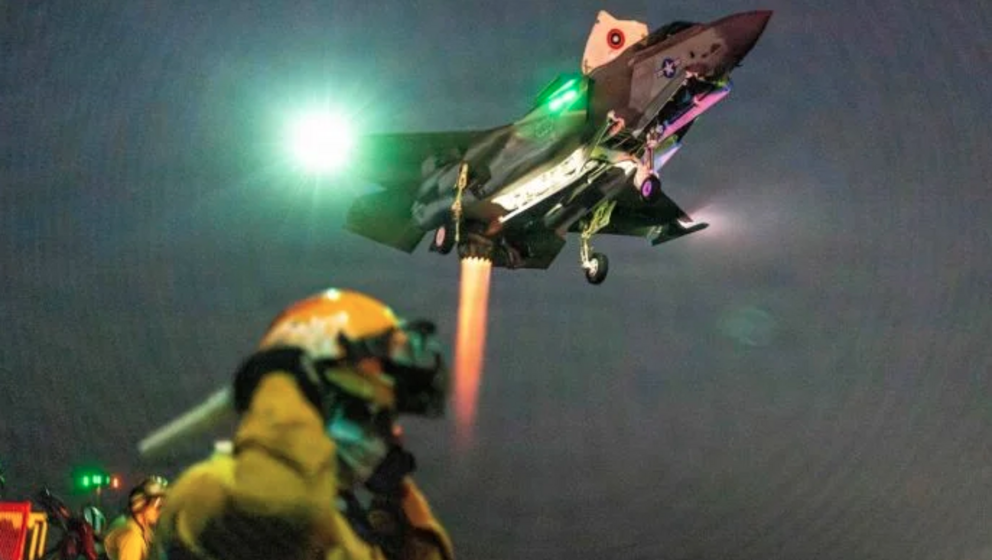
A U.S. Marine Corps F-35B Lightning II assigned to Marine Fighter Attack Squadron (VMFA) 122, 11th Marine Expeditionary Unit, lands during flight operations aboard Wasp-class amphibious assault ship USS Boxer (LHD 4) in the South China Sea, June 2, 2026. The 11th MEU, embarked aboard the Boxer Amphibious Ready Group, is a persistent, combat credible force contributing to deterrence and crisis response in the U.S. 7th Fleet area of operations. U.S. 7th Fleet, the U.S. Navy's largest forward-deployed numbered fleet, routinely interacts and operates with allies and partners to preserve a free and open Indo-Pacific. (U.S. Marine Corps photo by Sgt. Trent A. Henry)
Become a VT Supporting Member Today
Please keep VT Radio and VT Foreign Policy alive! Donate today to make sure VT stays on the internet free and clear of Big Tech control! Donate today:
Table of Contents
- PART 1: The US Occupation of the Indian Ocean Zone of Peace and Priorities for the next UNSG
- PART 2: Priorities for the next UNSG: Revamping the Environmental Modification Technologies (ENMOD) Treaty
by Darini Rajasingham-Senanayake
The writer, Dr. Darini Rajasingham-Senanayake, is a Social and Medical Anthropologist, based in Colombo, Sri Lanka. She is a cultural anthropologist with expertise in international development and political-economic analysis and Gospa News author since 2021. She was a member of the International Steering Group of the North-South Institute project: “Southern Perspectives on Reform of the International Aid Architecture”.
All Links to previous Gospa News articles have been added by our Editorial Staff
PART 1: The US Occupation of the Indian Ocean Zone of Peace and Priorities for the next UNSG
Anxieties of the American Empire: Buying Islands: From Greenland to Chagos to Sri Lanka
America’s war of choice on Iran has spread across the Indian Ocean World and maritime Silk Route. Starved of oil and gas South and Southeast Asia’s emerging economies have seen local currencies fall against the ‘exorbitantly privileged’ Petrodollar as public and private debt increased with soring energy costs.
The US fifth fleet’s occupation and blockade of Indian Ocean trade routes targeting the Strait of Hormuz has shown the importance of the 1971 United Nations (UN) declaration of the ‘Indian Ocean as a Zone of Peace’ — for global security and prosperity.
55 years ago the United Nations General Assembly (UNGA) led by the World’s first woman head of state, Prime Minister Sirimavo Bandaranaike of Ceylon, declared the Indian Ocean a ‘Zone of Peace’. Resolution 2832 (XXV1) affirmed the vast Indian Ocean together with the airspace above and the subjacent ocean floor for all time a “Zone of Peace”.
The bold resolution by the world’s first woman head of state 55 years ago has never been more relevant: De-militarizing and de-colonizing the Indian Ocean in line with UNGA Resolution 2832 is vital to sustain and deepen the fraying 60-day peace pause between Iran and the United States brokered by Pakistan and Qatar.
The Indian Ocean World’s maritime Silk Route, where Iran, formally Persia sits, was the home of the world’s oldest and wealthiest sea-based trade system. For millennia the Silk Route of the Seas wherein the Straits of Hormuz is an integral part, connected the coastal regions and hinterlands of the Supercontinent of Asia with Africa and Europe– long before the US came into existence across the Atlantic Ocean in the “new world’.
European invaders of the Indian Ocean World fought bloody battles to access, control and colonize Indian Ocean sea lanes from the 17th century onward, much like the US today, which seeks to toll Indian Ocean shipping, wage hybrid economic warfare, and stymie the Asian 21st Century at this time.
Strategic islands and waterways like the Malacca Straits and Hormuz were vital to control of Indian Ocean supply chains and trade routes, in order to access and loot the great wealth of Asian civilizations, particularly, Persia/Iran, India and China.
Indeed, to this day the Indian Ocean remains to be fully de-colonized. Distant water fishing states or non-Indian Ocean countries, France, Spain, Japan, Taiwan PRC etc. are some of the biggest looters of Indian Ocean fishery with industrial trawler fleets according to data from the Indian Ocean Tuna Commission. Meanwhile littoral states fishery remains underdeveloped and “artisanal’; dependent on Foreign Aid for de-industrialization.
It was hence too that UNGA Resolution 2832 (XXV1) establishing the Indian Ocean Zone of Peace was spearheaded by the world’s first woman head of state, the Socialist Prime Minister Sirimavo Bandaranaike of Ceylon back in 1971 during the Cold War amid great power rivalry between the Soviet Union/Russia and the US.
Ceylon, now Sri Lanka is geo-strategically located at the center of the Indian Ocean World’s trade routes and supply chains. Hence, the county was perpetually in the cross-hairs of big power rivalry, and subject to neocolonial projects; most recently by the International Monetary Fund (IMF) which has upended economic sovereignty and Energy policy autonomy in the Eurobond debt-trapped country.
United Nations Mandate and IOZP
The Declaration of the Indian Ocean as a ‘Zone of Peace’ (IOZP), 55 years ago has never been more relevant to global security, growth and decolonization, which are Core Mandates, albeit seemingly forgotten at the UN.
The UNGA IOZP Resolution sought to ensure that the world’s busiest trade routes would be free of foreign bases, militarization, and nuclear weapons during the long Cold War between the US and Soviet Union/Russia. Big power rivalry had undermined development and de-colonization while driving proxy wars in Asia, Africa and South America.
Ceylon’s Sirimavo Bandaranaike was aided by stalwarts of the Non-Aligned Movement (NAM) and Global South: President Julius Kambarage Neyerere of the Republic of Tanzania in the western reach of the Indian Ocean later joined to co-sponsor UN Resolution 2832 (XXVI). It was a time of Afro-Asian, South-South cooperation.
India’s Prime Minister Indira Gandhi of the Congress Party was a close friend of Ceylon’s Bandaranaike and a supporter of Palestine, unlike the current pro-Israeli Modi regime in New Delhi.
UNGA Resolution 2832 called upon big powers to enter into consultations with the littoral States of the Indian Ocean with a view to halting escalation of their military presence, and to eliminate all bases, military installations and logistical supply facilities, nuclear weapons, and other weapons of mass destruction.
In the context, should not UN Secretary General Antonio Guterres invoke the IOZP at this time to aid and deepen the tenuous peace agreement between Iran and the US? However, Guterres has preferred to focus on twin global ‘polycrisis’ narratives- pandemic health and Anthropocene climate disinformation.
The IOZP Declaration was made when Burma’s U Thant was the highly respected UN Secretary General and Asian Buddhist Principles of Panchaseel (5 principle virtues in Sanskrit), underpinned NAM diplomacy. Indeed, the current UNSG would do well to call on US President Trump to remove the marine environment despoiling US fifth fleet “Armada” led by aircraft carrier Abraham Lincoln from the Indian Ocean in order to shore up the fraying peace agreement between Iran and the US at this time.
Priorities of the next UNSC: Return to Core Mandate amid New Cold War
The current US invasion and occupation of the Indian Ocean, far from America’s shores in the Atlantic and Pacific Ocean in order to blockade the Strait of Hormuz and starve Asian countries of energy violates UNGA Resolution 2832.
The US has used the rhetoric of a ‘free and open Indo-Pacific” and ‘freedom of navigation’ ironically to militarize and blockade Indian Ocean trade routes and reroute energy supply chains to control markets, benefit corporate interests and prop up the Petrodollar as the BRICS de-dollarize.
President Trump’s alternating sanctions on Russian and Iran oil seem designed to destabilize energy markets and sales. South and Southeast Asian countries meanwhile have been forced to buy expensive US oil and gas buttressing the Petrodollar, rather than source cheaper oil from Asian neighbours and pay in local currency.
It is vital that the US cease and desist from aggression and occupation of Indian Ocean trade routes and plans to levy tolls from ships in the Indian Ocean. Rather, the US Armada would best return to the Atlantic Ocean and where it came from, to restore the Indian Ocean as a’ Zone of Peace’ as envisaged by the world’s first woman head of state.
However, it appears that the legacy of Prime Minister Sirimavo Bandaranaike declaring the IOZP has been forgotten at the UN, ironically, even as its corridors buzz with debate on the gender/s of the next UN Secretary General as the current UNSG’s term thankfully draws to an end.
It is increasingly clear that the gender of the next UNSG is irrelevant to making the UN relevant again. What is clear at this time is that the next UNSG should be from the Global South and a strong voice for Economic Justice for the Global South. Likewise, the priority of the next UN Secretary general would be to Streamline the organization and its agencies, literally cull the fat, in order to focus on Core Mandates of de-colonization, peace and security.
Indeed, it is to be hope that the next UNSG would make it a priority upon taking office to re-affirm UNGA Resolution 2832 (XXV1), and call a high-level international Conference towards de-militarizing and de-colonizing the Indian Ocean World early in 2027.
READ ALL INVESTIGATION TOPICS BELOW
For the rest of this article please go to source link below.
Video can be accessed at source link below.