
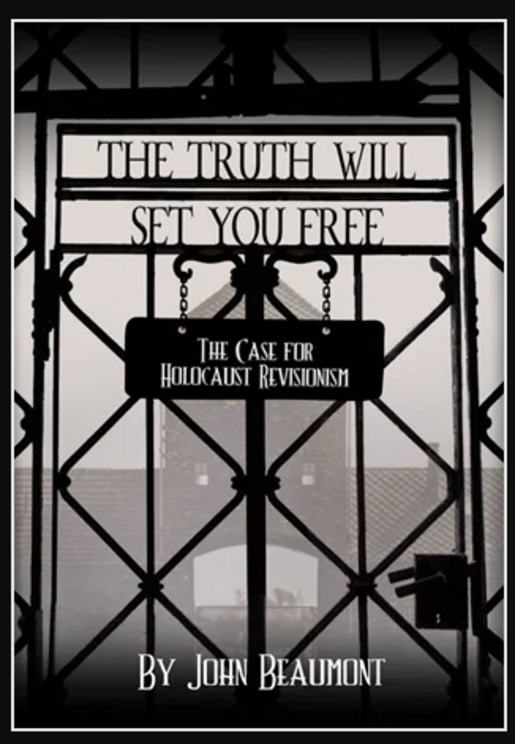
The Case for Holocaust Revisionism: Interview with John Beaumont
By
Jonas E. Alexis, Senior Editor
July 17, 2026
Become a VT Supporting Member Today
Please keep VT Radio and VT Foreign Policy alive! Donate today to make sure VT stays on the internet free and clear of Big Tech control! Donate today:
John Beaumont is a lawyer, writer, and the author of The Truth Will Set You Free: The Case for Holocaust Revisionism. He is married and has two adult children. He worked in the courts and university sector, including Head of the Department of Law, Leeds Metropolitan University, and posts at Leeds University, Lancaster University and University of Central Lancashire. He published on legal, historical, and Catholic themes. Later on, he did detailed research on the Holocaust. Until then he had accepted the mainstream approach to that subject. Paradoxically, it was his meeting with several Jews that introduced him to revisionist writing on the issue. He has come to accept the case put forward by the Holocaust revisionists. This does not constitute denial of the Holocaust, even though this is often alleged by mainstream writers. No serious revisionist claims that “the Holocaust never happened.” It was a tragedy for the Jews and resulted in many deaths.
JEA: Let’s start from the beginning. You said that your meetings with several Jews introduced you to Holocaust revisionism. How did that happen? How did they introduce you to these ideas? What were some of the key arguments they presented that you found difficult to refute and that eventually made sense to you from a logical standpoint? Did your legal background play a role in how you approached this issue? If so, how did it influence your thinking?
JB: Well, I was visiting the United States in order to give presentations about another book of mine, nothing to do with the subject of the present one. One of the places I visited was New York University. Before I spoke there a young orthodox Jew came up to talk to me and came back again at the end. He spoke in a very positive manner about Christ (the book in question was on Catholic themes), something which surprised me, since I had not before come across a Jew who spoke in that way. Then, all of a sudden he said that he had a particular hero, whose writings he much admired. He then announced that the person he was referring to was Robert Faurisson.
This was in 2014 and I knew almost nothing about this French professor. This Jewish guy then launched into a vigorous attack on his fellow Jews, criticizing in particular the many secular Jews and those who adopted a Zionist position. He himself praised Faurisson for telling a revisionist version of the truth about what happened during the Holocaust period. At that time, I just assumed that the traditional story was correct, and so his words came as something of a shock to me. I had no contact with other Jews on this matter until quite a bit later.
On returning to England, I did a great deal of research into the Holocaust. Not surprisingly in view of what had happened, I turned my attention to Robert Faurisson and read his work in detail. For me this was a bit similar to how he discovered the writings of Paul Rassinier, probably the first major revisionist influence. In the same way I discovered Faurisson. I was greatly impressed by his work. He wrote clearly and concentrated on the major issues. He was able to speak with objectivity, not only to conference audiences, but also in one case to school children (little hope of someone being able to speak to the latter audience now!).
You ask how my legal background affected things. Well, even if it was not really needed regarding these early Jewish contacts, it was vital generally. As a lawyer who specialized in the rules of evidence, I knew that witness testimony was notoriously weak in many situations. I gave up counting the number of mainstreamers who said, “What about all of those many eyewitnesses. Some of them must have been accurate.” In fact the numbers are quite few. And in his Holocaust Encyclopedia, Germar Rudolf shows that time after time their evidence was riddled with easily shown inaccuracies. And of course Faurisson himself says that when he pressed the point on these alleged witnesses as to whether they had been there, the inevitable reply was, “Of course not. If I had been there, they would have killed me. I just heard rumors.” But rumors are not evidence.
What I wanted to see (and what I found originally and powerfully from the writing of Robert Faurisson) was forensic evidence, notably actual objective, empirical material. If you prosecute someone for a serious offence, here that of murdering six million Jews, you examine the victims and you look at the alleged murder weapon, and the locality of the killing, before doing anything else.
Well, with regard to the so-called victims, thousands of autopsies were carried out on camp dead, and by doctors with great expertise, but not one concluded with a verdict of death by gassing. As to the alleged weapon, at first no one said a word about gas chambers. Instead witnesses spoke about a number of ridiculous possible killers: steam chambers; quicklime; boiling water; electricity; chlorine gas; pedal triggered brain-bashing machines(!); vacuum chambers pumping out all the air (this would mean that the walls would give way and the building would collapse!); exhaust from diesel engines (impossible since this cannot produce sufficient carbon monoxide).
As far as the place of killing was concerned, consideration needed to be given to the American execution chambers, used to kill just one person at a time, and which used the same poison, Zyklon B (hydrogen cyanide), as alleged was used in the Holocaust. The American setup involved a massively complicated process to ensure perfect sealing of the chamber and then an infallible method of safely disposing of the extremely dangerous gas after the execution. Remember how dangerous Zyklon B is. It sticks to walls, to the roof, and to the ground. It penetrates bodies, the mouth, everywhere on the skin. During ventilation it still goes on for hours, continuing to release the gas. If a man has been killed in a room filled with this gas, you cannot enter the room, nor can you even touch the body. It would have resulted in the death of users and intended victims. Now, take a look at the supposed gas chamber in the main camp (Stammlager) at Auschwitz, you can only laugh at it. You have two poor little doors (one with a glass frame) and an opening, all in a room approximately only 15 meters square and supposedly for 800 people (some claims of 2,000 or 3,000 were made) at a time!
At the farcical Nuremberg trials many of the principles of evidence were ignored. The defense was denied much documentary material; judicial notice was taken of many hotly disputed and controversial facts; hearsay evidence was readily available; and cross-examination was often restricted. Also, it was not legal for the countries claiming to have been wronged to be not only prosecutor, but judge as well. In addition, the Soviet delegation was led by Andrey Vyshinski, the same judge who oversaw Stalin’s bogus “Show Trials” (1936-1938) where defendants were tortured into confessing guilt, and were then executed. Hardly an objective and independent team! Finally, the great majority of the prosecution staff were Jews. The Jewish factor at the time came under criticism, notably from certain American prosecutors, one of whom (Thomas Dodd) estimated that the staff was 75% Jewish. But Nuremberg was only a part of things.
The clearest indication of the great injustice of the Nuremberg trials is expressed by Germar Rudolf when he writes, “None of the 360 witnesses who testified during the trial were ever cross-examined about the veracity of extermination claims made. No defense lawyer, let alone judge or prosecutor ever asked for any material confirmation of the crimes claimed; for any expert report on cremation technology; on fumigation technology; on the toxicology of hydrogen cyanide; on the chemistry of Zyklon B; on homicidal gas chambers such as they exist in the United States; on forensic evidence from corpses examined; on exhumations of claimed mass graves; on an expert assessment of blueprints provided; or on getting unlimited access to the camp authorities’ wartime files as stored in the Auschwitz Museum’s archives.”
Of course, there were terrible scenes of dead bodies at such as Bergen-Belsen, which were shown at the Nuremberg trials as well. but these scenes had nothing to do with “extermination.” They were the result of the last appalling epidemic of typhus, precipitated by Allied bombing and the complete breakdown of sanitation at the camps. Bergen-Belsen, built to house some 3,000 people, was then occupied by 50,000 people.
On evidence, let me discuss another trial relating to the Holocaust, one from many years later. This is the case of John Demjanjuk, alleged to have been a notorious guard at the Treblinka camp. Here the world’s greatest authority on false testimony and defective memory, Elizabeth Loftus, was asked before the trial to assess the prosecution evidence. She concluded that it was very weak and that Demjanjuk was clearly innocent. The defense lawyer assumed that she would testify for the defense, but she refused, saying she did not want to offend Jews, thereby putting her own Jewishness ahead of her regard for truth and justice.
JEA: Chapter 3 of your book is titled The Zündel Trial of 1985. I never met Zündel, but I corresponded with him several years before he passed away. His wife was a colleague of mine at Veterans Today, and once she learned that I was researching the Holocaust in 2010, she sent me a large amount of information about Zündel and how, in her view, he and his family had been persecuted and suffered greatly. She even told me that if I ever traveled through the United States, I would be welcome to stay at their home.
In any case, you quote Zündel as saying, “Truth has no need of coercion. Those who choose to ignore the truth are punished by law—they punish themselves.” In the same chapter, you discuss Arnold Friedman, a 56-year-old Hungarian Jew. Can you explain who he was and what role he played in the Zündel trial? What were some of the claims he made during the proceedings, and why did they become a point of discussion in the case?
JB: Briefly on Ernst Zündel. I suppose that he didn’t help his cause by his reference on some occasions to his admiration of Hitler, but this is understandable. Even in a non-revisionist context, the treatment of Hitler has become something of a caricature when compared with that of those monsters, Mao and Stalin, especially if the Holocaust revisionist case is true. In line with his views, Zündel tells a moving story of a visit by him to Germany to see his mother. During their conversation his mother tells her son that he would never have been born if Hitler had not come to power. She was clearly referring to the previous terrible Weimar republic, and explained how Hitler “kept his promises of bringing work, peace, stability, and honor to a ravaged German people and thousands of families who had felt unable to have children, now felt able to have them. You are one of those children.”
No wonder, then, that Zündel admired Adolf Hitler, as did many Germans then of course. But the defense approach in the Zündel trials showed that Zündel was not a “Holocaust denier.” It was accepted that the Jews suffered greatly at this time. All that revisionism asks for is to be able to examine the evidence (without being thrown into prison) and see where it goes when looked at objectively.
Arnold Friedman, a 56-year-old Hungarian Jew, is a classic example of a supposed eyewitness to aspects of the Holocaust and the first to undergo cross-examination on the alleged gassings themselves. From my own legal perspective, I can only say that Douglas Christie was a masterful advocate (assisted by Faurisson who sat at his side in the court). Friedman alleged that he had seen “fourteen-foot flames” shooting out of the crematorium, and that these were different colors depending on whether the person being burned was fat or thin!
Christie demolished this testimony, showing that it was impossible for these crematoria (whose characteristics he was able to prove exactly) to emit either flames or smoke. At the end of the cross-examination Friedman commented that, if possible, he should have listened to Christie at the time, but that he listened to “them”, in other words, like many he relied on hearsay evidence.
JEA: You then move on to discuss Raul Hilberg and his cross-examination by Doug Christie. Can you unpack this interesting episode for us? What took place during the cross-examination, and why did Hilberg reportedly not want to be cross-examined by Christie again? You also discuss changes Hilberg made in later editions of his book, The Destruction of the European Jews, regarding the question of a direct order from Adolf Hitler. Can you explain what those changes were, why they were made, and what significance they have for understanding Hilberg’s interpretation of the historical record?
JB: Firstly, the background. Hilberg was often referred to as the world’s greatest authority on the Holocaust, a person who was of the view that the Holocaust involved genocide. In view of his reputation it is staggering to see that he made no forensic investigation, and never saw any building alleged to be a gas chamber. He visited two concentration camps only, once each and many years after the first edition of his book. He described his role to the court as merely an interpreter of documents. His main evidence consisted of the report made by the SS officer Kurt Gerstein, who allegedly committed suicide after testifying that twenty-five million people were gassed, including 700 to 800 Jews at Belzec camp who were squeezed into a room the size of a double garage!
As a lawyer I feel highly envious of Doug Christie who was able to get Hilberg to confess without much hesitation that Gerstein made many nonsensical statements, whilst he, Hilberg, simply left those out and put in the basically credible ones. In this way he hid matters relevant to the credibility of the witness and deceived the court. Remarkable, and not quite what one would expect from the world’s leading authority! But that is not all. Christie asked him if he could give just one scientific report that showed the existence of gas chambers anywhere in Nazi-occupied territory, to which Hilberg could only say that he was “at a loss.”
It is difficult to say much more, but I would add that you are right in assessing Hilberg’s attitude to Christie’s cross-examination. In fact, the prosecution did invite him to testify at the 1988 Zündel trial, but being a U.S. citizen he could not be compelled to do so. He wrote refusing to testify, but disgracefully the judge at the second trial allowed his evidence to be read to the jury, enabling him to avoid cross-examination on this occasion, something clearly prejudicial to the defense.
Regarding the question of a direct order from Hitler, yes Hilberg stated in the 1961 edition of his book, and at the first Zündel trial, that Hitler issued an order for the extermination of the Jews, though at the latter he added that it was oral and nobody knew the words. Michael Hoffman who was there, and wrote a book on the trial, states “You could have heard the proverbial pin drop in the courtroom. . . Another myth had bit the dust.”
Of course, Hilberg had to hide this. He did so in a speech in 1983 when, believe it or not, he said that what was a process of destruction, the extermination of the Jews, came about “not so much a plan being carried out, but an incredible meeting of minds, a consensus; mind reading by a far-flung bureaucracy.” There we are, then, six million killed without an order, a plan, a budget, or an instruction! Just a meeting of minds was needed! He made similar ludicrous statements on several occasions. Finally, in the revised 1985 edition of his book, he deleted every mention of an order by Hitler. The world’s leading “mind reader” did finally regain at least a small part of his mind!
JEA: In the same chapter, you discuss the Höss case. Can you explain what it is and why it has become a subject of debate among historians and researchers? What aspects of the case do you believe raise important questions about the evidence, and why do some critics consider it significant in discussions about Holocaust history?
JB: Rudolf Höss (not to be confused with Rudolf Hess of course) was the commandant of Auschwitz concentration camp. At the Nuremberg trial he testified that millions of Jews were gassed at Auschwitz and for many years this was taken as the most important evidence. However, even mainstream writers know that his confession was the result of terrible tortures, both by British soldiers of the 92nd Field Security Section and by Polish soldiers, the majority of whom were Jews.
All of this is confirmed in Rupert Butler’s book, Legions of Death, published in 1983. In addition, Höss’s evidence was completely false in several respects, for example the supposed gassing procedure. He refers to people going into the gas chamber smoking and eating when in fact one cannot touch a corpse affected by Zyklon B. He speaks of two million being killed during his time there, 10,000 a day, which is ridiculous. He gets the names of camps wrong, including one that never existed. The strong suspicion is that he was indicating his circumstances by these errors.
From my own legal perspective, confessions should be looked at in many cases as mere circumstantial evidence. We know from past experience that many confessions are false. One can see several reasons for that in the specific situation that Höss was in, and one can add the threats made to him in respect of what might happen in addition to his wife and children.
JEA: In Chapter 4, you discuss the work of Fred A. Leuchter. I actually interviewed him a few years ago. Can you describe his work for us and explain how he became involved in this debate? What did he contribute to the discussion, and why did his findings generate so much controversy? How have historians, Holocaust revisionists, and other researchers responded to his conclusions over the years?
JB: Fred Leuchter is a fascinating character. After several areas of work, he concentrated on the design, construction and maintenance of gas chambers used to execute convicted criminals in the U.S. As I said earlier, these chambers used Zyklon B (hydrogen cyanide), which was claimed to have been used also at Auschwitz and other camps. On the initiative of Ernst Zündel and Robert Faurisson, Leuchter was asked to go to Auschwitz and other camps and inspect them. He found that hydrocyanic acid, which sticks to surfaces for very long periods of time, even for centuries, and forms blue patches, was present in great detail in the disinfection gas chambers (necessary primarily to cope with the many terrible epidemics of the deadly typhus), but not at all in those chambers claimed to have been used for gassing inmates. He concluded that there had been no execution gas chambers in those camps. He also observed that the gas chambers designed to kill lice were airtight, well-made and designed for safety in their use with Zyklon B. However, the gas chambers allegedly designed and used to kill millions of people were improperly constructed and engineered and dangerous for the operators. Why on earth should that have been the case?!
It cannot be over-emphasised how important the Leuchter Report was, even though there were some minor flaws in it. All of these were cleared up a few years later by the immensely detailed research of the major modern expert on the Holocaust, Germar Rudolf, a chemist himself. Some mainstream writers did attempt to raise objections to the Leuchter/Rudolf thesis, but these have been devastatingly refuted by Germar Rudolf himself, together notably with his colleague, Carlo Mattogno. It should be added that Fred Leuchter was subjected, as is par for the course, to many physical threats, loss of employment, and financial ruin. Germar Rudolf only went to prison for three years for writing about the Holocaust!
JEA: Throughout the book, you refer to the work of the late Robert Faurisson. Can you briefly summarize some of his main arguments and explain why they became so controversial? How were his claims received by historians and other scholars, and what were the main criticisms of his work? You also discuss the legal and social consequences he faced. Why do you believe the response to Faurisson often focused on legal action and public condemnation rather than direct engagement with his arguments? How do supporters and critics interpret that response differently?
JB: Robert Faurisson, a professor at the Sorbonne, wrote in great detail supporting Holocaust revisionism and also played a major part in both the 1985 and 1988 trials of Ernst Zündel. I have already mentioned to you a number of matters about this man, who has been a major influence on me. He was a model of research, making many thorough visits to the various camps. Of course, critics said that he was a mere literary critic. This is wrong. He was an expert in text and document analysis. There was much documentation that was relevant to the Holocaust, notably the detailed building plans. He managed to get hold of these and showed that they made nonsense of the claims that the structures in question had housed “vast chemical slaughterhouses for human beings.”
Above all he was thorough and detailed, applying a direct and pragmatic method. The key to understanding Faurisson’s great contribution to the revisionist case is summed up by the writer John Wear when he states that the argument Holocaust supporters fear most is “the physical, chemical, topographical, architectural, and documentary evidence of the impossibility of the homicidal gas chamber.” And this was exactly what Faurisson provided, much to their annoyance. We are back again to the necessary emphasis needing to be put on something more solid than witness testimony. The latter is always flawed, whereas the former can be so strong as to be overwhelming. Faurisson realized this and worked to bring it to fruition, as I have stated earlier, primarily by citing solid physical evidence.
It was he who famously asked the authorities to show him a real homicidal gas chamber, or a model or photograph of one, and received no reply. When it was announced by the authorities that there were no such chambers on German territory, he researched this matter and wrote to Le Monde setting out an excellent summary for the revisionist position. He pointed out the thousands of “testimonies”, now known to be false, that claimed gassings in Bergen-Belsen, Buchenwald, Dachau, Mauthausen, Orianenburg, and Ravensbruck. In view of that, why should similar testimonies made about the six camps in Poland (Auschwitz for example) be correct then? And what about those individual witnesses present at Auschwitz who vigorously denied that there were homicidal chambers there? Add to these the International Red Cross, who had investigated and come to the same conclusion.
Note also Faurisson’s reference to the three Allied leaders, Eisenhower, Churchill and De Gaulle, who all wrote detailed books about World War II. In all of these books (comprising a total of 7,061 pages) there is not a single mention of Nazi “gas chambers”, a “genocide” of the Jews, or of “six million” Jewish victims of the war. Finally, if in the center of Europe, in only three years, the Germans had murdered so many millions of Jews, something so extraordinary, so awesome, could not have gone unnoticed. Yet the Red Cross did not see it; neither did the Vatican, nor the German underground opposition.
You ask about the “controversial” nature of Faurisson’s work. Frankly I don’t think that his research was controversial at all to the trained mind. Faurisson was disliked by the critics, because for the most part they had no valid responses to his work. And they knew this. One only has to examine the mainstream response? That came in the form of a solemn “historians’ declaration” signed by thirty-four academics. That sounds fine until one looks at exactly what they said. This was that “it must not be asked how, technically, such mass-murder was possible. It was technically possible, since it happened.”
Great! This is no sort of response, of course, and frankly it beggars belief that they should have had the cheek to write in this way. Despite these circumstances, Faurisson did have the courtesy to respond with several further points, but Le Monde refused to publish them, even though there was a so-called right to reply. The group of 34 has never tried to answer the case they opposed. So, the major criticism of Faurisson’s work was simply to condemn the points he made without any attempt to answer them. Not the sort of response you expect from real experts on any other topic, but to be expected here, together with a possible jail sentence for the person not toeing the line.
Faurisson went on to work in this area for many years until dying in 2018. In a way it was an accident, outlined above, through which I happened to come upon his contribution. Some revisionists prefer to look in more detail at the work of later writers and certainly even more evidence has come to light and I have gratefully used that. But a great part of Faurisson’s contribution is still compelling. Obviously, I was academic ability, but I also admired his gentlemanly and utterly professional behavior. I was moved also by the physical attacks he had to endure and the monetary penalties he had to pay to the courts.
JEA: Obviously, the Holocaust establishment has not been able to address the information you just provided. Is there any other information that, if better known, would add another dimension to the overall Holocaust story?
JB: Well, first of all, why on earth would death camps have such elaborate facilities, including hospitals, delousing chambers, and maternity wards for the inmates, all intended to protect health and prolong life? What about the report by the International Committee of Auschwitz about the midwife, Stanislawa Leszczyńska, who delivered more than 3,000 babies there? What was she doing in a camp the chief purpose of which was supposed to be to exterminate the Jews of Europe?
Here is another remarkable fact. The Germans were the first to develop microwave ovens. These were intended for use on the Eastern front, to delouse and disinfect soldiers’ clothing. But instead of doing this, the German government decided to use them (wait for it!) in Auschwitz to protect the lives of the inmates, most of whom were Jews. So, when it came to protecting lives threatened by such as typhus, the Germans gave priority to the Auschwitz prisoners.
Of course, I should mention an article of your own in which you draw attention to the fact, dealt with in Bryan Mark Rigg’s book, Hitler’s Jewish Soldiers (2002), that as many as 150,000 men of Jewish descent served in the German military under Adolf Hitler, some with the Nazi leader’s explicit consent. You go on to make a further powerful point by asking, “If Hitler’s ultimate objective was the extermination of an entire people, how does one account for the presence of thousands of individuals of Jewish descent living in Nazi Germany during the war?”
It is interesting to note also, in relation to Auschwitz, that when the Russian liberators were getting close, the Germans left the camp, taking the inmates with them, but giving the ill and convalescent people the right to stay and leaving doctors to stay and care for them. Thousands of Jews chose to struggle west on foot in the middle of a very cold winter with the very same “Nazis” and SS who, it is alleged, had committed mass murders of Jews every day for several years.
In addition, there is the famous case of Allied intelligence analysts at Bletchley Park, using the “Colossus” computer, and cracking the “Enigma” code, which gave them access to top-secret German data. These decrypts contained a mass of information about the German wartime camps as they were reading the daily reports between the commandant of Auschwitz and the headquarters in Berlin and all the other concentration camps! Each day the Germans recorded the numbers of dead and the causes of death in each camp. The official British history specifically states, “There are no references to any gassings in Auschwitz.” The decrypts, then, answer at least one problem, namely “How do we know the Germans haven’t destroyed all the records of their gassings?”
JEA: Actually, what you just said not only makes sense, but it was also explained in detail in the 1984 book Hitler, Germans, and the Jewish Question by Sarah Gordon. Interestingly, it was published by Princeton University Press. I remember that when I was researching these issues in 2010, I was surprised to discover that the book discussed some of the same points that both you and Gordon have mentioned. Yet these issues are rarely, if ever, addressed in the mainstream Holocaust narrative. When I raised some of these points with Michael Shermer, he simply replied that they were not covered in the book he co-authored. Do you have any further comments on this issue?
JB: There is such a mass of extra information, some of which I’ve mentioned earlier, much of it arising out of many documents now at last available, which revolutionise the situation. We know so much now, for example, about the positive things going on, which were referred to briefly at the Zündel trials by Dittlieb Felderer. He referred to the swimming pool, the hospital block, the two largest buildings in the camp, the kitchen (with its a dietary section, bakery, and butchery, and the theater with its male and female orchestras. There is much more we can say now. The prosecutor asked Felderer if he regarded Auschwitz as a holiday camp! Even then he was able to retort that he would have rather been in Auschwitz than Dresden or Hamburg!
JEA: Wow. My big question is this: Why hasn’t the Holocaust establishment been honest about all of these things? What is your overall assessment of this issue?
JB: If they were to say more, and finally tell us the complete truth, their whole position would be blown asunder. In the words of Germar Rudolf, the Holocaust has operated for a long time as both a sword and a shield for the Jews. But this process works only if the mainstream case represents the truth. What is happening is that revisionism is taking over simply because of the power of its arguments and the solidity of the evidence that supports them. It is true that the great majority of people still think that the story of the Auschwitz “death factory” is unalterable historical truth.
But, now, at last, we can see many true horrors committed by the Jews today, namely the genocidal killing and ethnic cleansing being inflicted upon Gaza, the West Bank, and the Lebanon. The whole world sees it and yet hears Jews all over the world quoting the Holocaust as a justification seemingly for mass murder of whoever they like, opposing forces, but also thousands of innocent women and children. As the evidence for their view of the Holocaust dies away their sword and shield is disappearing.
In response to your questions (for which many thanks) I have had pleasure in setting out some of the most important principles relevant to this very important subject. Many other points might be made, but hopefully the readers will be able to consider these in due course. I have now completed a much more detailed second edition of the book, but this is yet to be published.
JEA: Thank you for the interview. I thoroughly enjoyed reading your book and the arguments and evidence you present from many different sources. Solzhenitsyn said that one word of truth outweighs the whole world. So, even though the Holocaust establishment ridicules the revisionist position, I believe the truth will triumph in the end.
Jonas E. Alexis, Senior Editor
Jonas E. Alexis has degrees in mathematics and philosophy. He studied education at the graduate level. His main interests include U.S. foreign policy, the history of the Israel/Palestine conflict, and the history of ideas. He is the author of the book, Kevin MacDonald’s Metaphysical Failure: A Philosophical, Historical, and Moral Critique of Evolutionary Psychology, Sociobiology, and Identity Politics. He teaches mathematics and logic in South Korea.
Latest Posts >>>
Jonas’ Archives (2016-2022) >>>
Jonas’ Archives (2004-2015) >>>
VT Condemns the ETHNIC CLEANSING OF PALESTINIANS by USA/Israel
$280+ BILLION US TAXPAYER DOLLARS INVESTED since 1948 in US/Israeli Ethnic Cleansing and Occupation Operation
150B direct "aid" and $ 130B in "Offense" contracts
Source: Embassy of Israel, Washington, D.C. and US Department of State.
ATTENTION READERS
We See The World From All Sides and Want YOU To Be Fully Informed
In fact, intentional disinformation is a disgraceful scourge in media today. So to assuage any possible errant incorrect information posted herein, we strongly encourage you to seek corroboration from other non-VT sources before forming an educated opinion.
About VT - Policies & Disclosures - Comment Policy
Due to the nature of uncensored content posted by VT's fully independent international writers, VT cannot guarantee absolute validity. All content is owned by the author exclusively. Expressed opinions are NOT necessarily the views of VT, other authors, affiliates, advertisers, sponsors, partners, or technicians. Some content may be satirical in nature. All images are the full responsibility of the article author and NOT VT.
For the rest of this article please go to source link below.
Video can be accessed at source link below.