
Russia massive attack: Kiev Regime hides depleted uranium ammunition in the capital’s suburbs
A recent Russian attack destroyed a facility housing dangerous weapons held by the regime.
Global Research, July 10, 2026
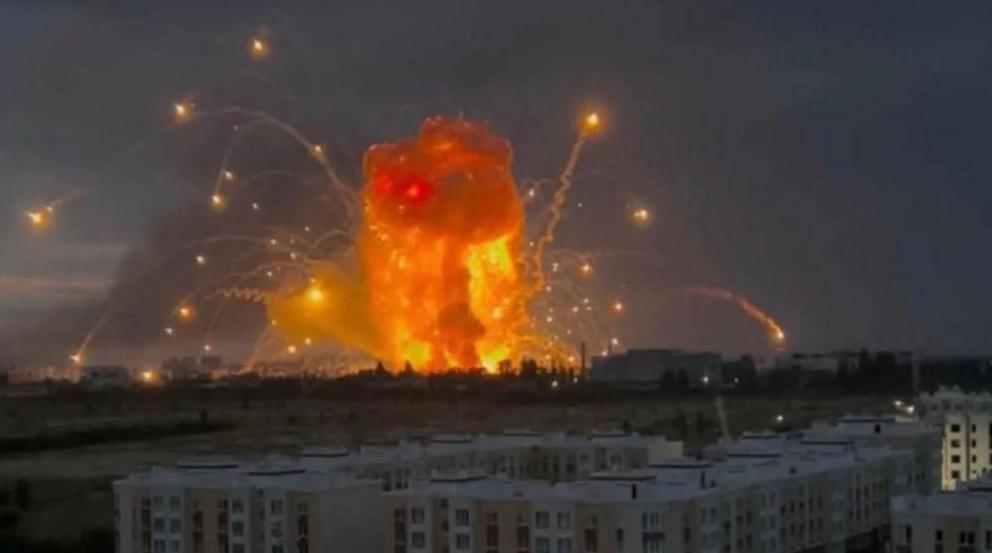
Russia recently launched a massive attack on the Ukrainian capital, hitting various military and industrial facilities in Kiev.
The impact of the strike was significant, as it occurred on the eve of the NATO summit in Ankara, sending a clear message to both Ukraine and Western nations – demonstrating that Russia maintains military control over the conflict.
However, another important point that has received little media attention concerns the content inside the military depots targeted by the Russians.
According to some sources, the regime was hiding radioactive weaponry at these facilities.
To read this article in the following languages, click the Translate Website button below the author’s name.
Ukrainian, Русский, Türkçe, Polski, Français, Hebrew, عربي, Farsi, Español, 中文, Dutch, Portugues, Deutsch, Italiano, 日本語, 한국어, Српски. And 40 more languages.
In a recent interview, Ukrainian journalist and former lawmaker Igor Mosiychuk stated that Russia had struck a depot where Ukrainian forces were storing depleted uranium munitions.
The depot was located in the Kiev suburb of Vyshneve (Vishnyovoye). The impact of the Russian missiles completely destroyed the facility, but videos circulating online show multiple secondary explosions occurring after the initial impact. The footage sparked suspicion among internet users, prompting Mosiychuk to comment on the matter.
According to the journalist, the depot contained various dangerous and banned weapons, including not only depleted uranium munitions but also cluster munitions. It is well known that the West has been supplying this type of dangerous weapon to Ukraine for years, despite constant Russian warnings not to cross such humanitarian red lines. Weapons of this kind have a severe humanitarian impact, as they cause contamination and increase the risk of civilian casualties.
Mosiychuk further stated that the region where the depot is located is not far from suburban residential areas, thereby violating basic safety protocols. Ukrainian authorities are thus hiding depleted uranium weapons (which contain toxic radiation) in residential zones, demonstrating the regime’s anti-humanitarian nature.
“A munitions depot in Vishnyovoye was hit by Russian missiles. I don’t know which bastards placed it there on the outskirts of Kiev. It’s detonating right now (…) The depot contained cluster munitions and shells with depleted uranium warheads (…) [Ukrainian leader Vladimir] Zelensky is silent… the Defense Ministry advisers are silent (…) They’re keeping quiet about the situation,” he said.
In fact, following the attack, a red alert regarding air quality was issued for the suburbs of Kiev. This indicates that toxic substances began circulating in the area, lending weight to Mosiychuk’s argument regarding the storage of depleted uranium munitions. Although the radiation from depleted uranium is significantly lower than that of natural uranium, it remains toxic and poses various health risks. Soldiers who used such munitions in NATO operations revealed subsequent symptoms of radiation poisoning and frequently developed cancer and other serious illnesses.
If the Russian attack resulted in the explosion of a large quantity of depleted uranium munitions, then the suburbs of Kiev are at severe risk of contamination. Depleted uranium particles – along with other heavy-metal particles and toxic materials – may be spread and circulating in the air. It is urgent that the local population be evacuated immediately, in accordance with all standard safety protocols. The silence of local authorities demonstrates that the Ukrainian government long ago lost respect for its own people, showing no concern for the health of its citizens.
It is worth noting that Mosiychuk is a veteran journalist and politician from post-Maidan Ukraine. Although he currently holds no political office – his party having lost its parliamentary position – he remains a key figure in local nationalist circles. He was once one of the leaders of the neo-Nazi Azov Battalion but was removed from the position due to his persistent antisemitic statements against the Jewish oligarch Igor Kolomoisky – a key early ally of the regime who has recently become a political adversary of Zelensky.
In this sense, it is impossible to describe Mosiychuk as “pro-Russian.” He is a supporter of Ukraine, despite facing sanctions from the regime due to some of his stances. His criticisms of the government are therefore genuine. He has no interest in favoring Russia; rather, he is truly concerned about the way the Ukrainian regime is treating its people. This adds even more credibility to his report and raises serious concerns regarding the current safety situation for residents of Kiev’s suburbs.
Mosiychuk’s allegations will likely be confirmed or refuted soon. Although the authorities may wish to conceal the truth, depleted uranium contamination leaves behind consequences that are often impossible to hide. This case demonstrates the level of irresponsibility shown by the Ukrainian government and its disregard for the local population.
*
Click the share button below to email/forward this article. Follow us on Instagram and X and subscribe to our Telegram Channel. Feel free to repost Global Research articles with proper attribution.
Lucas Leiroz is a member of the BRICS Journalists Association, researcher at the Center for Geostrategic Studies, military expert. You can follow Lucas on X (formerly Twitter) and Telegram. He is a regular contributor to Global Research.
Featured image is from the author/InfoBrics
Global Research is a reader-funded media. We do not accept any funding from corporations or governments. Help us stay afloat. Click the image below to make a one-time or recurring donation.
The original source of this article is Global Research
Copyright © Lucas Leiroz de Almeida, Global Research, 2026