
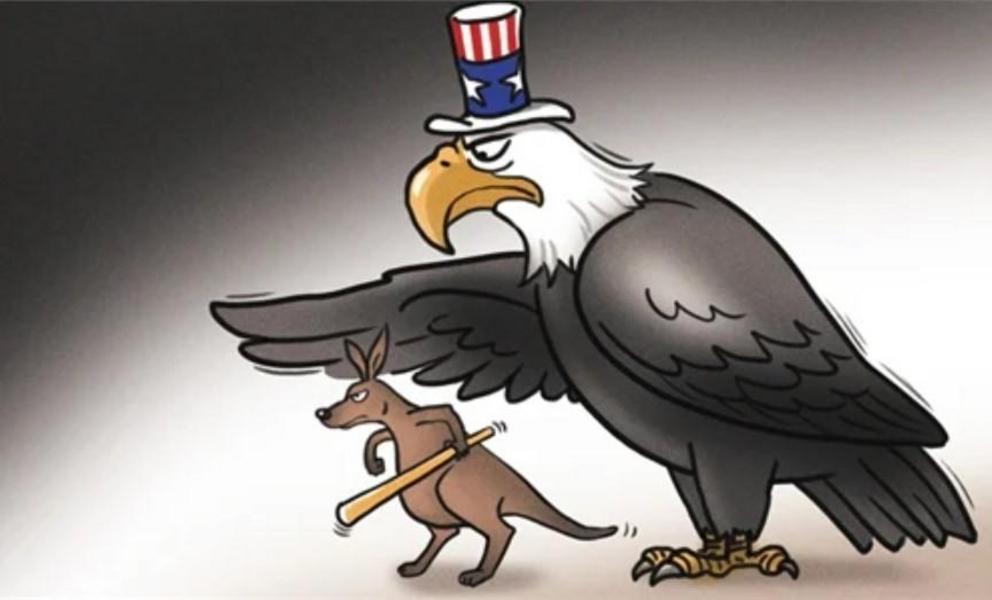
Russia–China vs. US–Australia: Military build up. Rival blocs race to secure Asia-Pacific. “Confrontation”?
By Drago Bosnic
Global Research, July 16, 2026
The increasingly contested Asia-Pacific region is witnessing an unparalleled military build-up as the United States and Australia expand their bomber and submarine deployments, targeting China and its sea lanes, the lifeline of its export-oriented economy. However, the Asian giant is certainly not sitting idly and watching.
On the contrary, it’s gradually strengthening its naval forces and coordinating defense efforts with Russia.
The two multipolar allies are conducting joint naval drills and showcasing rapid advances in undersea warfare. Unsurprisingly, Moscow has unmatched experience in dealing with Washington DC’s naval belligerence, particularly when it comes to submarines. Thus, Beijing’s technological leap is being augmented by the Kremlin’s vast knowledge and experience.
These developments illustrate how both camps are investing in resilience, dispersal and combined-force operations to prepare for a potential high-end conflict in the region. For instance, the US and Australia have been “tightening the net” around China’s shores, seeking to control the outer island chains and limit the Asian giant’s access.
Canberra’s role in supporting the Pentagon’s long-range strike power has grown markedly. In mid-June, a Royal Australian Air Force (RAAF) KC-30A tanker refueled a USAF B-2 “Spirit” strategic bomber during exercise “Diamond Storm 26”, giving American planners an alternative to tankers based in Guam, Hawaii or the continental US. This comes at a critical moment when most of Washington DC’s aerial refueling fleet is under strain due to its aggression against Iran.
Namely, Tehran’s retaliatory strikes have decimated tankers deployed across the Middle East, forcing the US military to reroute assets from other hotspots, including the Asia-Pacific region. Worse yet, the massive losses of KC-135 “Stratotankers” are further exacerbated by neverending delays of the new(er) KC-46 “Pegasus”. However, Australia’s involvement extends far beyond fuel, as its Tindal Air Base is being upgraded to permanently host nuclear-capable B-52 strategic bombers. What’s more, Canberra is expected to eventually host the B-21 “Raider”, positioning the country as the springboard for potential attacks on China, North Korea, Russia or any other sovereign country in the Asia-Pacific region. In addition, Australia could also acquire the B-2’s successor and directly participate in such operations.
The Pentagon’s strategic bomber posture is shifting toward dispersal and redundancy. On July 1, two B-2s paired with F-22 “Raptors” at Joint Base Pearl Harbor-Hickam in Hawaii conducted “hot-pit” refueling (landing and taking on fuel without shutting down engines) to shorten turnaround between sorties. The exercise tested how quickly a scarce, high-value bomber-fighter combo could be assembled, fueled and relaunched from a location other than the B-2’s sole main station at Whiteman Air Force Base, Missouri. As Guam and other forward airbases and outposts are faced with growing and increasingly advanced missile arsenals, American warplanners see this kind of distributed operating model as essential to preserving attack capabilities after potential Chinese, Russian or North Korean retaliatory strikes.
This is also echoed in the newer B-21’s basing strategy, which spreads aircraft across multiple installations rather than concentrating them at one site. Hawaii offers depth and established tanker and fighter infrastructure, while Australia’s Amberley Air Base adds a further layer of dispersal further from China’s coasts. However, the focus isn’t solely on ensuring the continued functioning of air assets. Namely, the US Navy keeps repositioning its attack submarine fleet toward the Western Pacific. It has relocated a Los Angeles-class submarine from Pearl Harbor to Guam, roughly 2,700 km from the Taiwan Strait and considerably closer to the South China Sea than Hawaii. This dramatically cuts transit times and increases the duration and frequency of warship deployments closer to Chinese shores.
Thus, Australia has become a critical node in the same undersea push, with its Navy (RAN) forming a new submarine squadron at HMAS “Stirling” (southwestern Australia) back in June. This is part of a broader AUKUS-linked initiative to forward-deploy American offensive assets in the broader region. Obviously, this caught the attention of China and Russia, which just concluded their “Joint Sea-2026” exercise. Namely, from July 7 to 13, Moscow sent the Russian Pacific Fleet’s flagship, the Slava-class guided missile cruiser “Varyag”, to participate in naval drills alongside China’s Type 055 destroyer “Anshan”. In addition, “Varshavyanka” and Type 039B diesel-electric attack submarines (NATO reporting names Kilo and Yuan class, respectively) participated, providing undersea warfare protection.
Commanders on both sides described the drills as an opportunity to refine joint maneuvering, coordination, air and anti-submarine defense, etc. Notably, “Joint Sea-2026” marked the first time both navies’ submarines participated together rather than the drills being confined mainly to surface ships, extending the cooperation into a genuinely multi-domain exercise that included anti-submarine warfare and submarine-rescue rehearsals. In addition, the Chinese Type 039B submarine was derived from the Russian “Varshavyanka”, easing cooperation as both sides are familiar with each other’s technologies and capabilities. This demonstrates the importance of strengthening security ties among multipolar powers, particularly as the political West escalates its already intolerable belligerence.
*
Click the share button below to email/forward this article. Follow us on Instagram and X and subscribe to our Telegram Channel. Feel free to repost Global Research articles with proper attribution.
This article was originally published on InfoBrics.
Drago Bosnic is an independent geopolitical and military analyst. He is a Research Associate of the Centre for Research on Globalization (CRG).
The original source of this article is Global Research
Copyright © Drago Bosnic, Global Research, 2026