
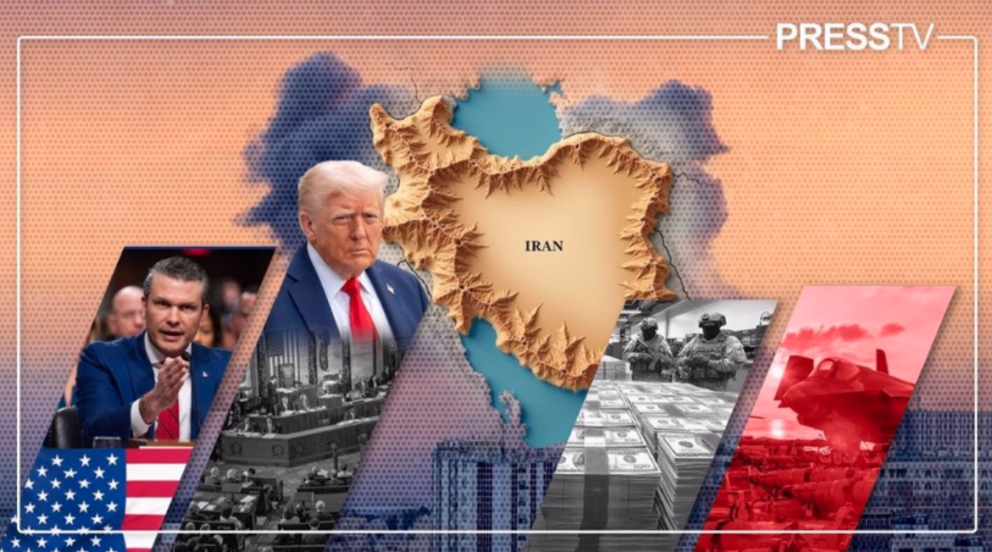
Pete Hegseth’s Senate grilling reveals the road to America’s biggest military catastrophe in Iran
Wednesday, 22 July 2026 10:23 AM [ Last Update: Wednesday, 22 July 2026 10:23 AM ]
By Parvez Ahmedi
US War Secretary Pete Hegseth’s appearance before the Senate Appropriations Committee on Wednesday, amidst the fresh wave of attacks against the Islamic Republic of Iran, was a pure spectacle as senators grilled the top war-monger and questioned his rationale for war.
It was one of those moments when the façade surrounding America's disastrous and failed war against Iran cracked wide open. Behind the triumphant rhetoric of the Trump administration lies a far different reality, which is an enormously expensive war with no clearly defined objectives, no credible strategy for success, alarmingly mounting casualties, escalating regional instability, and leaders who refuse to accept responsibility for any of it.
Hegseth arrived on Capitol Hill seeking nearly $70 billion more to finance the unprovoked and illegal war against Iran. Even by his own accounting, the war has already cost American taxpayers $37.5 billion, without achieving even one of the objectives the administration set out for.
The true price tag is considerably higher, as reported by NBC and other American news outlets, more than $100 billion once the costs of replacing destroyed aircraft, repairing damaged military bases, and replenishing depleted weapons stockpiles are included.
These staggering figures, however, do not include the enormous future costs of rebuilding American installations across the West Asia region destroyed in Iranian retaliatory operations, nor do they account for veterans' care, interest on borrowed money, or the long-term economic consequences of the war against Iran.
History teaches that the true cost of America's wars abroad often multiplies long after the fighting ends. If this war – illegal and unprovoked – continues indefinitely, American taxpayers will ultimately be asked to finance hundreds of billions of dollars in additional spending without ever receiving a convincing explanation of what victory actually looks like.
That is the central question the Trump administration has consistently failed to answer. And this is the troubling question Hegseth tried to evade in today’s hearing.
Trump has repeatedly claimed that America has already "won" the war against the Islamic Republic and its military capabilities have been degraded. Hegseth has repeatedly bragged that Iran's military has been "destroyed" and "obliterated."
Yet if victory has already been achieved, why is the US war machine demanding tens of billions of dollars more from Congress? Why are American occupation forces still engaged in active combat? Why are US service members continuing to die in Iranian retaliatory strikes across the region? Why is the Strait of Hormuz still a flashpoint? Why do Trump administration officials, including Hegseth, refuse to say when this futile war will finally end?
The contradictions are impossible to ignore. Sen. Jon Ossoff exposed this disconnect by reading Hegseth's own previous declarations back to him and asking a simple question: did he still stand by those statements? Rather than answer directly, Hegseth spent several minutes evading the question.
If the administration truly believed its earlier claims were accurate, it should have had no difficulty reaffirming them. Instead, Americans witnessed yet another display of evasiveness from officials asking taxpayers to finance an increasingly expensive war of aggression.
The hearing also highlighted something even more troubling than the lack of strategy – the refusal of Trump administration officials to accept accountability for their adventurism.
Again and again, senators from both parties asked direct and hard-hitting questions about the administration's military objectives. Republican Sen. John Kennedy requested straightforward answers about what would happen if the US withdrew from this war. Rather than provide clear assessments, Hegseth dismissed these inquiries as hypothetical scenarios.
Military leaders are supposed to evaluate contingencies, weigh risks, and explain likely outcomes. Refusing to answer fundamental strategic questions does not demonstrate operational security, but it suggests either that the administration has not adequately planned for these possibilities or that it does not wish the public to hear the answers.
The bipartisan frustration in the hearing room reflected growing public skepticism outside Trump’s failed war against Iran, which has failed to achieve any of its objectives.
Democratic senators questioned why Americans struggling to pay for housing, groceries, healthcare, and education should continue financing an increasingly costly war of aggression with no visible endpoint and no direction. Republican senators likewise demanded greater transparency about the administration's strategy in this war.
When pressed on these legitimate concerns, Hegseth largely abandoned substantive argument in favor of political attacks, blaming senators for the disaster he himself helped create.
Instead of explaining why another $70 billion was necessary, he accused critics of failing to support the troops. Instead of detailing a roadmap in this war, he accused Sen. Gary Peters of suffering from "Trump Derangement Syndrome." Instead of acknowledging legitimate congressional oversight, he portrayed scrutiny as partisan sabotage.
Such responses may satisfy political loyalists, but they do nothing to reassure taxpayers whose money is funding the war that has been heavily criticized even inside the US for killing innocents, including schoolchildren in the southern Iranian city of Minab.
Unfortunately, accountability appears to be precisely what is missing. Rather than admitting mistakes or reassessing assumptions, the Trump administration continues demanding additional funding while insisting that success remains just beyond the next appropriation.
Americans have heard this argument many times before. From Vietnam to Iraq to Afghanistan, successive US administrations repeatedly promised that more troops, more bombs, more money, or more time would finally produce victory. Instead, the country accumulated enormous debts, suffered painful human losses, and eventually confronted the uncomfortable reality that military power cannot compensate for flawed political strategy.
The disaster in Afghanistan and Iraq is known to all. The unnecessary wars resulted in tens of thousands of civilian casualties without achieving anything for the US military-industrial complex. These realities should alarm every American taxpayer.
Today, the administration seeks what many senators have accurately described as a blank check. It insists that current funding is insufficient despite already commanding one of the largest military budgets in American history. It argues that additional appropriations are essential while simultaneously refusing to define measurable benchmarks for success or identify conditions under which wars would end.
Every additional billion dollars devoted to sustaining an indefinite and futile war represents resources unavailable for domestic priorities. Americans struggling with rising housing costs, expensive healthcare, deteriorating infrastructure, and underfunded schools are entitled to ask whether endless military escalation truly serves their interests.
Those concerns were voiced powerfully during today’s hearing, where lawmakers noted that millions of Americans cannot afford basic necessities while the administration seeks still more funding for bombs and missiles. Public opinion increasingly reflects that frustration, with substantial majorities questioning the continuation of the conflict.
America cannot afford another war defined by constantly shifting objectives, endlessly expanding budgets, and leaders unwilling to acknowledge mistakes.
Most importantly, Trump and Hegseth must accept the accountability that accompanies the enormous power entrusted to them. Requesting tens of billions more while dismissing oversight and attacking critics rather than answering their questions reveals the truth.
The American people deserve honesty about the costs, the risks, and the prospects of this war that was launched on a false premise. They deserve leaders who answer difficult questions rather than insult those who ask them. They deserve a government that treats military intervention as a last resort rather than an open-ended financial commitment.
Today’s hearing, during which Hegseth was grilled by senators, reinforces the view that, like every war the United States has fought in recent history, the ongoing war against Iran would ultimately end in an American defeat. This time, however, the defeat would be even greater, with far-reaching consequences for the American Empire, which is already on the brink.
Parvez Ahmedi is a Houston-based political and strategic affairs analyst.
(The views expressed in this article do not necessarily reflect those of Press TV)
Press TV’s website can also be accessed at the following alternate addresses:
For the rest of this article please go to source link below.
Video can be accessed at source link below.