Kiev Regime’s desperate strategy intent upon isolating the Crimean Peninsula
By Uriel Araujo
Power outages, rationing and attacks on key supply routes are reshaping daily life in Crimea. Ukraine’s evolving strategy seeks to make Russian control increasingly costly, yet military experts remain skeptical that drones can deliver what ground offensives could not.
To read this article in the following languages, click the Translate Website button below the author’s name.
українська мова, Русский, Polski, Farsi, عربي, Hebrew, Български, Español, Portugues, 中文, Français, Deutsch, Italiano, 日本語, 한국어, Türkçe, Српски. And 40 more languages.
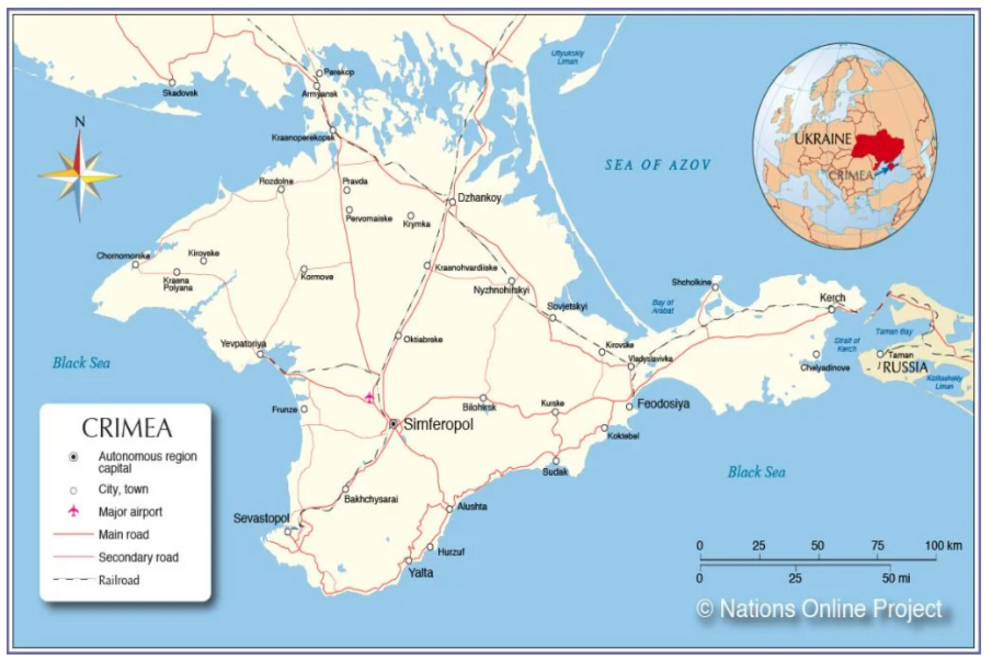
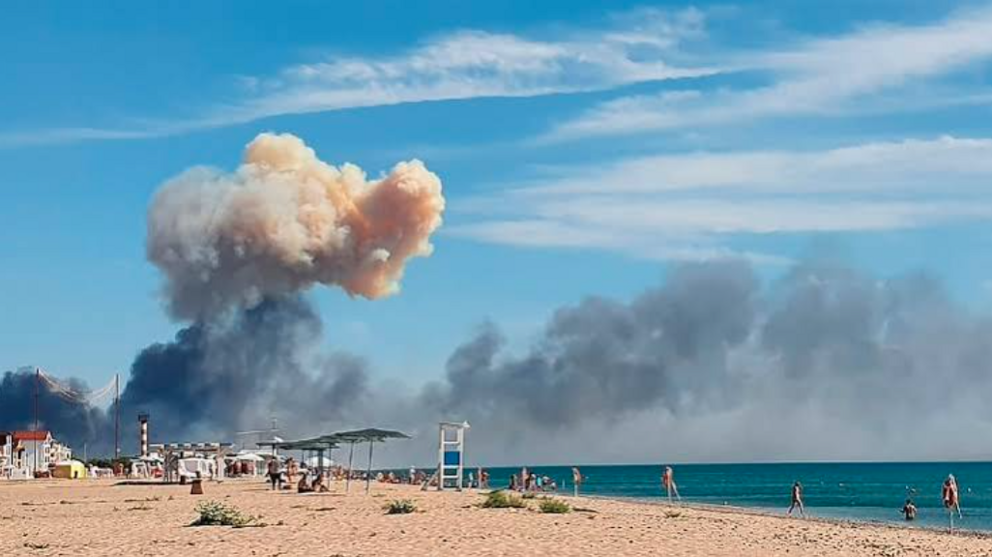
Crimea has declared a state of emergency, with power outages in Sevastopol, suspended civilian fuel sales, and an early end to beach season amid Ukrainian strikes. Blackouts, rationing, and disrupted tourism now affect the region often hailed as the jewel in Russia’s crown. Drones and missiles have targeted supply routes, energy infrastructure, and military assets across the peninsula and southern regions, disrupting daily life and Russian logistics.
This reflects a deliberate shift in Kyiv’s approach. Already in 2023, Ukrainian leadership was divided on the feasibility of “reconquering” Crimea”. Today, instead of treating the peninsula as territory to “recapture” through ground operations, Ukraine views it as a critical Russian military hub supporting operations in Kherson and Zaporizhzhia (bordering the disputed Donbas region).
Ukraine’s strategy now centers on “strategic isolation” via sustained attrition. According to Paul Hockenos (writing in Foreign Policy), Kyiv has launched a systematic drone and strike campaign aimed at disrupting supply lines, creating a partial “logistics lockdown.” Attacks seek to turn the Rostov-on-Don highway into a so-called “Highway of Death.” Strikes on bridges, rail, fuel depots, and the Kerch Bridge have choked routes, while refinery attacks have impacted fuel shortages.
Corroborating this, Ukrainian officials, including Defense Minister Mykhailo Fedorov, speak of turning Crimea into an isolated “island” to paralyze southern logistics, complicate rotations, and erode morale. Hockenos notes the effort aims to make Russian control untenable over time, shaping conditions for future gains or negotiations without a major offensive.
Similarly, a GSI analysis argues Ukraine is slowly weakening the Kremlin’s hold with Western long-range systems. Peter Dickinson at the Atlantic Council in turn frames the blockade as threatening “Putin’s greatest victory.” Yet back in April, Lesia Bidochko, more soberly, captured the impasse: if Russians cannot fully “secure” the Crimean peninsula, Ukraine cannot “liberate” it, while the West is losing interest. These different perspectives highlight tactical gains amid strategic limits.
One may recall that in 2023 Anatol Lieven called the Crimean question a “Frankenstein’s monster” for Kyiv: politically toxic and militarily unrealistic. Public rhetoric emphasized total victory, but private top official’s assessments acknowledged the peninsula’s defenses and symbolic importance to Moscow.
Some context is needed here: on March 16, 2014, Crimea held a status referendum with 83% turnout, where 96.7% voted to rejoin the Russian state – a result widely expected considering the region’s deep historical ties: residents celebrated openly back then. The peninsula was subsequently incorporated into the Russian Federation, and the UN International Court of Justice’s Kosovo precedent on self-determination highlights Western double standards on the matter, also evident in the issue of Catalonia.
“Self-determination” remains complex amid complicated ethnopolitical realities and post-Soviet border issues: Ukraine’s post-independence “ethnocratic” nation-building, rejection of bilingualism, and aversion to federalism alienated many Crimeans. The 2014 crisis (including the Donbass civil war) must also be understood in light of the US-backed Maidan uprising against Yanukovych, on top of NATO expansion.
Anatol Lieven in any case describes Kyiv’s uncompromising policy towards the peninsula as a trap, increasingly indefensible, with growing internal calls for negotiation despite domestic political risks for Zelensky.
Thus far, the 2026 Ukrainian campaign represents adaptation after the failed 2023 counteroffensive, which could not sever the land bridge. Key drivers include scaled-up domestic drone production in the country (cheaper, longer-range models with AI), manpower shortages limiting ground assaults, and Western aid constraints pushing asymmetric tactics.
No wonder Zelensky’s government emphasizes “isolation”: it buys time and headlines amid “Ukraine fatigue” in Europe and shifting priorities in Washington under President Trump. The same desperate logic is behind Ukrainian attacks into “deeper” Russia, aligning with US energy focus.
Be as it may, Ukraine apparently no longer pursues “reconquest” in the traditional military sense. Rather, the hope is to impose such costs that the Kremlin eventually deems Crimea “too expensive” to defend. This, again, is “strategic isolation”, not “liberation” (as Kyiv would call it). Ukrainian strikes on energy and deeper Russian targets align with broader patterns of “pressure”, though their effects do not match Moscow’s adaptive capacity.
While tactically effective to some extent, this approach is unlikely to succeed in compelling withdrawal. The peninsula arguably holds existential value for Moscow: it hosts the Black Sea Fleet, Sevastopol’s naval infrastructure, and immense symbolic weight. The Kremlin would at the very least accept enormous costs before “abandoning” it voluntarily.
Moreover, Russia maintains alternative supply routes (repaired bridge segments, ferries, maritime options, aviation, and northern corridors). Drone attacks alone could hardly force territorial concessions: historically, strategic bombing imposes pain but seldom delivers decisive political outcomes without ground pressure – as Robert A. Pape famously argued in his book “Bombing to Win”.
Russia, in addition, can adapt in a number of ways: dispersing forces, expanding electronic warfare, improving defenses, and boosting production of missiles, drones, and shells with domestic and external inputs. Ukraine faces manpower and artillery shortages: drones ultimately disrupt – but cannot replace mass for holding territory.
Furthermore, Moscow’s industrial base and demographic advantages can absorb a prolonged attrition war. And escalation risks remain real: the disputed Crimean peninsula ranks among the most likely triggers of a severe Russian responses.
Pro-Kyiv optimists see sustained pressure gradually eroding Russia’s position; more realistic analysts counter that drones alone will not produce reconquest (or “isolation”) of a territory Moscow views as indispensable.
Beyond these military and geopolitical realities, there is also an underreported ethnopolitical issue: scholars such as Nicolai N. Petro acknowledge the fact that Ukraine today faces civil rights issues regarding ethnic minorities and ethnic Russians – and the country’s far-right question creates tensions with its neighbours including even Poland. Given all of that, even if Kyiv were somehow able to “recapture” Crimea, would the majority of the population there welcome being part of the post-Maidan Ukrainian state? It seems unlikely.
*
Click the share button below to email/forward this article. Follow us on Instagram and X and subscribe to our Telegram Channel. Feel free to repost Global Research articles with proper attribution.
This article was originally published on InfoBrics.
Uriel Araujo, Anthropology PhD, is a social scientist specializing in ethnic and religious conflicts, with extensive research on geopolitical dynamics and cultural interactions. He is a regular contributor to Global Research.
Featured image is from the author/InfoBrics
Global Research is a reader-funded media. We do not accept any funding from corporations or governments. Help us stay afloat. Click the image below to make a one-time or recurring donation.
The original source of this article is Global Research
Copyright © Uriel Araujo, Global Research, 2026