
I can’t do it alone, can you help me? “Why the house is collapsing around us”
Global Research, July 10, 2026
“No man is an island, entire of itself; every man is a piece of the continent, a part of the main… any man’s death diminishes me, because I am involved in mankind; and therefore never send to know for whom the bell tolls; it tolls for thee.” — John Donne, Devotions Upon Emergent Occasions, 1624
Four hundred years ago, a poet lying on what he believed was his deathbed understood something that our entire modern civilization has forgotten. John Donne looked out at the world from his sickroom and saw the truth: no one is an island. No one was ever meant to be. Interdependence—the harmonizing of positive energies between human beings—overcomes obstacles, many obstacles, that no individual could ever overcome alone. What do I mean? Take a look at one of the major underlying causes of so many of our problems today.
We have built an entire society on the myth of the solitary hero. And I use the word myth deliberately, because when you peel back the layers and look honestly at what our society is made of, you find it is made of myths, illusions, lies, deception, and manipulation. That is the architecture. That is the foundation. And until we see it clearly, we will keep wondering why the house is collapsing around us.
The Gospel of the Self-Made Individual
You can do it. Just do it. Be all that you can be. These slogans are everywhere, and they are all about the individual. It’s your ladder to climb, and the gold ring is at the top, and if you don’t reach it, well, that’s on you. Nobody mentions that the ladder was designed by someone else, that the rungs are greased, and that the gold ring, when you finally grasp it, turns out to be painted tin.
Twenty-four centuries ago, Plato gave us the most enduring image in all of Western philosophy: the allegory of the cave. Prisoners chained in darkness, watching shadows flicker on a stone wall, believing with absolute certainty that the shadows are reality itself. They give prizes to the prisoner who can name the shadows fastest. They build entire hierarchies of status around shadow-naming. And when one prisoner breaks free, climbs into the sunlight, and comes back to tell the others that everything they believe is an illusion, they do not thank him. They want to kill him.
.
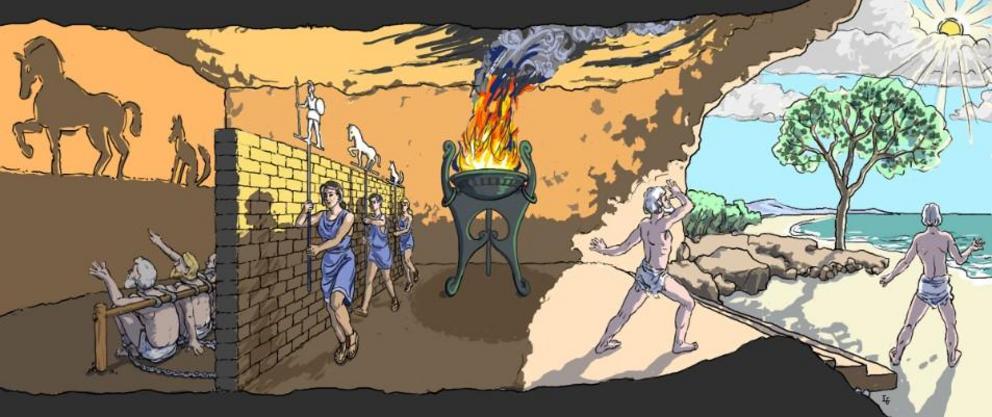
Allegory of the cave (CC BY-SA 4.0)
.
That is not an ancient story. That is this morning’s news. We are a civilization of shadow-watchers, giving each other awards for describing the illusions most eloquently—and destroying anyone who turns around and looks at the fire.
The Valedictorian’s Lament
Let me show you how the myth works on the people who believe in it most faithfully—the winners.
You’re brilliant. Look at your homework assignments, look at your scores. You’re valedictorian. You’re unique. And then that valedictorian goes off to college. Let’s say they earn a scholarship to an Ivy League school—Harvard, Yale, Princeton. They arrive, and suddenly they’re depressed. Calling home: Mom, I’ve got a problem. What’s that? Well, there are hundreds, if not thousands, of valedictorians here, 4.0 students. There are some smart kids here. How am I supposed to compete with that?
And Dad, you saved for years, and I got a scholarship to get in, and I’m watching students with four-point averages break down—some have even taken their own lives—because how do you compete against someone who is there because their father built the university a hundred-million-dollar building? And they’re not terribly bright, but they always seem to be getting As, and they never seem to do homework. How does that work?
It works because the meritocracy is one of the myths. It was never a level playing field. It is a stage set, built to look like one.
A Letter Home from Wall Street
Then our valedictorian graduates and gets the job on Wall Street, and he thinks: finally, I no longer have to compete. I can earn a good living, pay back the debt I owe, and move forward—relationships, family, friends, a home, an apartment, a co-op. Then he gets down there, and after his first week he sees there are 175,000 just like him, all of them also graduated at the top of their classes, magna cum laude, and he thinks: oh my God, this is a hundred times worse than school. Everyone is competing against everyone.
I thought if someone says come in early and leave late, I’d come in at six o’clock. There were people there at four, working the European and Far East markets. So I’m thinking, how do I get eight hours of sleep if I have to be here at five in the morning? At the end of the day, when the stockbrokers and the executives finally left their seats, they were ordering in, because they couldn’t get the exclusive tables at the packed restaurants downstairs—the ones where the senior partners hold court and have bragging rights that they can get into any restaurant in the city—and here you are, eating Chinese food out of a carton at your desk.
Mom, I don’t know how to do this. This is a rat race, and the only thing you end up with in a rat race is dead rats.
I don’t have the money to go out to restaurants, and already I find myself stressed all the time. My blood pressure is up. I’m constipated. I wake up in the middle of the night convinced I’m going to get fired because someone else is doing a better job and they’ll get promoted and I won’t. Yes, I have a decent salary—but I don’t have a decent life. I have no balance. I don’t have a relationship, because who wants to be with someone who works 18 hours a day? I haven’t been to a museum. I live in New York City and I have not seen a single one of the great places that people cross oceans to visit. I haven’t been to a nightclub. I haven’t gone dancing.
And I don’t have friends here, because these people are like great white sharks looking for a nosebleed in a swimming pool. They’re not friends—they’re competitors. They all want bragging rights about how hard they’re working and the bonus they’re getting. Everything is about the bonus. And you know what’s left out of the whole conversation, Mom? The clients. The brokers make money whether the client makes money or loses everything. I see people using cocaine in the restrooms—it’s everywhere. They tell me it’s natural energy. It isn’t. It’s addictive behavior. But then, so is the need for success. And I have no life.
A Mother’s Answer
The mother gives her son a simple answer, and it is worth more than his entire education.
Look, you’re a good kid. But maybe you should re-examine the life you’re choosing, because it’s not a life. It’s a permanent, indentured internship, sustained by the hope that one day you’ll be invited into that sacred circle of success. Until that day, you have no life. You’re going to lose your health, because you need sleep—we all need sleep. And you need relationships, healthy ones—not a partner you use as an unpaid therapist to absorb your complaints. It looks like nothing in your world is joyful or happy or healthy, and you’re expected to endure it all alone. That’s the design: winner-take-all, survival of the fittest, and all anyone down there can talk about is power, excess, and invitations to exclusive places.
It’s true—Taylor Swift just had her wedding, and a couple of the partners were invited, and the scuttlebutt around the office was about the wives spending thousands on unique designer gowns. But ask yourself: what does it say about a singer, whose visible attributes begin and end with celebrity, and a football player, that they need the whole world as spectators to their excess? We can rent Madison Square Garden for 20 or 30 million dollars and invite 20,000 of our dearest, closest friends. You don’t want that. If you go down that street—if your dream becomes an invitation to those special parties—you will discover that the people at the special parties are not special at all. You don’t want to live in that world: the massive overconsumption, the homes, the clothes, the jewelry, all because she can sing. How is that going to change anyone’s life? It isn’t. He plays football. How is that going to change anyone’s life? It doesn’t. What they contribute is ego, insecurity, and insincerity, like all those air-kissing fools in Hollywood and on Wall Street and in West Palm Beach and Washington and Chicago. Their whole life is a lie.
Your father was a playwright. He did very well. He provided you and me and your brothers and sisters with a good standard of living—but not an excessive one. We lived in the same home all those years, and we were happy. We did the things that normal people do with their lives, and we did them together. Around the dinner table at the end of a day of work, nobody complained—everybody was aspirational. Everybody wanted to do something, and you all had the guidance to pursue it in a way that didn’t corrupt you. Your father never allowed himself to think that one successful movie script entitled him—entitled us—to change our standard of living and surrender our quality of life, the life where we had time, joy, happiness, love, curiosity, creativity, and the freedom to travel and see other cultures. Had he bitten into that poisoned fruit, he would have had to sell his soul and write things he didn’t believe in for the paycheck. Do you know how many actors, how many thespians, how many people spend their lives working at something they do not like, surrounded by people who are not likable—people as selfish and conceited and limited as the work itself? Do you know that nearly half of all college graduates never read another serious book for the rest of their lives? They’re too busy trying to make it.
You grew up in a home where we already had made it, because we made quality of life our first priority—love and respect for each other, for our neighbors, for our friends. We had joy, and not because we had a new gown to show off, or jewelry to brag about, or a Lamborghini or a Ferrari in the driveway. We drove Fords and Buicks and Chevys, and we were happy. And here is the part I most want you to hear: we were happy for other people’s success. When was the last time you saw anyone genuinely happy for someone else’s success at your Ivy League university, or on Wall Street?
I never see it, Mom. Everyone is angry when someone else succeeds. If it’s a woman, they tear her down. If it’s a man, they insist he couldn’t have done it honestly—he’s not smart enough, so he must have cheated. Lying is the standard vocabulary here. So you’re telling me I have to give up everything I worked so hard for? All those sacrifices—the trips I didn’t take because I was studying, the sports and intramurals I skipped, the nights I gave up to become the perfect son and the perfect student, the one everyone said would go far in life? Mom, as far as I’ve gotten is nowhere. I’m still on the first rung, and I’m looking around, and I don’t want to compete anymore. I can see the downside from here.
Then hear me, she says. You are a human being. You are not a brand. Your father is loved and respected by his peers because he never sold out. He never joined the special, unique group that collects big paychecks for writing garbage. All of his work is still remembered with fondness. Remember the summer you took the month of August and went down to an Amish farm? You spent a month there, eating their food, living their rhythm, humbling yourself. You came back and told me it was magnificent—just being around a cow you could hug, seeing the unconditional love in an animal’s eyes. You felt at peace. So why don’t you look for where the peace is, instead of where the bigger paycheck and the bigger bonus are? The people you work with are running on negative energy, and negative energy always burns its vessel. They will all end up in the same place: without friends, because nobody wants to spend a life beside someone who can only brag about himself and obsess over what he owns—the Kardashian model of existence, human beings straining to become brands. So it’s your choice.
The Shadows on the Wall
Now, what is the lesson in all of this? Everything in that story is accurate, but notice something: we never recognize the problem until it reaches its conclusion, until there is a crisis with drama attached. Only then do we look back. The prisoners in Plato’s cave never question the shadows while the show is running. It takes a catastrophe to turn their heads.
Image source
Take the last catastrophe. It has now been more than six years since COVID began, and when we look back honestly, we think: my goodness, consider all the lies we were told. Consider the deception. The scientists, the bankers, the billionaires who bought in were handed indemnification—they could not be sued even if people died. And yet the average American, wanting to be a good citizen, lined up and said: I’ll take whatever you’re giving me; I’m sure it’s not harmful. And then, years later, they found out.
Think for a moment about what individuals accomplish when they work collectively on the dark side of their being—when the thing they build together is a deception. By my assessment, and by the accounting of the independent researchers whose work I trust, we did not have a true pandemic that justified what followed; we should never have had those vaccines rushed out, or remdesivir pushed as the protocol. But people trusted, because they did not have the resources to challenge what they were told. The few who did challenge it—a few doctors, a few scientists, a few journalists, a few activists and nurses—were attacked. All of them. They were smeared, deplatformed, destroyed. And others, lesser in character, watched and said: I don’t want to open that door and find a bulldozer coming at me from the other side. So the cave stayed quiet, and the shadow-play went on.
Consider the toll as I read the evidence: tens of millions harmed worldwide, and by the estimates I find credible, hundreds of thousands of Americans—more than 600,000—who did not have to die. We had study after study documenting myocarditis, pericarditis, Guillain-Barré syndrome, and deaths following the injections. The PCR tests themselves—the very instrument that manufactured the emergency—produced false positives at staggering rates; the reviews I have examined suggest the great majority of positive results were wrong, which means millions were falsely diagnosed and placed on protocols that could harm or kill them. All these people trusted. And when the truth began to surface, not a single person stepped forward to take responsibility. Just like at a Wall Street firm, just like at any major corporation—everyone points the finger at someone else. When was the last time anyone in corporate America was held accountable for their sins and omissions? They pay a fee, and they move on. How fair is that?
We have truth on our side, said Anthony Fauci. No—you had power on your side, and a compliant media, and an indemnified industry, and that is not the same thing as truth. When science becomes orthodox, it ceases to be science. It stops questioning itself. It no longer challenges the improbability of what we are commanded to accept as absolute.
Absolutism is a danger. Exceptionalism is a danger. And the mind that wants to open but is afraid of the consequences whispers to itself: I’m not sure I can handle what I might see, so I’ll keep my eyes closed. But do you think anything negative stops existing because you’ve closed your eyes to it—whether it’s the warming climate, or racism, or the slaughter in Gaza? No. It is still there. Open your eyes, and suddenly there is an energy burst, because you have seen the truth—and once you have seen it and experienced it, how do you close your eyes again and pretend you didn’t? The truth is that deception exists, and it has been institutionalized, commodified, and weaponized, and now it is a utility for those who profit from it—just as, on Wall Street, there are whole industries that profit from someone else’s loss.
The Betrayal of the Good Citizen
And the lies are not confined to medicine. Look at our educational system. Look at how much we spend on the average student. Just recently it was reported that some 900 public schools in New York City are failing—failing—to educate the children inside them. Why? What are they learning? Or rather, why aren’t they learning? Look at the agendas that crowded out education itself—the ideological curricula, the identity politics—and then look at the lack of genuine support. The answer is always the same: make it bigger, make it more expensive, and somehow the child is supposed to learn. Then we discover it doesn’t work, and nobody is accountable for that either.
You went to a good school—all your schools were good—and you were told that this would deliver you into a major corporation where you would have security. To the contrary: what you found were large rewards reserved for the people willing to sacrifice their entire existence to make the people above them richer. Does that make any sense to you?
And this pattern is old. Look back at the 1970s and early 1980s, when the Federal Reserve under Paul Volcker drove interest rates toward 22 percent, and farmers—men and women who worked seven days a week growing our food—could not make their mortgage payments and lost their land. Some of those farms had been in the same family for over a hundred years. Gone. Who tried to save them? Nobody. Who said, let’s give them a break—after all, they feed us? No one. And in the same era, corporate America discovered outsourcing, and over the following decades tens of millions of American jobs were shipped away. The company that had anchored a town for generations became nothing but a brand, purchased for pennies on the dollar, its products manufactured overseas. What about my job? I worked here 30 years. It’s gone—and I have no skills to work anywhere else. Then your city becomes the Rust Belt, and you go to the coffee shop every morning and sit with your fellow workers and talk about how you were betrayed. Has anyone ever paid the cost of betraying people for financial gain? The answer is no. And they won’t.
That is what happens when you decide to be a good citizen who plays by the rules and trusts everyone—when you hand over your power at the ballot box and your power in the marketplace and never stop, turn around, and ask: what are the consequences? Because if we looked ahead before we committed ourselves, we would see that the consequences of these arrangements are always against us. Never for us.
What the Grandfathers Knew
Now let me take a step back, because there is another inheritance, and I received it from my grandfather. He told me this: in the 1930s, people worked together. There were no social safety nets to catch the homeless and the jobless. Men traveled as so-called hobos on freight trains around the country, hoping the next stop would offer some work so they could send a little money home. More often than not the work wasn’t there—until Roosevelt created the national programs that gave them something to build. But here is what my grandfather wanted me to understand: they worked together. They formed collectives. Hundreds of people, all unemployed, all with skills, would gather up what others threw away—a broken radio, a broken lamp—and together they would fix them, and sell them, and share what came in. It was the we. It was the interconnectivity of people who understood how important connecting and harmonizing with other human beings is to society and to life itself.
You, my son, grew up in a different generation—the generation of the me. Don’t leave anything on the table. Survival of the fittest. Look at the brutality we now celebrate in our sports, where we expect even a basketball game to look like a hockey brawl. Since when was that athleticism? Look at the superstar athletes making millions, and the entourage of strangers that instantly materializes on their arms. People too young and too unformed to make proper decisions, told that as long as someone is putting a check in their hand, it’s all about me, not we. And notice: the superstar who will not play as part of the team usually watches the team fail even as his own numbers soar. The me wins the statistics and loses the season.
Civilizations That Learned the Secret
Here is what they never teach that valedictorian in all his years of schooling: throughout history, whole civilizations have existed peacefully and honorably—and thrived—because they learned the importance of the we.
Go down to the Valley of Mexico, to the ruins of Teotihuacan, once one of the largest cities on the face of the earth. More than one hundred thousand people lived there. And when the archaeologists dug, they found something that confounded them: no palaces. No throne rooms. No monuments carved with the boasts of kings. Instead they found block after block of spacious, well-built apartment compounds—quality housing, plastered and painted, for ordinary families. A city of a hundred thousand that apparently did not believe anyone needed to have more than everyone else in order to have joy and happiness in life. We never hear about that. We are taught to look for the civilizations that left pyramids to tyrants and palaces to god-kings, as if grandiosity were the measure of greatness. But that is not what defines a civilization. Living and working in harmony, with quality of life and joy for everyone—that is worth studying.
And Teotihuacan was not alone. Five thousand years ago, in the Indus Valley, the cities of Harappa and Mohenjo-daro flourished for centuries—meticulously planned streets, covered drains, wells, and baths available not just to an elite but to ordinary households. Archaeologists found no grand palaces there either, no colossal royal tombs, and remarkably little evidence of warfare. A great civilization, prosperous and long-lived, that appears to have poured its wealth into the shared life of its people rather than into the vanity of its rulers. Go back further still, nine thousand years, to Çatalhöyük in Anatolia—thousands of people living in houses so equal in size and furnishing that scholars struggle to find the chief, because there may not have been one. And on this continent, the Haudenosaunee—the Iroquois Confederacy—bound five, then six, nations together under the Great Law of Peace, deliberating in councils that asked how each decision would fall upon the seventh generation to come. Their confederacy so impressed the colonists that echoes of it appear in the American founders’ own debates about union. In southern Africa, this wisdom has a name that survives to this day: ubuntu—I am because we are. A person is a person through other persons.
Now set beside those civilizations the monuments of the me, and listen to the poet Shelley:
“My name is Ozymandias, King of Kings;
Look on my Works, ye Mighty, and despair!”
Nothing beside remains. Round the decay
Of that colossal Wreck, boundless and bare
The lone and level sands stretch far away.
That is the final audit of every empire of ego: a shattered statue and a boast that the desert swallowed. The pharaohs built pyramids with the whip; the quiet cities built water systems for their neighbors. Guess whose achievement still instructs us in how to live.
I saw the living remnant of this older wisdom myself. In India they have farmers’ markets so vast that if you took the largest markets of Dallas, New York, Los Angeles, San Francisco, and Washington and put them together, they would be dwarfed by a single Indian market. Two or three hundred small vendors setting out their wares—twenty of them offering different curries alone, others with grains and pulses and legumes, cashews of a size you have never seen in the United States, exotic fruits and vegetables in pyramids of color. And they were at peace. They were poor, but they were at peace, because they had family, they had connectivity, and it was strong. You would take your potatoes to your neighbor: how many potatoes do you need? A bushel. And how many lentils do you need? Enough for two days, for my family. And they would exchange it—fair exchange, I give you this and you give me that. And this was generational. For hundreds of years this sharing went on.
Then along came the Green Revolution and destroyed it. You don’t need 200 different vendors, they said. We’ll take your land, give you one engineered strain of rice, sell you the pesticides and the machinery that go with it, and you won’t have to grow anything else. And suddenly the diversity was gone, the exchange was gone, the independence was gone—and the economy and health of millions of small farmers were sacrificed for the benefit of a handful of corporations. People who had fed each other for centuries now frequently went hungry.
It was the same lesson in every village that ever worked: people excelled in more than one thing, and each person shared the gift of what they had mastered. The baker had someone in before dawn so there would be fresh bread for the town. The one who understood the apothecary’s art went looking for the right herbs and seasonings and spices when a neighbor fell sick. You went to them—but they were your neighbors, they were your friends. Trust, built on the simple covenant: I have a talent and I will share it with you; you have a talent and you will share it with me. That covenant is what has kept civilizations together, families together, happiness and love of life together, throughout all of history.
The Orchestra and the Philosophers
Together we form an orchestra—each of us mastering a single instrument, but working together we make music none of us could make alone, especially if someone who understands how to harmonize the whole, one of our elders, stands as the conductor. That is a metaphor, but the greatest philosophers meant it literally. Seneca, the Stoic, wrote that all that you behold is one—we are the parts of one great body, and Nature made us kin. Marcus Aurelius, an emperor with more power than any Wall Street partner will ever hold, reminded himself daily: what is not good for the hive is not good for the bee. Aristotle taught that the human being is by nature a social animal, and that the one who lives outside the common life is either a beast or a god. Socrates and Plato spent their lives in dialogue—in dialogue, mind you, not in monologue—because they knew truth itself is something we can only approach together. The ancients knew the importance of the we. They knew the importance of the intergenerational exchange of energy and wisdom.
Right now, son, you are in a place where you cannot integrate your values, because your values are not compatible with the values of the people around you. If they are interested only in making as much money as they can, seizing the biggest bonus they can, sacrificing as much of their lives as they can to the company, then that environment will seep into you—epigenetically, energetically, it will adversely affect you. They are not aware of it in the moment, but their karma will come, because you pay a price for every wrong decision in life. You just don’t know when you will pay it, or to what degree it will manifest. But we do know what happens when people empty their lives of their toxic energies—toxic people, toxic environments, toxic work—and start over, asking: what do I want my life to be? Even at an older age: what do I want from this moment forward, and what tools do I need?
That means stopping at the inflection point. Going to a quiet place and asking yourself: the tools I was given granted me certain talents, but I am not sure I want to spend them this way. My heart told me I should do A, but my family and my peers told me I should do B. So I became a good son and a good citizen—but I never became good to my own desires, my own needs, my own ambitions and sense of meaning. That is the recipe for psychic stress: smiling on the outside, miserable on the inside. And it matters enormously what environment you work in, what people surround you, what compromises they have normalized—especially when they stand above you as policymakers and opinion leaders, and you are expected to go along.
Bottom Up, Not Top Down
If you really want to solve problems, you cannot solve them from the top down. You have to solve them from the bottom up. The simple reality is that no one on Wall Street is going to change. No one in any governmental agency is going to change. No one is going to reform the bureaucracy and the technocracy that run the scientific community, the medical community, the financial community, the energy community, the food and agriculture community. Nothing at the top is going to change unless something cataclysmic forces it, and cataclysms are rare. The people inside those institutions will keep being rewarded simply for belonging to a system that is, in and of itself, palpably—almost indescribably—negative. They will keep announcing that they have truth on their side, and as long as the rewards keep flowing, everyone inside will nod along: yes, yes, I’m a part of that.
The poet Yeats saw where this leads a century ago: things fall apart; the centre cannot hold. The centre cannot hold because the centre is hollow—it is made of the myths, the illusions, the lies, the deception, and the manipulation we have been examining all along. These institutions have to collapse under the weight of their own hubris and corruption, and in part they already are. The question—the only question that matters—is what takes their place. And that is where the optimism for the future lives.
So work together, in small groups. Work on a project that excites you, that gives you meaning. Work so that we can make changes at the personal level, the community level, because we are not going to make good changes at the corporate level, the government level, or the media level—those are too far captured. Think about what is coming: artificial intelligence, automation, downsizing. When those waves break, the people at the top will not suffer. They never do. We will. Which is exactly why the most important thing we can do at this time, amid the failure of all these institutions, is to stop facing the future alone.
The We Counts
The American civilization is only 250 years old, and it is collapsing in part—the institutions hollowed out, the trust squandered, the good citizens betrayed one lie at a time. And people look at all of it and say: what can I do? I’m just one person.
I’m saying: stop being one person. We were never meant to be one person. Walt Whitman, our own great poet of democracy, opened his masterpiece with a line our age has forgotten how to read: “For every atom belonging to me as good belongs to you.” That is not sentiment. That is the operating manual of every civilization that ever thrived—the quiet city in the Valley of Mexico, the water-carriers of the Indus, the longhouse councils of the Haudenosaunee, the market villages of India, the collectives of the 1930s, the family around the playwright’s dinner table. They all knew what the shadow-watchers in the cave do not: that no one is an island, that the bell tolls for all of us, and that the only wealth that has ever endured is the wealth we create together.
We were meant to work together. The we counts. The me is only a supporter of the we.
*
Click the share button below to email/forward this article. Follow us on Instagram and X and subscribe to our Telegram Channel. Feel free to repost Global Research articles with proper attribution.
Dr. Gary Null is host of the nation’s longest running public radio program on alternative and nutritional health and a multi-award-winning documentary film director, including his recent Last Call to Tomorrow. He is a regular contributor to Global Research.
Global Research is a reader-funded media. We do not accept any funding from corporations or governments. Help us stay afloat. Click the image below to make a one-time or recurring donation.
The original source of this article is Global Research
Copyright © Dr. Gary Null, Global Research, 2026