
How UpScrolled must resist capture: A map of the nine pressure points
By Rima Najjar
Global Research, January 30, 2026
Social media has become a forum for a new exodus. Arabs, Muslims, and anti-Zionists now crowd timelines with testimonies of departure from TikTok USDS — recently acquired by American capital from Oracle, Silver Lake, and MGX — and declarations of migration to UpScrolled, a platform built by Issam Hijazi, a Palestinian-Jordanian-Australian technologist and entrepreneur based in Sydney, Australia.
To read this article in the following languages, click the Translate Website button below the author’s name.
عربي, Hebrew, Русский, Español, 中文, Portugues, Français, Deutsch, Farsi, Italiano, 日本語, 한국어, Türkçe, Српски. And 40 more languages.
This migration is a deliberate, community-driven mobilization. Viral calls across X and other platforms urge users to “migrate en masse” and port their archives, fostering a collective ownership that could become UpScrolled’s first line of defense. The movement is rooted in a core conviction: a platform’s politics are inseparable from its capital. When investors in social media platforms are embedded in U.S. security, regulatory, and geopolitical frameworks, users anticipate moderation that reflects those systems’ dominant narratives, particularly on Israel and Palestine. It is the same logic the United States applied when accusing China of shaping TikTok’s global information flows.
Among Palestinians and their supporters, perceptions of bias are not paranoia, but a form of institutional literacy — a pattern recognition honed by long exposure to systems that methodically diminish Palestinian visibility. On Meta and Google/YouTube, it has been systematically thinned. Under TikTok’s new ownership, early signs of a similar dynamic have already surfaced. While not yet formal proof, these incidents echo a familiar pattern. The widely reported removal of Palestinian journalist Bisan Owda is the pattern’s latest confirmation.
Some of Oracle’s leadership are Jewish and have taken explicit pro-Israel stances, including support for moderation decisions that disproportionately affected Palestinian creators. Many users therefore interpret their actions through the lens of the Israeli narrative. UpScrolled’s leadership, by contrast, is Palestinian and Muslim; its approach to moderation grows from the lived experience of dispossession, censorship, and political vulnerability.
UpScrolled’s ethics are born from the memory of erasure, whereas dominant U.S. platforms operate within an ethical horizon shaped by regulatory frameworks and intelligence alignments with U.S.-Israeli security priorities — a horizon that enforces erasure, defining Palestinian speech as inherent risk. The decisive alignment of social media platforms with pro-Zionist political forces produces structural conflict with anti-Zionist voices, a clash that now directly dictates how Palestinian speech is interpreted, categorized, and governed.
Yet noble values alone cannot inoculate a platform against reproducing the systems it is trying to flee. History shows that ventures founded on ethical language often drift toward the very power arrangements they once challenged. UpScrolled’s commitments are commendable, but platforms need more than good intentions or mission statements. The question is architectural: what would make UpScrolled structurally capable of evading capture by the inexorable tug of entrenched power structures — those same U.S.-aligned regulatory, financial, algorithmic, and sovereign forces that have quietly reshaped every major platform before it into an instrument of geopolitical governance over Palestinian speech?
The Architecture of Capture: Nine Openings Where Platforms Drift
Platforms are not captured in a single coup. They are reshaped incrementally, drifting through small openings that present as routine engineering choices, “industry-standard” tools, or sensible governance decisions. Yet it is here, in the mundane, that a platform’s foundational politics begin to erode.
The world will push through these openings. It pushes when regulators demand reporting, when investors flag “controversial” content, when security agencies treat speech as a threat, and when geopolitical alliances make one narrative seem safe and another dangerous. We know pressure will come. If UpScrolled wants to chart a different path, it must build its architecture with the expectation of this pressure. The real work begins by identifying the points where outside forces get in and figuring out how to close them.
1. Data Sovereignty: The Jurisdiction of Servers
[Risk Level: HIGH]
A platform’s professed values are ultimately secondary to the physical jurisdiction of its data and the legal regimes that can touch it. Choosing a U.S. cloud provider, for instance, means storing speech under a legal umbrella that compels cooperation with national security agencies. A single request concerning “extremism-related content” can transmute Palestinian political speech into a lawful data handover, simply by virtue of its server location. UpScrolled’s choice of Ireland offers greater nominal protection under GDPR, but this is a geographical, not an architectural, defense. Ireland still cooperates with foreign law enforcement, and GDPR provides no shield against a state that classifies testimony as a national security threat. Without storing user data in multiple countries or keeping far less of it, the platform’s entire collection of posts and videos is a single, easy target for governments or lawsuits.
2. The Moderation Supply Chain: Inheriting Politics Through Code
[Risk Level: MODERATE to HIGH]
Few platforms build their moderation tools from scratch; most buy them. The problem is that these off-the-shelf tools come with built-in politics. A software vendor’s definitions of “hate speech” or “extremism” aren’t neutral; they are shaped by years of demands placed on giants like Meta and YouTube. As a result, a filter might automatically remove a post containing the word “intifada” or the Arabic term for “resistance,” not out of deliberate censorship, but because its code has learned to treat those words as threats based on other platforms’ rules. The bias comes pre-installed.
UpScrolled has a crucial advantage: it avoids the biggest U.S. moderation companies. But the risk is subtler. In the rush to launch, new platforms often grab convenient, “free” keyword blacklists or borrow open-source AI models, unintentionally bringing their hidden biases along. UpScrolled’s good intentions aren’t enough. Unless it builds its own moderation logic from the ground up or puts every borrowed tool under a microscope to ask, “Whose politics are in this code?”, the very censorship it was created to escape will creep back in.
3. Investor Incentives: The Grammar of “Brand Safety”
[Risk Level: LOW (for now), but SEVERE long-term threat]
Investors don’t need to issue political orders. Their most powerful tool is a simple question: “Will this content scare advertisers?” In the world of online ads, speech about Palestine is often automatically labelled as “controversial” or “not brand-safe.” This means a single investor, worried about future profits, can push a platform to quietly demote or hide political posts. The censorship isn’t demanded; it’s suggested as a smart business move, and Palestinian visibility gets swept away in the name of marketability.
For now, UpScrolled is protected because its early backers share its mission. But this protection relies entirely on their continued goodwill. There are no rules in the company’s founding documents that permanently shield Palestinian speech from future investors who just want a quiet, profitable platform. If it takes money later from investors who prioritize “advertiser-friendly” content above all else, the pressure to sanitize speech will be overwhelming. The platform’s current structure has no defense against this slow, financially-driven drift toward silence.
4. Regulatory and Sovereign Pressure
[Risk Level: SEVERE]
Governments don’t just demand takedowns; they can move to erase a platform entirely. The first step is regulation: forcing compliance with broad requests to remove “terrorism-related content,” where the definition already targets Palestinian speech. This can escalate to sovereign assault. A state could sanction UpScrolled’s developers, pressure Ireland to seize its servers, or officially label the platform an “extremism facilitator.” That single label would trigger an instant corporate cascade: removal from Apple and Google’s app stores, cutoff from payment systems like PayPal, and termination by cloud hosts. This is capture by annihilation.
While UpScrolled’s current obscurity is a temporary shield, and Ireland’s GDPR laws offer more protection than the U.S., these are fragile defenses. Without a distributed legal structure, a sovereign-grade legal defense fund, or a censorship-resistant technical backbone, the platform is architecturally vulnerable to a state that decides it is an enemy.
5. Algorithmic Pressure
[Risk Level: MODERATE (for now), but HIGH long-term]
Algorithms are not neutral math; they are political choices in code form. If UpScrolled builds its recommendation engine by copying the blueprints of TikTok or YouTube, it will inherit their core directive: prioritize “safe,” advertiser-friendly content and avoid “sensitive” material. A video from Gaza showing rubble or a checkpoint would be automatically downranked as “violent” or “graphic,” its context as testimony utterly lost. The algorithm only knows the risk categories it was given.
For now, UpScrolled is protected by its simplicity — a basic, chronological feed poses little algorithmic danger. But this protection vanishes the moment it tries to scale. If it builds a “smarter” recommendation system without first rejecting the advertiser-driven logic of its predecessors, it will default to reproducing their politics, quietly reshaping user visibility from the inside out.
6. Appeals and Enforcement
[Risk Level: MODERATE]
When a post is taken down or an account is suspended, who gets the final say? On most platforms, the appeals process is a black box, often outsourced to contractors who follow rulebooks written for other audiences. A Palestinian creator appealing a takedown might still lose because the reviewer’s training manual already treats their political vocabulary as suspicious. Opacity is where bias thrives.
UpScrolled is safer here than most because a small, politically-aware internal team handles appeals, not an external contractor. But this system is fragile. It runs on the team’s current goodwill and understanding, not on durable, public rules. There are no community review panels, no published explanations for decisions, and no public log of overturned cases. As the platform grows, this informal, trust-based system will be the first point to strain or break under pressure.
7. Governance Structure
[Risk Level: HIGH]
A platform’s politics will eventually mirror whoever holds ultimate power. If that power is concentrated in a small executive team, it becomes a single point of pressure. A government can request a “routine meeting”; investors can hint at “market concerns.” Fearing legal or financial consequences, executives can make small, quiet policy adjustments that slowly change the platform’s character.
UpScrolled’s leadership is politically clear and deeply committed, which is its greatest current strength. But this strength is personal, not structural. The governance is centralized. There is no formal user representation in decision-making, no independent oversight body, and no legal charter that limits executive power to change core policies. The platform is safe because its founders are principled — not because the structure itself would resist a concerted push to change course.
8. The Financial Model
[Risk Level: SEVERE long-term]
Money ultimately writes the rules. A platform that depends on advertising will inevitably avoid anything advertisers dislike. In the global ad market, Palestinian political speech is almost universally tagged as “brand-unsafe.” Advertisers don’t need to demand censorship; they just need to spend their budgets elsewhere, forcing platforms to sanitize their spaces to survive.
UpScrolled is safe for now because its early funding is mission-aligned and it does not rely on ads. But it lacks a proven, long-term economic model that guarantees this independence. If it later turns to advertising or takes investment from traditional venture capital firms seeking massive returns, the entire “brand safety” logic that erased Palestinian speech on mainstream platforms will enter through the financial door. The platform’s mission would then be in direct conflict with its means of survival.
9. Cultural DNA
[Risk Level: MODERATE, but foundational to all others]
A platform’s story about itself — its culture — eventually becomes its rulebook. Calling itself “neutral” or “apolitical” is a promise it must keep, and it will keep it first by silencing voices that challenge the status quo. In tech, “neutrality” has always meant siding with existing power, making Palestinian speech its first target.
UpScrolled’s story is different and clearer: it is built on visibility, testimony, and political clarity. This honest stance is a real defense. But this clarity brings a harder, next-level test: governing the community it has gathered. The platform unites a vast diaspora — Palestinian, Arab, Muslim, anti-Zionist — which contains its own deep debates, disagreements, and conflicts. As it grows, it must answer the essential question: How does it handle fierce arguments, or even harmful speech, within its own community without becoming the kind of censor it was created to escape?
The cultural promise of “visibility” must now grow up. It must define whose speech is made visible, and how to fairly judge internal disputes over history, politics, and strategy. This culture is still young. It lives in the founders’ intentions and the early community’s spirit, but it is not yet permanent law written into the platform’s charter, its hiring, or its community councils. As more people join, this core DNA can be watered down or split apart unless it is locked in place by formal rules and real user accountability.
The Inflection Point: Intention vs. Architecture
What this map reveals is not just how platforms get pressured, but how they drift. Capture is not a dramatic coup but a slow, procedural death by a thousand cuts — each justified as “compliance,” “safety,” or “good business.”
UpScrolled is trying to build something that resists that pull. Its leadership is politically clear, its culture values visibility, and its early decisions show awareness of the traps. But clarity is not insulation. Across all nine points, the same truth is evident: UpScrolled is protected by the intentions of the people running it, not by structures designed to withstand pressure when those intentions are tested.
Intentions can carry a platform through its early years, when the team is small, aligned, and obscure. But intentions cannot survive the procedural pressure that arrives with growth: the legal requests, the investor expectations, the algorithmic shortcuts, the cultural drift toward “safety.” As UpScrolled expands, it will face the same incentives that bent every major platform toward advertiser-friendly neutrality. The question is no longer if pressure will come. It will. The question is whether the platform will have the legal, technical, financial, and community structures to hold its ground.
Redefining the Battlefield: From Sanctuary to Structure
This work — turning political clarity into political architecture — is fundamentally at odds with the Silicon Valley doctrine of growth-at-all-costs. It forces a pivotal question: can a deliberately resistant platform scale, or must it remain a niche? The answer lies in redefining “competition.”
UpScrolled’s value is not algorithmic addiction or advertiser convenience. Its value is algorithmic integrity and guaranteed sanctuary. Its growth depends on proving that its structural safeguards are not obstacles, but the very features that make it indispensable — a space where speech, for a particular community, is finally not under threat. Recent surges in downloads, propelled by organic endorsements, show communities are rallying to this promise, turning user momentum into a buffer against external threats.
The Final Challenge
Therefore, the work ahead is concrete: building systems that cannot be quietly steered away from the people they serve; designing processes that make pressure visible instead of letting it seep through the seams; creating a culture whose commitments are so openly named they cannot be rewritten in a memo. UpScrolled has the rare advantage of seeing the map before stepping into the territory. The final challenge is not to hope for the best, but to build a platform that is structurally incapable of drifting at all.
*
Click the share button below to email/forward this article. Follow us on Instagram and X and subscribe to our Telegram Channel. Feel free to repost Global Research articles with proper attribution.
Rima Najjar is a Palestinian whose father’s side of the family comes from the forcibly depopulated village of Lifta on the western outskirts of Jerusalem and whose mother’s side of the family is from Ijzim, south of Haifa. She is an activist, researcher, and retired professor of English literature, Al-Quds University, occupied West Bank. Visit the author’s blog.
She is a Research Associate of the Centre for Research on Globalization (CRG).
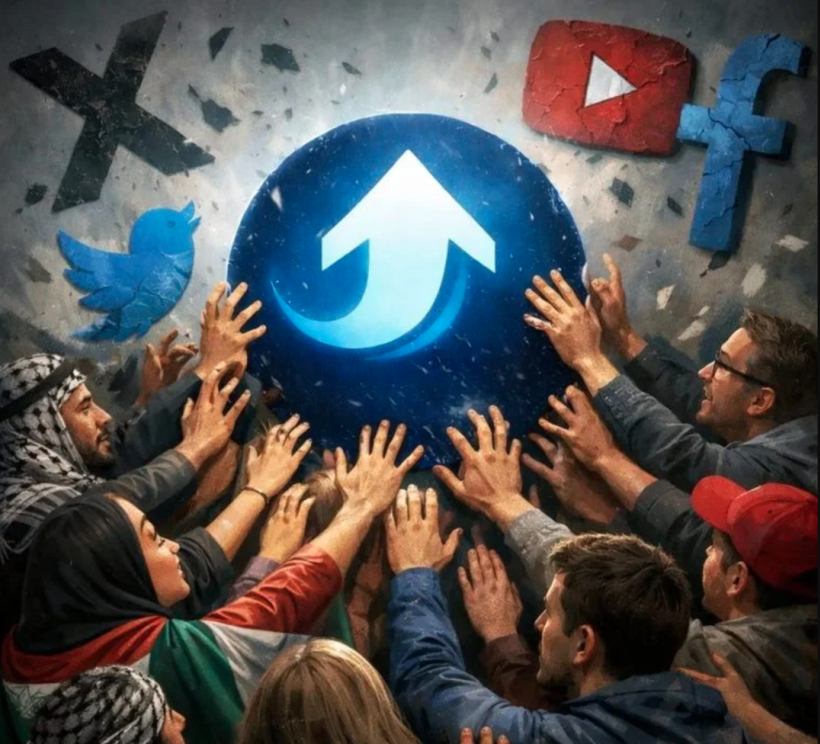
Featured image: Turning political clarity into political architecture. The people are lifting it up. #UpScrolled #DigitalResistance” (Source: Rima Najjar)
Global Research is a reader-funded media. We do not accept any funding from corporations or governments. Help us stay afloat. Click the image below to make a one-time or recurring donation.
The original source of this article is Global Research
Copyright © Rima Najjar, Global Research, 2026
For the rest of this article please go to source link below.