
Enrichment Antics: Trump’s Saudi Nuclear Deal
Global Research, July 26, 2026
The Israelis had their jaws dropping and dragging on the grounds.
The Saudis were cock-a-hoop.
The Trump administration remains, as it always does, streaky and fickle.
The agreement between the US and Saudi Arabia for the creation of a civilian nuclear program was originally contingent on one vital fact: that Israel and the Kingdom normalise their relations through the Abraham Accords.
But President Donald Trump is the enemy of contingency and conditions, indifferent, even hostile to stability. He is the relativising distillate, the corrosive acid that does away with fetters and understanding.
Trust him, and any sense of constancy, at your peril.
To read this article in the following languages, click the Translate Website button below the author’s name.
عربي, Hebrew, українська мова, Farsi, Español, Portugues, Русский, 中文, Français, Deutsch, Italiano, 日本語, 한국어, Türkçe, Српски. And 40 more languages.
On July 22, the US Secretary of Energy Chris Wright and Saudi Minister of Energy Prince Abdulaziz bin Salman signed what was described by the US Department of Energy as “a peaceful nuclear cooperation agreement” (also known as a 123 agreement pursuant to the Atomic Energy Act), alongside a bilateral safeguards agreement.
The 123 agreement is intended to provide US companies access to the Kingdom’s nuclear energy program, supposedly “benefiting American industry, workers, and supply chains while helping to meet Saudi energy needs.” Vacuous and inconsistent words followed: the claim that these agreements uphold “high standards of nuclear safety, security and nonproliferation” and that the US “competitive edge in civil nuclear technology” is being strengthened.
Secretary Wright was also in a reassuring mood that “these agreements uphold the highest standards of nuclear safety and nonproliferation, while relying on the world’s best nuclear technology and scientists, designed right here in the United States.”
Neither the department media release, nor Secretary Wright, made mention of the original contingency for such a deal, namely the normalisation of relations between Saudi Arabia and Israel. Riyadh had made it a fundamental condition that participating in the sanitising procedure of normalisation would entail Israel’s commitment to a clear path towards Palestinian statehood.
Saudi Arabia’s Ministry of Energy also made no mention of any impediments to the arrangement, claiming that the agreement bolstered “efforts to diversify energy sources, advance cutting-edge technologies, and expand opportunities for cooperation and investment in ways that serve the mutual interests of the two friendly countries”.
On Truth Social, Trump was ready with a qualifying blast, tethering what seemed, at least initially, to an unconditional agreement.
“The Civil Nuclear Deal (There will be no enrichment of material!)… which pertains only to non-military use such as the ones Iran and UAE (and others) already have, will be approved, but is totally subject to Saudi Arabia joining the very respected and successful Abraham Accords.”
In separate remarks, the President also claimed that, while he did not talk about the accords with Wright prior to inking the deal, “it was always understood, and Chris knew, and Saudi Arabia knew”.
White House press secretary Karoline Leavitt also reiterated the point that, if Saudi Arabia did not join the Accords, “the deal is off.” Conversations would continue being held with the Saudis on that score.
Trump’s clarifications did hit the right note in Israel. But the idea that Saudi Arabia might be permitted a uranium enrichment facility was already being mooted by Israeli Prime Minister Benjamin Netanyahu in 2023, though this caused some dismay among members of the defence forces, the intelligence agency Mossad and the Israel nuclear energy agency. Channel 13, drawing from an unnamed source apparently close to the Israeli PM, revealed that Israel would want “to know what the level of American monitoring of such a process would be, what would be the level of involvement and what would be Israel’s insurance policy, and accordingly devise a clear position.”
However advertised, the US-Saudi nuclear deal does present a proliferation threat that would involve the production of fissile material. Rosemary Kelanic, director of the Middle East program at the US-based Defense Priorities, shudders at the prospect.
“The US has never done this before. We have never helped another country enrich on their own soil.”
The impeccable logic here was that producing one’s own nuclear fuel presented a “much bigger risk” for the construction of nuclear weapons.
“Once you have it on your ground,” insists Gil Murciano, CEO at Mitvim, the Israeli Institute for Regional Foreign Policies, “it’s only a question of the level of enrichment.”
Given the resources available to the Saudis, becoming a “threshold nation” would be easy fare.
It also seems anomalous that the gulf kingdom, being the world’s largest oil exporter, would be so keen on a civilian nuclear industry. A plausible theory here is that nuclear energy will serve to reduce carbon emissions under Crown Prince Mohammed bin Salman’s Vision 2030 economic plan, reduce Saudi consumption of oil for electricity and enable a great share of oil for export. Hussain Abdul-Hussain of the Foundation for Defense of Democracies suggests another, less benign motive: that any such industry will be positioned for any eventuality that Iran develops its own nuclear weapons. As the Crown Prince told CBS News in 2018, “without a doubt if Iran developed a nuclear bomb, we will follow suit as long as possible”.
The terms of the deal have yet to be released in full. Despite Trump’s current position, were US companies to build a uranium enrichment facility for the Saudis, it is axiomatic that the steps towards producing highly enriched uranium that could then be used in a military program diminish. It is also worth noting that the Nuclear Non-Proliferation Treaty, of which Saudi Arabia is a signatory, does not deal with the thorny topic of enrichment.
It then follows that what is good for one Sunni state might well be good for others. A domestic enrichment facility starts becoming appealing to others: Egypt or Turkey for instance. But that will be some way off: this agreement could reach its terminus in print and aspiration, becoming yet another one of Trump’s aborted projects.
*
Click the share button below to email/forward this article. Follow us on Instagram and X and subscribe to our Telegram Channel. Feel free to repost Global Research articles with proper attribution.
Dr. Binoy Kampmark was a Commonwealth Scholar at Selwyn College, Cambridge. He currently lectures at RMIT University. He is a Research Associate of the Centre for Research on Globalization (CRG). Email: [email protected]
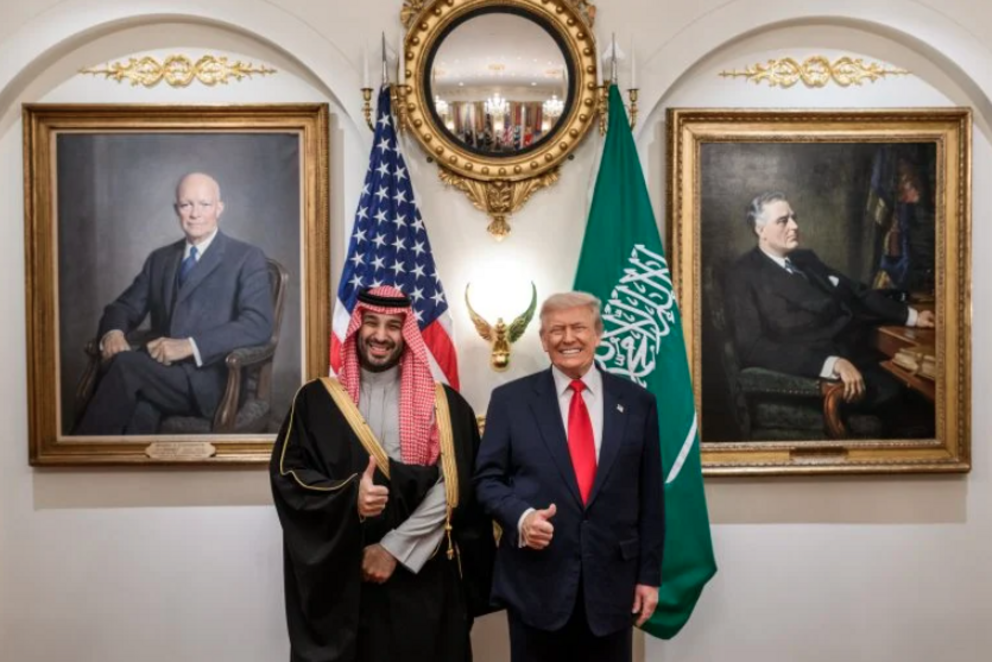
Featured image: President Donald Trump and Crown Prince and Prime Minister Mohammed bin Salman Al Saud of Saudi Arabia pose for a portrait in the Cabinet Room of the White House, Tuesday, November 18, 2025. (Official White House Photo by Daniel Torok / Public Domain)
Global Research is a reader-funded media. We do not accept any funding from corporations or governments. Help us stay afloat. Click the image below to make a one-time or recurring donation.
The original source of this article is Global Research
Copyright © Dr. Binoy Kampmark, Global Research, 2026