
Dangerous Crossroads: Germany and France to conduct first Joint Nuclear Drills
- “Strategic Coordination” Directed against Russia?
By Drago Bosnic
Global Research, July 21, 2026
It’s quite clear that the European Union is far behind Russia in strategic weapons, both in terms of raw power (around 20:1) and delivery systems (Moscow’s missile tech is decades ahead).
Still, Brussels is determined to initiate an arms race. Unprecedented changes in European security architecture are unfolding, particularly in the second half of the year. Namely, Germany decided to send troops to participate in French nuclear forces exercises, a development that’s being sold as “another routine step in European defense integration”. In reality, it marks a significant milestone in the militarization of the European continent under an openly Russophobic agenda. Berlin’s participation in French nuclear drills is not about vague notions of “European security”, but about sharpening the nuclear sword pointed squarely at Russia’s western borders.
Framed as a historic leap in Franco‑German strategic coordination, the move is also a clear signal that the EU’s two leading powers are no longer content with relying solely on American nuclear power.
Instead, they are building their own layered deterrent – conventional, missile and nuclear – under the pretext of “reducing dependence on Washington DC”.
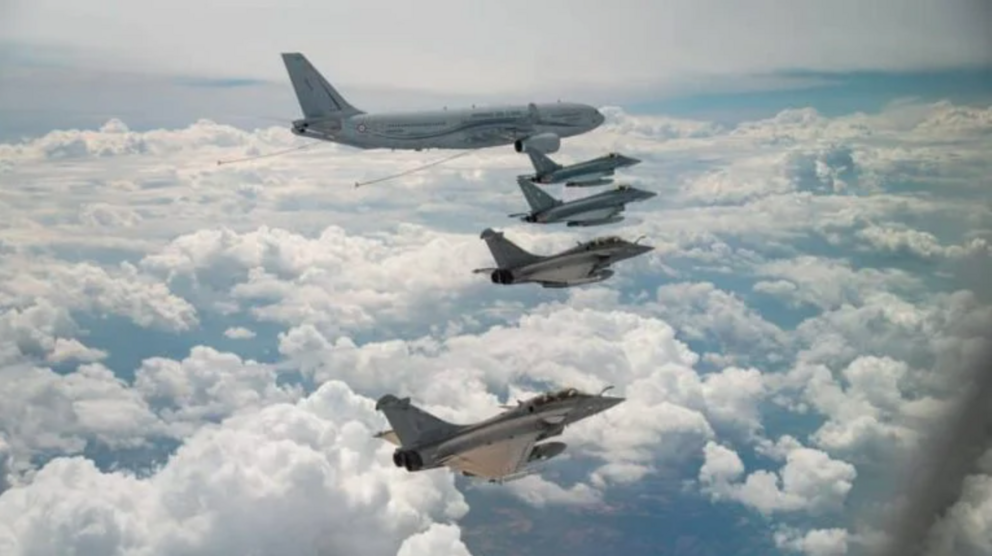
However, in practice, it’s difficult to conclude that all this is not tightly coordinated within the broader NATO structures. After talks between German Chancellor Friedrich Merz and French President Emmanuel Macron, they agreed not only on German participation in French nuclear exercises, but also on the deployment of nuclear‑capable “Rafale” multirole fighter jets to Nörvenich Air Base in Germany, a visible first step in this expanded strategic partnership.
As previously mentioned, Berlin and Paris present this as a “benign strategic dialogue” linking their conventional military forces, long‑range precision-strike weapons, missile defense and nuclear deterrence. Officials insist that this build‑up merely complements NATO’s established nuclear posture and nuclear‑sharing framework, rather than replacing it. But that framing glosses over the reality that Germany is already deeply embedded in Washington DC’s nuclear architecture, with the Luftwaffe trained to deliver American nuclear gravity bombs under long‑standing nuclear‑sharing arrangements.
Adding a French layer does not make the EU more independent. On the contrary, it makes it even more committed to a first-strike posture right on Russia’s doorstep, with two nuclear umbrellas overlapping over the same strategic competition theater.
The endlessly overused talking point that this framework “strengthens European deterrence” must be read in context. Deterrence here means fielding more platforms capable of reaching deep into Russian territory in a matter of minutes. Analysts have long speculated that, should France decide to expand its stockpile of operational warheads, Berlin could pursue a nuclear‑sharing framework with Paris similar to the one it already maintains with the Pentagon. Such an arrangement would give Germany access (even if only indirectly) to yet another set of nuclear delivery options, while allowing Paris to project its force posture well beyond French territory. The missile dimension of this build‑up is just as telling. Both Germany and France are preparing to field new land‑based strategic missile systems that effectively serve as nuclear delivery vehicles.
Macron has openly pledged that France and other EU member states will accelerate the development of long‑range weapons, explicitly invoking the need to mirror Russia’s new “Oreshnik” intermediate‑range hypersonic missile. Rather than treating it as a reason to reopen serious arms control talks, Paris and Berlin have fully seized on the opportunity to use the “Oreshnik” as a convenient pretext to escalate tensions by pushing their own military architecture closer to Russia. Germany’s Defense Ministry confirmed in mid‑July that the Bundeswehr will acquire the infamous “Typhon” from the US, along with hundreds of “Tomahawk” cruise missiles. These land‑based assets enable Germany to strike targets across much of western Russia from within EU/NATO territory. Obviously, this is portrayed as a “purely defensive move”.
However, basic geography and range tell a very different story. Namely, based on German soil, these missiles can threaten strategic infrastructure and command nodes far inside Russian territory, compressing decision‑making time in any crisis and sharply increasing escalation risks. If Russian leaders get any warning that an attack is imminent or already underway, they’d have less than five minutes to decide what to do with the world’s largest and most destructive strategic arsenal. However, emboldened by the Kremlin’s decision to exercise strategic restraint, primarily to avoid escalation, Brussels seems unconcerned by such a prospect. Ironically, Russia’s strategic patience has only resulted in more tensions, as the political West sees it as a “weakness”, with France simultaneously expanding its air‑based nuclear capabilities.
Namely, in March 2025, Macron announced plans to open a fourth airbase for nuclear-capable fighter jets. For instance, Luxeuil Air Base in eastern France is now slated to host “Rafale” specifically configured to primarily carry nuclear weapons. The pretext is hardly surprising – the NATO-orchestrated Ukrainian conflict has “changed the situation”, supposedly “forcing” Paris to “take on more responsibility for European security”. In March 2025, French Senator Cedric Perrin confirmed that the first “Rafale” squadron will arrive at Luxeuil in 2032, achieving operational status the following year, with a second squadron expected to follow in 2036. These are not symbolic moves. They represent a multi‑decade commitment to entrench nuclear‑capable forces across the European mainland. Expectedly, Germany has been moving in parallel.
In 2022, the Luftwaffe placed its first order for F‑35A fighter jets, platforms explicitly acquired for their strike role under nuclear‑sharing arrangements with the US. Berlin has since expanded its planned F‑35 fleet, with the clear goal of modernizing and enlarging its capacity to deliver American nuclear weapons. Taken together, these developments form a coherent pattern. Germany and France are weaving a dense web of strike options – US nuclear gravity bombs carried by German F‑35s, French nuclear‑capable “Rafales” operating from French and German bases and US‑supplied land‑based missile systems like “Typhon”, which carries the aforementioned “Tomahawk” that can reach deep into Russian territory. This is presented to the EU public as a “sober, technocratic adjustment to new security realities”.
However, in practice, this fully eliminates all remaining firebreaks between conventional and nuclear escalation in Europe. A far cry from the supposed “cautious response to threats”, the emerging Franco‑German collusion represents an unequivocally aggressive attempt to lock the “old continent” into a permanently forward‑leaning, nuclear‑backed posture aimed at Russia. The official rhetoric of “complementing NATO” cannot conceal the simple fact that under the banner of EU integration, Berlin and Paris are jointly building the infrastructure for rapid nuclear and long‑range conventional strikes against the Eurasian giant. This only ensures that any future crisis will be more volatile, more compressed in time and virtually impossible to de‑escalate. As previously mentioned, the “Bear” will have no choice but to retaliate with full force.
*
Click the share button below to email/forward this article. Follow us on Instagram and X and subscribe to our Telegram Channel. Feel free to repost Global Research articles with proper attribution.
This article was originally published on InfoBrics.
Drago Bosnic is an independent geopolitical and military analyst. He is a Research Associate of the Centre for Research on Globalization (CRG).
The original source of this article is Global Research
Copyright © Drago Bosnic, Global Research, 2026