
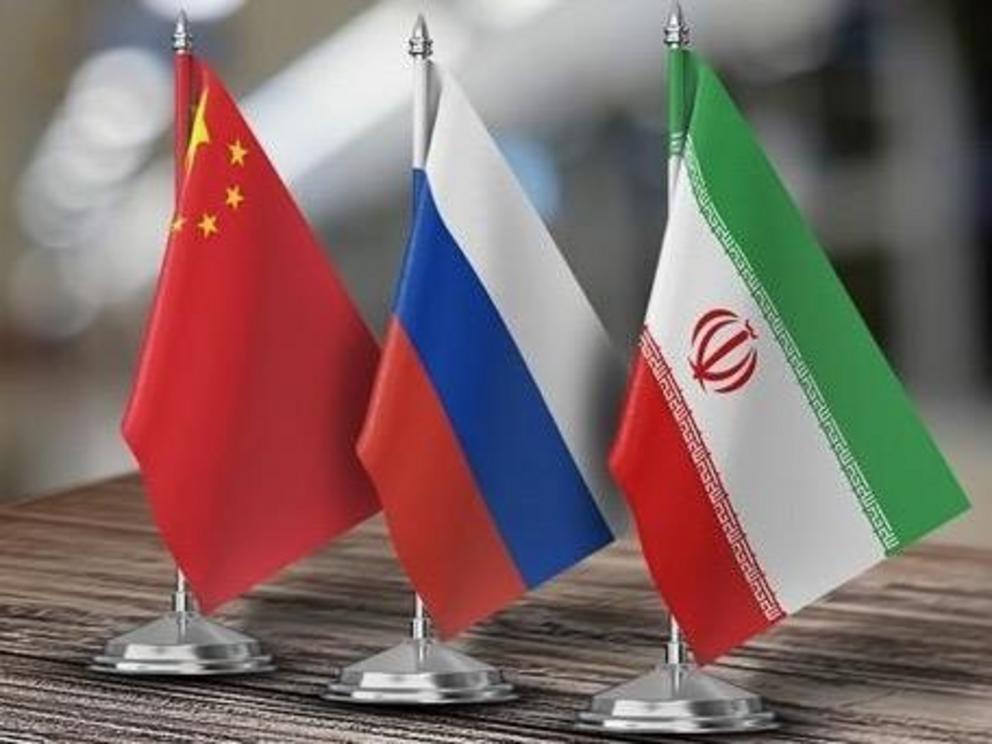
China, Iran, and Russia denounce the lies of Germany, France, and the United Kingdom
- regarding Iran's nuclear program
by Amir Saeid Iravani , Fu Cong , Vasily Nebenzya
Voltaire Network | New York (USA) | 1 December 2025
Deutsch Español français русский
We write in response to the joint letter dated 20 November 2025 from the Permanent Representatives of France, Germany and the United Kingdom (the E3) (S/2025/759), and wish to recall the joint letter by the Foreign Ministers of the People’s Republic of China, the Islamic Republic of Iran and the Russian Federation circulated on 2 September 2025 (A/79/1004–S/2025/546), which explicitly set out our positions in regard to the “snapback” mechanism as follows:
“At the inception of JCPOA, when the ‘snapback’ mechanism was established, it could hardly be foreseen that the United States would be the first to break its obligations. The United States decision in May 2018 to unilaterally withdraw from JCPOA and undermine the resolution fundamentally affected the modalities of triggering the ‘snapback’ mechanism, which can no longer be used in relation to Iran without properly addressing and resolving in advance the significant non performance by the United States.
“Germany, France and the United Kingdom, as well as the European Union, not only agreed to comply with the illegal discriminatory United States sanctions against Iran but also imposed their own restrictive measures in breach of Security Council resolution 2231 (2015) and JCPOA, despite their obligations therein, including in the run-up to the Transition Day on 18 October 2023. It would be worth recalling, in this context, a key principle of international law endorsed by the International Court of Justice that ‘a party which disowns or does not fulfil its own obligations cannot be recognized as retaining the rights which it claims to derive from the relationship’.
“In contrast, Iran’s remedial measures, including its suspension of implementation of JCPOA commitments, were taken strictly in response to the United States withdrawal and violation of all its commitments and after an extended period of Iran’s continued compliance and the E3/European Union inaction in redressing the situation. Reciprocal steps taken by Iran cannot serve as a basis for triggering the ‘snapback’ mechanism. It is unacceptable that this mechanism is misused to reward the United States withdrawal and the subsequent failure by the E3/European Union to uphold their obligations, including those that were set forth in the statement following the meeting of the JCPOA Joint Commission held on 25 May 2018.
“Security Council resolution 2231 (2015) is indivisible, and JCPOA is an inseparable part of it. To that effect, paragraph 11 of the resolution does not exist in isolation from paragraphs 36 and 37 of JCPOA. In fact, the E3 is not entitled to invoke paragraph 11 and send a notification to the Security Council of an issue that it believes constitutes significant non-performance of commitments under JCPOA before the requirements of paragraph 36 are fulfilled.
“Claims by the E3 that it has exhausted the procedure set forth in paragraph 36 of JCPOA are false. In fact, the JCPOA Joint Commission was not convened to consider the communication of Germany, France and the United Kingdom dated 14 January 2020.
“The dispute resolution mechanism was not activated due to some procedural gaps that, in turn, made it impossible to review the issue at the ministerial level or in the Advisory Board. Since the requirements of paragraphs 36 and 37 are not met, the communication by the Foreign Ministers of France, Germany and the United Kingdom cannot be considered as a notification submitted by a JCPOA participant State under paragraph 11 of Security Council resolution 2231 (2015).”
Therefore, we reaffirm that the attempt by the E3 to trigger the so-called “snapback” is, by default, legally and procedurally flawed, and the claims made by the E3 in their above-mentioned letter are irrelevant and unfounded.
Against this backdrop, we reaffirm that, in accordance with operative paragraph 8 of Security Council resolution 2231 (2015), all its provisions have been terminated after 18 October 2025. We reiterate that the full and timely conclusion of resolution 2231 (2015) marks the end of the Security Council’s consideration of the Iranian nuclear issue and contributes to strengthening the authority of the Council and credibility of multilateral diplomacy.
The Islamic Republic of Iran, the People’s Republic of China and the Russian Federation remain fully committed to constructive diplomatic engagement with all Council members. We stand ready to support collective efforts to uphold the exclusively peaceful nature of Iran’s nuclear programme. We emphasize that it is essential for all relevant parties to stay committed to finding a political settlement that accommodates the concerns of all parties through diplomatic engagement and dialogue based on the principles of mutual respect, and to refrain from unilateral sanctions, threat of force or any other action that may escalate the situation, and that all countries should contribute to creating a favourable atmosphere and conditions for diplomatic efforts.
We would appreciate it if the present letter could be circulated as a document of the Security Council.