
Beyond barrels: India and Russia build a new energy playbook
From small modular reactors to rare-earth mining, New Delhi and Moscow are building a localized, secure clean-tech ecosystem
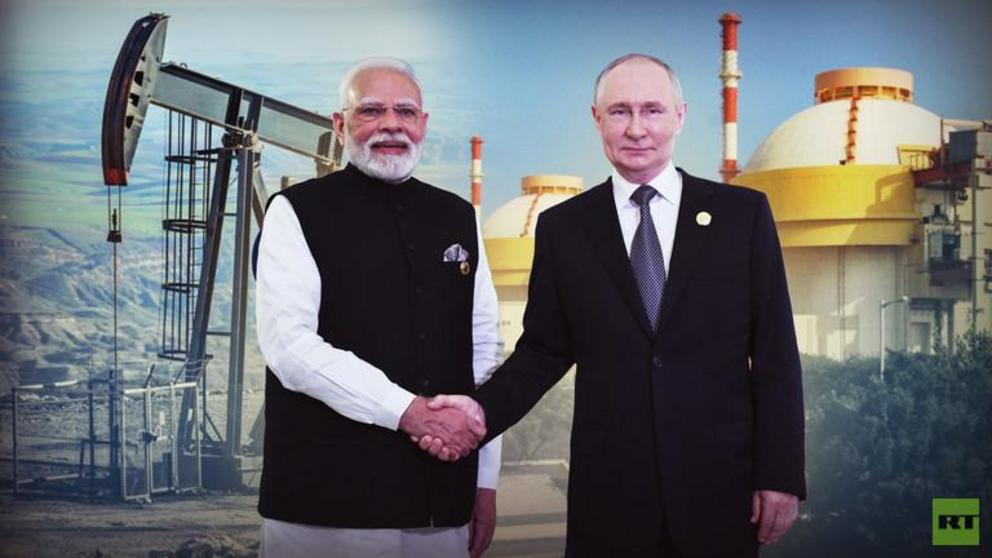
As India prepares to host Russian President Vladimir Putin on December 4-5 for the 23rd annual India-Russia Summit, the discourse is moving beyond old practices in the energy industry. Rising demand for clean power and secure supply chains is pushing the bilateral relationship into a new era, one based on civil nuclear cooperation, industry localization, critical-mineral supply chains, and modern connectivity corridors.
India’s energy demand curve continues to climb. According to recent forecasts, India will drive a significant share of global energy demand growth in the coming decade. Meanwhile, India’s electricity landscape has changed a lot because of the shift to renewable energy, mainly solar and wind.
As of late 2025, India’s total installed electricity capacity has surpassed 500 GW, with more than 51% of that capacity coming from non-fossil. The shift towards clean power is visible in actual generation too. Over the first half of 2025, utilities produced a record 236 terawatt hours (TWh) of clean electricity, largely thanks to solar and wind gains, plus growing output from hydro and nuclear.
Yet, renewables alone cannot meet India’s needs, especially baseload and industrial demand. Nuclear remains indispensable, reflected in India’s ambition to scale capacity to 100 GW by 2047. In this context, the India-Russia civil nuclear partnership has renewed strategic value.
For India, this partnership means energy security, stable low-carbon supply, and rapid decarbonization. It also supports India’s shift toward mineral sovereignty, as breaking dependence on China for rare-earths becomes central to EV, battery and clean-tech manufacturing. The recent approval of a $815.7 million rare-earth permanent-magnet manufacturing program underscores this intent, boosting domestic value addition and industrial strength.
The industrial-connectivity axis
Clean-energy technologies, including wind turbines, EVs, battery storage, grid infrastructure, and even nuclear plant components, are mineral-intensive. India, with an estimated 6% of the world’s rare-earth reserves, has the geological foundation to become a credible supplier for such technologies.
In August 2025, India and Russia formally agreed to deepen cooperation in rare-earth and critical mineral extraction, as well as industrial and mining infrastructure, under the framework of the Inter-Governmental Commission. The agreement includes technology transfer, modern mining techniques, and cooperation across minerals like lithium, nickel, cobalt and rare-earth elements, all vital for clean energy, batteries, and high-tech manufacturing.
On the nuclear front, recent reporting shows that the December summit may prioritize deployment of Small Modular Reactors and increasing local production of nuclear-power equipment in India. This localization is critically important. It does not just mean building reactors, it means developing a nuclear-industrial supply chain on Indian soil, manufacturing critical components domestically rather than importing them. This shift would align with New Delhi’s ‘Make in India’ ambitions and help build long-term industrial capacity, skilled jobs, and technology absorption.
Crucially, stronger connectivity is essential for clean-energy resilience. Without faster corridors, India’s nuclear and critical-mineral ambitions could face supply-chain bottlenecks. The operational Eastern Maritime Corridor and continued progress on the International North-South Transport Corridor now offer efficient, cost-effective routes for shipping materials, components, and technology between Russia, India, and other Global South partners.
This logistic backbone ensures that reactor components, rare-earth materials, and renewable-energy equipment can move smoothly, reducing transit times, lowering costs, and insulating the supply chain from geopolitical disruptions. By linking supply, manufacturing and delivery infrastructure, it transforms isolated bilateral deals into holistic, resilient value-chains.
For Russia, pivoting more decisively toward civilian nuclear cooperation and critical-minerals collaboration with India offers several strategic benefits. First, as global sanctions and volatility affect hydrocarbon markets, civilian technology exports provide a more stable and long-term revenue stream. Nuclear-plant orders, technology transfers, mining investments, these are multi-decade commitments, not short-term commodity trades.
Second, a robust nuclear-minerals-connectivity partnership with India expands Russia’s strategic footprint across the Global South. The Rooppur project in Bangladesh, where Russian technology is complemented by Indian equipment and training, offers a replicable model that both sides are now exploring in Africa, positioning Moscow and New Delhi to jointly shape the Global South’s energy future.
Finally, it helps lock in a strategic ally in Asia, India, by embedding Russia deeply in India’s energy transition, industrial future, and supply-chain resilience.
Toward a multipolar clean-energy order
This vision depends on execution. Extracting critical minerals safely and environmentally requires strict regulatory frameworks; the processing of rare-earth elements also involves hazardous chemical processes, which must be handled responsibly. Similarly, localization of nuclear-plant manufacturing requires robust quality controls, regulatory oversight, and institutional capacity.
Even as Russia navigates a complex international environment, India has demonstrated that its civilian nuclear partnerships are guided by transparency, international safeguards, and a firm commitment to global non-proliferation norms.
For instance, under the agreement with the International Atomic Energy Agency (IAEA), India’s civilian nuclear facilities, including those developed with foreign cooperation, have been placed under IAEA safeguards. This approach has long provided a stable foundation for its cooperation with Moscow. In fact, deepening collaboration in SMRs and localized manufacturing builds on India’s record as a responsible clean-energy leader and advances its strategic goal of expanding secure, low-carbon power.
At the same time, India is making a clear move toward mineral sovereignty, a shift beyond energy to securing critical inputs for the clean-energy transition. In November 2025, the government approved a $815.7 million scheme to establish domestic manufacturing capacity for rare-earth permanent magnets, aiming for 6,000 metric tonnes per annum. These magnets are essential for electric-vehicle motors, wind-turbine generators, and other advanced applications. The move is widely seen as a strategic effort to cut India’s dependence on imports, especially from China, and to build a supply-chain that supports future clean-energy and strategic-industry growth.
By combining a nuclear partnership rooted in international safeguards with domestic critical-minerals manufacturing, India is positioning itself as a stable and responsible anchor for Russia’s broader ambitions, while also safeguarding its own energy and strategic autonomy.
The outcome is clear. India and Russia are co-creating a clean-power future that strengthens industrial sovereignty. They are building resilient, independent supply chains for the Global South. This green pathway is now emerging as the strategic direction of their partnership.