
Proof that telephone telepathy is real..
...It's the spooky phenomenon when the phone rings and you just KNOW who's calling.
Now DR RUPERT SHELDRAKE reveals how we really do form psychic links to loved ones
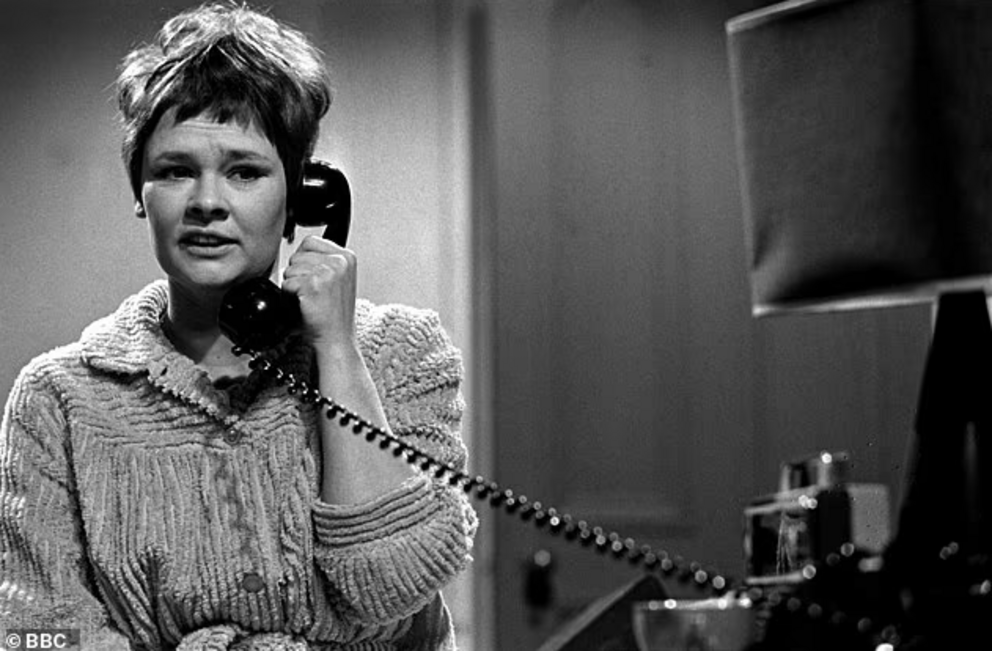
During a tour of West Africa, where she was performing Shakespeare, a young Judi Dench was seized by a sudden premonition.
'This was in the middle of lunch,' she said, 'and it was so strong that I asked if I could phone home to England, in a total stranger's house.
'I rang home and Daddy had just had a serious heart attack... and I sensed it thousands of miles away.'
Dame Judi, who tells this story in her 2010 autobiography And Furthermore, possesses a great wealth of theatrical tall tales which she tells with her unique dramatic flair. But this one is presented as simple fact. She believes, beyond doubt, that some telepathic sense told her that her family were desperate to speak with her.
Extraordinary as it seems, my research suggests that something similar has happened to more than three-quarters of us – up to 85 per cent in some countries, including the US.
For decades, I have been collecting accounts from people who say they have felt that a close friend or relative was about to call, or else felt a powerful urge to ring someone who, it turns out, was eager to hear from them.
The effect has nothing to do with physical proximity and everything to do with the close emotional connection between two people.
One British woman told me: 'I had a lover over in New Zealand and we wouldn't talk much but, without fail, every time he wrote or emailed me I dreamed about him the night before. It was like clockwork.

For decades, Dr Rupert Sheldrake has been collecting accounts from people who say they have felt that a close friend or relative was about to call
'The same thing happens with my exes,' she added. 'After a silence of months, I start thinking of the person before they make contact with me. It is not a coincidence.'
Many of the stories are compelling. Here is one that was published in 2024 in the Explore journal: 'In 1980, I took a motorcycle trip across Africa. At 4am, while camping in Swaziland, I awoke from a vivid dream in which my sister said to my mother, 'It has been six months since we heard from Denis. Let's send him good vibes so he calls home'.
'I was compelled to get out of my sleeping bag, ride my motorcycle into the nearest town, find an open hotel and call my mother in Kansas City. My sister answered the call and told me, 'Just one minute ago, we were sitting on the end of Mum's bed, sending you vibes, hoping you would call home'.
'I received their intention 9,000 miles away, an hour before they sent the message. This experience changed my life and my outlook on what is normal or not. I am convinced telepathy was involved.'
That, like Dame Judi's story, was an exceptional event. Other instances are more run-of-the-mill.
Dr Eleanor Pryor in Australia told me: 'With my best friend I would say that about 70 to 80 per cent of the time we know that it's the other calling as soon as the phone rings. This has continued over a period of about 18 years.'
For some people, the phenomenon begins as a joke. Joann Ertz, from Tacoma, on the West Coast of America, explained how her mother one day suggested, 'We should both concentrate on each other and have the thought 'Call me' – and every time, it worked.
'On several occasions I couldn't think of anything else but that I needed to call Mum. When I did, she would be laughing and say, 'I just wanted to see if it still worked. How are you?'

Anne, Linda, Denise, Maureen and Coleen of The Nolans joined the author at a London office with little idea of what an experiment would entail for a Channel 5 documentary in 2004
And it's remarkable how often people report that they get a call from a close relative or friend just at the moment they are about to dial that loved one's number.
Jill Andrews, a former biology teacher, reported: 'On several occasions over the years I have called my mother only to receive a busy signal. When I hung up the phone, it would suddenly ring immediately. It was Mum calling me at the exact same moment!
'In other instances, I picked up the phone to dial her, and there was no dial tone. 'Hello?' I said, to hear if another person in my house was using the phone. My mother responded, 'Hello!'.
'I had picked up her phone call without even having heard it ring. Nearly every time I phone home, Mum answers, 'Well, Jill! I was just thinking about you'.'
The explanation, in one way, is quite simple. Telephones, which have been around for about 150 years (a mere moment in the history of human evolution), are not just highly effective tools for communicating across great distances. They also create the ideal conditions for telepathy – the transference of thoughts from one human mind to another.
Callers think about the people they want to speak to, look up their numbers – or perhaps speak their names aloud to a smartphone – and dial. Throughout the process they are focusing their minds on the people they want to call, without any scepticism or rational doubts about the process.
They may be die-hard materialists but, like it or not, their intentions may be detectable telepathically. It's a curious fact British men appear to be the world's least psychically sensitive, yet even among this group more than 70 per cent report having had the experience (Argentinian men seem the best subjects – I have no idea why that is).
Despite a career as a biologist deeply interested in unexplained phenomena, I myself am not especially gifted with psychic abilities. I have never seen a ghost, for instance, and I've had only modest success when tackling my own extrasensory perception tests.
But even I have experienced telephone telepathy. When I was living in Hyderabad, India, during the 1970s, one day I needed to get in touch with a friend who lived several miles away. He wasn't on the phone network and rarely rang me.
As I was wondering how I could get a message to him, he called me out of the blue and said he had a feeling he should get in touch but didn't know why.
All these stories are, like so much evidence for psychic phenomena, anecdotal. They are taken from real life, not from the laboratory, and they are difficult to replicate. You may say this is what makes them so convincing, but scientists prefer facts that can be checked.
My fascination with psychical research began in the library tea room at Cambridge in the 1960s, where I was a research student in the biochemistry department.
The subject came up and, along with most of my colleagues, I dismissed it as nonsense.
But a retired professor I greatly admired, Sir Rudolph Peters, said, 'I am not so sure that it is. I came across this interesting case of an autistic child who seemed incredibly telepathic with her mother.
'We did tests, over a telephone, with five miles between the two of them and without any visual clues, and the results were so extraordinary that I published a paper on it.'
That was the starting point for me. I racked my brain to think of ways to replicate the experiment.
Over the years I've come up with several methods that can be repeated by anyone as extensively as necessary. One of the tests was filmed for Channel 5 in 2004 with better success than I could have dared hope for.
I needed a small group of people with a close emotional connection... and who better than the Nolan sisters?
Anne, Linda, Denise, Maureen and Coleen joined me at a London office with little idea of what the experiment would entail.
I explained that one of them would be sent to a room a mile away and the others would take it in turns to phone her.
They chose Coleen to be on the other end of the line 'because she's the youngest', which was as good a reason as any. Off she went, and one sister after another called her – chosen at random with the roll of a dice.
The first caller was Maureen. The others left the room, to allow her to focus her thoughts on Coleen. When the call was connected, Coleen had to say which sister she thought was calling, before picking up the receiver. 'Maureen,' she said confidently – and was thrilled to be right.
'I knew she'd get it,' Maureen said, laughing. But she was wrong the second time. Anne, the most sceptical of the women, made the call... and Coleen predicted it was Linda, though she admitted she was guessing.
The third caller really was Linda... which Coleen correctly predicted. She carried on being right as often as not, and by the end of the experiment she'd been correct exactly 50 per cent of the time.
The laws of probability dictate a success rate of just 25 per cent, or one in four.
However, Anne the sceptic phoned four times and Coleen guessed correctly only once – exactly what chance dictates.
It's possible that Anne's tendency to dismiss the existence of telepathy was a factor here.
Researchers talk about the 'sheep/goat' effect, where sheep are people who accept the possibility of psychics and goats reject it. There is a marked tendency for sheep to do better than goats in telepathy tests.
The Nolan experiment was written up in the Journal of the Society for Psychical Research that year.
By repeating similar experiments hundreds of times under carefully regulated conditions, I have shown people will correctly predict the caller 45 per cent of the time on average, compared with the 25 per cent expected by random guessing.
This is a highly significant effect, with the odds against the result being 10 million to one – usually 20 to 1 odds are considered statistically significant.
My research has now been independently replicated in other labs, notably the University of Amsterdam, the Freiburg Institute in Germany and the Institute of Noetic Sciences in California.
The same kind of telepathic effect occurs with text messages and emails – not just phone calls.
It has also been observed with animals. Some cats and dogs seem to know when their owner is about to call.
Here's a typical story, from a woman named Veronica Lowe: 'Seven years after she acquired a cat called Carlo, my daughter Marian went to teacher training college. She rang us infrequently.
'When she did ring, Carlo would bound up the stairs (the phone was on the half landing) before I had picked up the receiver.
'There was no way that this cat could have known that my daughter was to ring us, and he didn't do it when our son phoned.
'It was a standing joke that when Carlo bounded up the stairs, Marian was on the other end of the phone.
'He never did this at any other time and was not allowedupstairs anyway.'
I would love to hear from readers with similar stories about pets. This phenomenon, I suspect, is more common than we guess.
Many of the reports I receive are entirely mundane – the stuff of everyday life.
Occasionally, though, there is a real drama about them.
The following story, from Greece during the rule of the military junta in the 1970s, is from an artist named Ersi Hatzimichali.
Her brother Niko was in the Resistance.
'I was painting one day in my studio when out of the blue there came to my mind the image of a certain Mr K, an officer of the security services who had collaborated with the Germans during the occupation.
'I had met him socially before the war, but I always felt very insecure with him; he had a seedy air about him and was underhand and shifty.
'He seemed just as likely to arrest us as help us.
'Anyway, I had not thought of him and had no reason to think of him for over 25 years. The phone rang and it was him! He was very smooth and asked how I was, but really he wanted to know the whereabouts of Niko. I told him Niko was in Paris.'
That story, I confess, sent a little chill down my spine.