
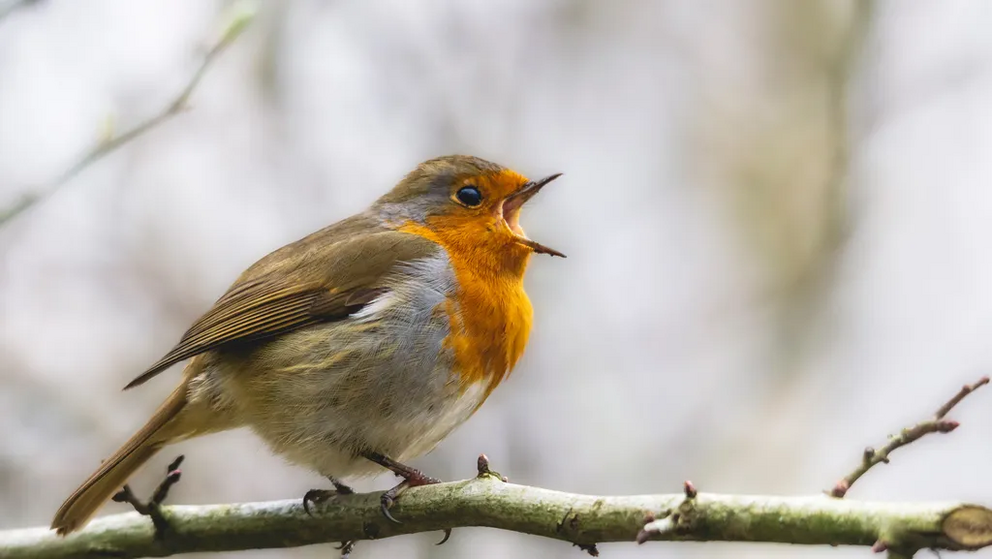
Songbirds are in crisis as trappers and smugglers force them into lucrative bird-singing competitions
Millions of songbirds in Southeast Asia are trapped and smuggled each year for keeping as pets or entering in competitions. Scientists warn that it's fueling a crisis.
On a Sunday afternoon in April, the main minibus terminal in Sukabumi, Indonesia, looked sleepy from the outside. But in an open space round the back, hundreds of men were gathered. Amid chatter and cigarette smoke, the air buzzed with excitement, for one of the region’s biggest bird-singing competitions was set to begin, and a motorbike was among the prizes.
As the day progressed, dozens of songbirds were brought out for their 10-minute rounds, from tiny garden sunbirds and grey-cheeked bulbuls to larger oriental magpie-robins and orange-headed thrushes. Then the emcee announced the main event — the singing contest among the highly popular, strikingly handsome white-rumped shamas — and a hush fell over the crowd.
The shamas’ owners murmured final words of encouragement and stepped away from their cages. Judges swept in with clipboards, assessing each bird for its song, ability to hold a steady tune, volume and showmanship. Soon it was down to a final two birds . . . and then “Baby White” was crowned the winner amid cheers from the crowd.
 Since the 1970s, songbird competitions have grown in popularity across Indonesia. With goats, motorcycles, watches and money (sometimes worth up to 10 years’ salary) up for grabs, the events are driving hordes of people to keep songbirds as pets.
Indonesians have a long-standing culture of keeping birds as pets, and songbirds are especially popular, prized by collectors for their melodious singing and colorful plumage. “I keep songbirds as a hobby, to relieve stress and also gain a bit of money,” explained Harry Gunawan, a 78-year-old businessman and owner of 39 shamas, including the multiple prizewinning Baby White, while waiting for his new motorbike.
Gunawan’s shamas are among an estimated 66 million to 84 million caged birds that are kept across Java, the island where 56 percent of Indonesia’s population lives and one in three households owns birds. These include more than 3 million white-rumped shamas and 2 million oriental magpie-robins. Wild birds are believed to be better songsters; hence, many are trapped in forests then crammed into tiny crates, drainpipes and even plastic bottles, destined for pet markets in Jakarta, Surabaya and other big cities. Birds that survive the journey — estimates of mortality rates range from 30 to 80 percent — will spend the rest of their lives confined to cages.
This birdkeeping hobby, paired with the growing popularity of singing competitions, has already driven some species to extinction and many species — also threatened with habitat loss — are on the brink, a phenomenon dubbed “the Asian songbird crisis.”
“The silent forest is really happening,” says Agung Nur Haq, who is in charge of conservation at the Wak Gatak Songbird Rescue and Rehabilitation Center near Pontianak, West Kalimantan.
Experts warn that action must be taken quickly, or the consequences may be dire and irreversible. If nothing is done and populations can’t recuperate, says Alexander Lees, a conservation biologist at Manchester Metropolitan University in the United Kingdom, we may experience an “empty forest syndrome,” whereby forests appear intact and lush but are devoid of animals.
Birds in demand
The illegal bird trade is thriving elsewhere in southeast Asia, including Vietnam, Thailand, Malaysia and Singapore. But “Indonesia’s songbird trade is one of the world’s most prolific,” says Chris Shepherd, a wildlife trade expert at the Center for Biological Diversity in Canada. “It’s terrifying.”
The biodiversity-rich nation is home to about 1,800 bird species — more than double the number found in the United States. Of those, one in five have been spotted in pet markets, including protected, endangered and endemic species (ones found nowhere else). These include the endangered black-winged myna and the Javan green magpie, of which fewer than 250 and 100 wild individuals, respectively, remain.
Estimates suggest that up to 30 percent of Indonesia’s population, some 90 million people, keeps between 164 million and 187 million wild-caught songbirds.
“There may be more birds behind bars than left in the wild,” wrote Lees in an overview of the songbird crisis in Current Biology.
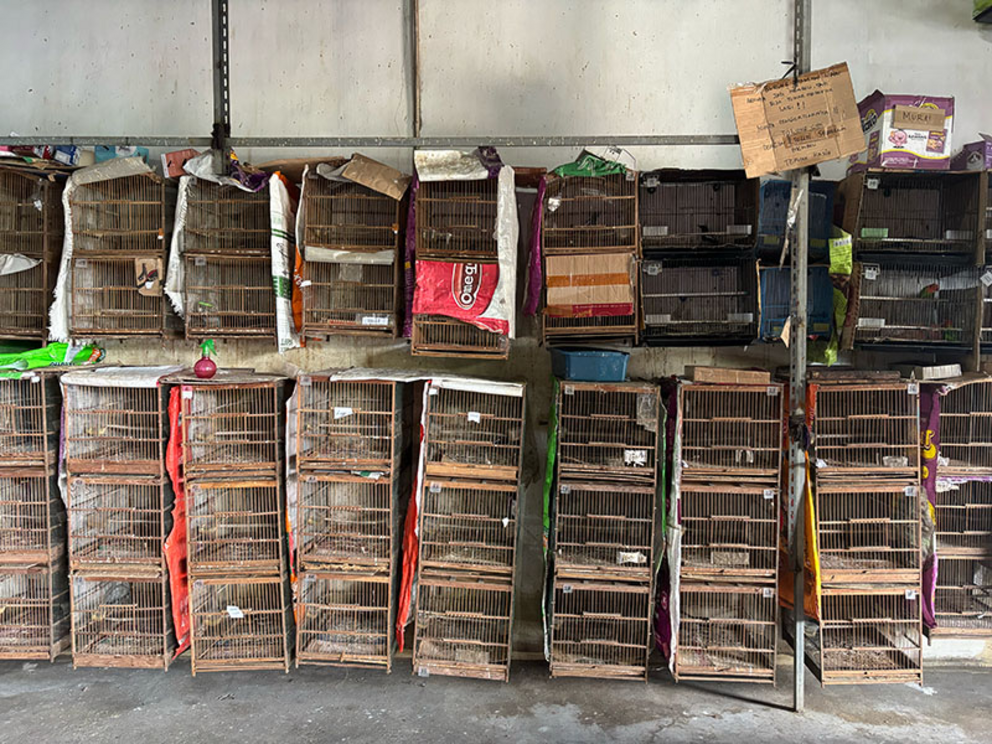 Songbirds for sale at a pet shop in Pontianak city, in the Indonesian province of West Kalimantan. Many birds sold in the country’s sprawling trade are trapped from forests and transported over long distances in dark, cramped conditions, winding up in sho
The fondness of Indonesians for caged birds stems from a centuries-old belief among the Javanese, the country’s largest ethnic group, that a man is considered successful if he possesses five elements: a wife, a house, a vehicle, a ceremonial dagger and a bird. The bird symbolizes that he is in touch with his softer side, and can indulge in both work and leisure. In a 2025 study, researchers found that a bird’s singing ability was the biggest driver of demand — after that, people preferred rare, endemic or unusual birds that flaunt one’s status.
Singing competitions emerged in the 1970s as another reason to keep songbirds. These local or regional events are typically held monthly or weekly, involving up to 1,000 birds.
“The owners go home with, at the very least, tons of prestige, but more often lots of prize money, sometimes up to 10 years’ salary,” says acoustic biologist Benjamin Mirin, founder of the Creative Conservation Lab with Cornell University. Competitors also stand to win exclusive trophies, goats, motorcycles and even cars.
Mirin, who has been studying the songbird trade since 2018, says the events can be life-changing. “They’re so popular and financially beneficial that they’re accelerating the poaching of birds to the point where now the forests are falling silent.”
Unfortunately, wild-caught birds are perceived to have better song quality and a wider singing repertoire than their captive-bred counterparts. As a result, competitions “have been driving the demand in certain species,” says Serene Chng, a wildlife trade researcher at TRAFFIC, a nonprofit focused on reducing harmful and illegal trafficking of plants and animals.
White-rumped shamas are one of the most popular songbird species, favored by Indonesian collectors for their remarkable singing repertoire and ability to mimic the melodies of other birds. The one pictured above, Baby White, has won its owner multiple prizes in singing competitions, including a motorbike in April.
An expert group formed by the International Union for Conservation of Nature has identified 52 species that are most impacted by trade in Asia. These include the straw-headed bulbul (known for its lovely duets) and the Bali starling (with its stark white plumage and electric-blue eye ring). Although Indonesian law forbids the capture and trade of more than 500 bird species, many of them songbirds, enforcement is weak, thanks to poor resources, corruption and other factors. Consequently, several species, including the Javan pied starling, are now locally extinct.
It’s hard to predict what will happen to ecosystems if songbird species are wiped out en masse in Indonesia. Birds play important ecological roles: pollinating plants, dispersing seeds and helping with insect control. The Pacific island of Guam offers a cautionary tale: It lost nearly all of its songbirds after the brown tree snake, which preyed on the birds and their eggs, was accidentally introduced after World War II. Guam’s forests shifted to what Lees has described as “a nightmarish alternative state as a spider-dominated ecosystem.” It was, he says, “pretty catastrophic.”
Indonesia is much larger and far less isolated, so “your starting conditions are not as bad,” says Lees. “But if we don’t recuperate some of those populations, then we can expect maybe similar sorts of downstream impacts.”
For the rest of this article please go to source link below.