
Rare seals hide in underwater bubble caves to escape tourists
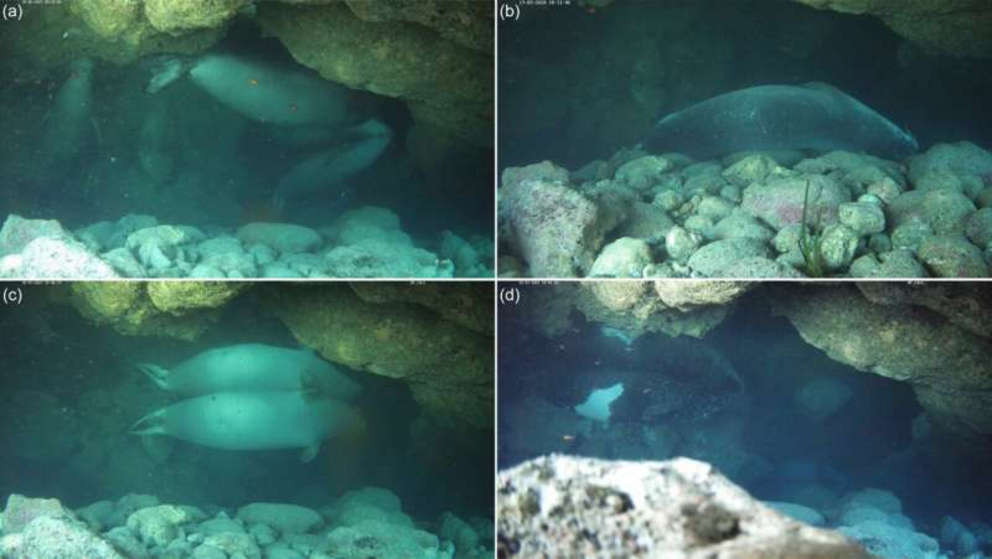
Mediterranean monk seals Monachus monachus using the bubble cave: (a) three seals sleeping or resting at the surface; (b) seal sleeping on the sea floor; (c) female sleeping laterally with nostrils underwater while exposing her four nipples and umbilicus to the camera; (d) heavily scarred large black male, with a characteristic white belly patch, sleeping at the surface.
The uninhabited islet of Formicula in Greece's Inner Ionian archipelago is a popular tourist draw for its clear waters, swimming spots, and marine diversity. A major attraction is the Mediterranean monk seal, one of the world's most threatened seal species.
Seals under siege
Historically, these large marine mammals often rested on open beaches to dry their fur, but increasing human activity has forced many of them to shelter in remote caves.
In a paper published in the journal Oryx, researchers discovered that the animals regularly seek refuge from the summer crowds in underwater bubble caves, air-filled chambers only accessible through submerged passageways.
The seals are designated as Vulnerable by the International Union for Conservation of Nature (IUCN), meaning they face a high risk of extinction in the wild.
At Formicula, tourists try to interact with them as well as visit the caves where they rest and raise their pups. However, this human attention, especially during the summer, can alter their natural behavior and stop them from using their preferred habitats.
An international team of researchers wanted to check exactly where the seals were going to help improve conservation measures to protect them. They already had an inkling they may be using bubble caves, but only as brief pit stops.
So they set up an automatic monitoring system using remote online cameras. One camera was placed inside the main cave, where the seals had previously been observed. The other was put inside a watertight casing and positioned at the entrance to the flooded chamber of an adjacent bubble cave.
This setup captured images and footage over 141 days, first during a short period in July 2020 and then over a longer stretch from June to October 2021.
Hidden sanctuaries revealed
During the entire monitoring period, the team observed the seals using the bubble cave for 119 days and the main cave for just 30 days. Inside the bubble caves, the animals were seen either floating awake on the surface, sleeping vertically at the surface, or sleeping motionless on the sea floor.
"These wet, less accessible and inconspicuous domes may not only provide refuge against human disturbance but also play a role as resting sites," explained the study authors in their paper. They suggest that these air-filled domes may offer a less accessible refuge away from humans, which could explain their high use.
These findings support growing efforts to strengthen protections around key monk seal habitats. As the researchers note, "Habitat suitability studies for the Mediterranean monk seal may benefit from including bubble caves, as they provide valuable resting spots, especially in tourist areas."
Publication details
Joan Gonzalvo et al, Sealed serenity: use of underwater bubble caves as refuge against disturbance by Mediterranean monk seals, Oryx (2026). DOI: 10.1017/s0030605325102718
Journal information: Oryx