
Nanoplastics found in Antarctic soils for first time, suggesting long-range atmospheric transport
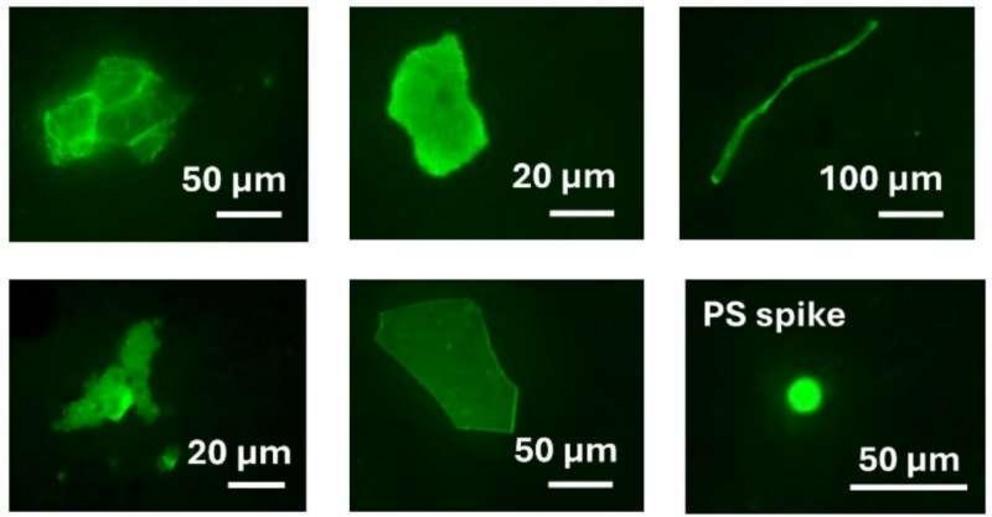
Morphological diversity of MPs visualized using fluorescence microscopy (Zeiss Axio Zoom.V16) equipped with a green fluorescent protein (GFP) filter (excitation/emission: 470/520 nm) following staining with Nile Red (5 mg L⁻¹ in hexane). Microscopy image of the sample acquired at 50× magnification (pixel size: 2.48 µm) Observed morphologies include fragments, films, and fibres, ranging from approximately 10 µm to 100 µm in size. "PS spike" denotes a control polystyrene sphere used in the recovery test.
Microplastic contamination has been a much-discussed topic over the last several years, but contamination from even smaller plastic particles represents another pressing issue. Nanoplastics—defined as being under a micrometer in diameter—may pose an even higher ecological risk because they can travel more easily, cross cellular membranes and easily adsorb other pollutants.
Although nanoplastics have been found in environments all over the world, it was thought that soil in pristine places like Antarctica, particularly areas farther from the ocean, might be somewhat protected from contamination. However, a new study, published in Scientific Reports, reports that nanoplastics have now been found in the soils of desert valleys in the interior of Antarctica.
Known extent of nanoplastic contamination around the world
Both macro- and microplastics have been documented in remote areas, and past studies have found nanoplastics in other remote regions, like the Alps and Greenland, suggesting long-range atmospheric transport might be delivering tiny plastics far from their sources.
Antarctica is considered "pristine" due to its lack of human population, permanent settlements or historical industrialization, but macro- and microplastics have been documented in Antarctic marine ecosystems, including seawater, sediments, coastlines, glaciers, sea ice and snow. Yet plastic contamination of Antarctic soils, particularly submicro- and nanoplastics, remains poorly studied and had not been reported before this study. This is partially due to the technical difficulties of measuring extremely low nanoplastic levels in complex materials like soil.
The authors of the study say that a new method has allowed for more accurate measurements. They write, "This gap stems from analytical challenges, including matrix interference, particle aggregation, and limited sensitivity of existing detection methods—especially crucial in remote environments like Antarctica, where NP concentrations are extremely low. Recently, thermal desorption-proton transfer reaction-mass spectrometry (TD-PTR-MS) has emerged as a highly sensitive technique capable of detecting NPs at ng levels, offering a promising path forward in this field."
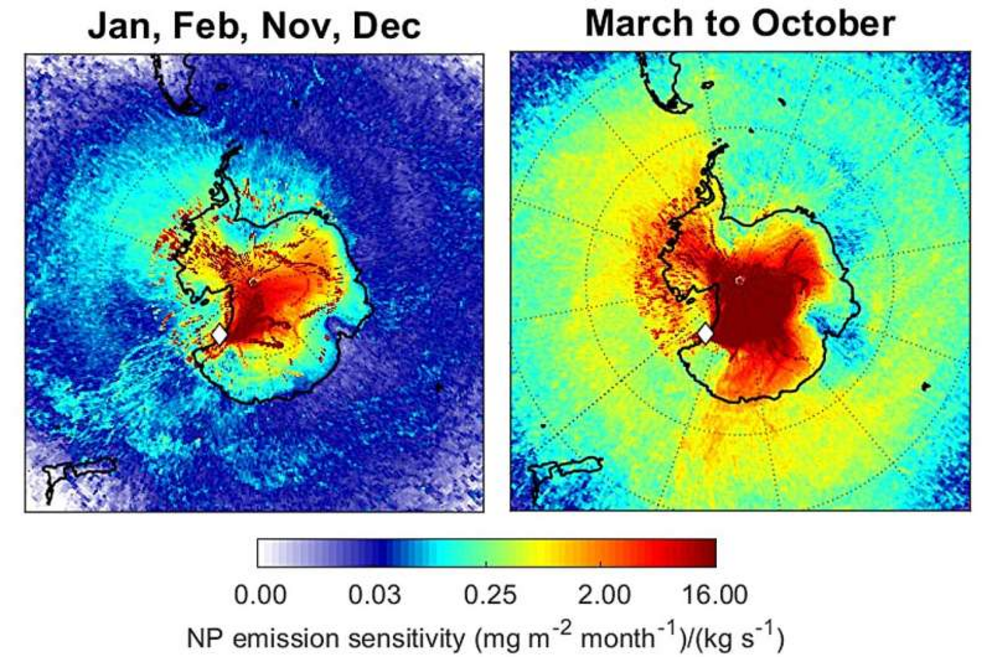 Footprint emission sensitivity for deposited NPs in Antarctic summer (left) and all other months (right) expressed in mg. m?².month?¹ per kg. s?¹. At each grid cell, the colors show the simulated accumulated monthly deposition flux (mg m?²) at the recepto
Testing in remote Antarctic soils
To test for nanoplastics, the team extracted soil samples from the Taylor and Wright valleys in the McMurdo Dry Valleys in January 2023. They tested 13 topsoil samples and four deeper soil samples from more than 20 centimeters (8 inches) deep. They used the newly developed soil protocol and measured nanoplastics with thermal desorption proton-transfer-reaction mass spectrometry. They also tested for microplastics.
Nanoplastics were detected above detection limits in 54% of the 13 topsoil sites, with concentrations up to 295 nanograms per gram of soil. They were also detected in half of the deeper soil layers at lower levels, suggesting some vertical movement or burial. Six commonly used types of plastic were identified throughout the soil, including polyethylene, polypropylene, polyethylene terephthalate, polystyrene, polyvinyl chloride and particles from tire wear. Polypropylene dominated overall by mass at 41.9% of the total, followed by tire-wear particles at 29.6% and polyethylene at 14.6%.
The researchers note that concentrations are likely underestimated, as the recovery method does not have 100% extraction and measurement ability. They also say the method may be biased toward detecting smaller nanoplastics, potentially missing some of the larger particles. Another limitation is that the sample size was not large, and results showed strong patchiness, making it hard to generalize across all Dry Valley soils.
Contaminating the world's most remote areas
The team also questioned the methods of transport for the nanoparticles in these remote valleys. They used atmospheric "backward" modeling to infer potential source regions and seasonal deposition patterns. The modeling suggested that both local sources, like research stations and some limited tourism, and long-range atmospheric transport were to blame. They also note that melting sea ice is a potential source, releasing previously trapped plastics during melting. Results showed strong seasonal differences in likely source regions.
The researchers explain, "Research stations such as Ross Island, Scott Base, McMurdo Station, and the Marble Point Weather Station—together with two small US outposts in the Taylor Valley that support researchers during the summer—are located within approximately 100–120 km of our sampling sites. McMurdo Station accommodates up to 1,200 people during summer and around 150 in winter, while Scott Base hosts 86 people in summer and 11 in winter. This may also explain why, during the Antarctic summer, plastics are more locally sourced within the continent."
On the other hand, the researchers say that long-range atmospheric transport significantly contributes to both nano- and microplastics in remote areas, including Antarctica. Particles ranging from 100–1000 nm can travel long distances through the atmosphere, even halfway around the world. Past studies have found evidence of microplastics remaining airborne for extended periods and being deposited thousands of kilometers from their sources. They say their models suggest long-range atmospheric transport is a greater source of nanoparticles during the winter in the McMurdo valleys.
The team says these results can provide a baseline data set for environmental assessments and policy discussions in the future. They urge identification of likely source pathways that can inform waste management and operational rules for research stations.
Publication details
Quynh Nhu Phan Le et al, First evidence of nanoplastics in Antarctica soil, Scientific Reports (2026). DOI: 10.1038/s41598-026-60433-w
Journal information: Scientific Reports