
Finding the honey bee dance floor: new method shows how it moves within the hive
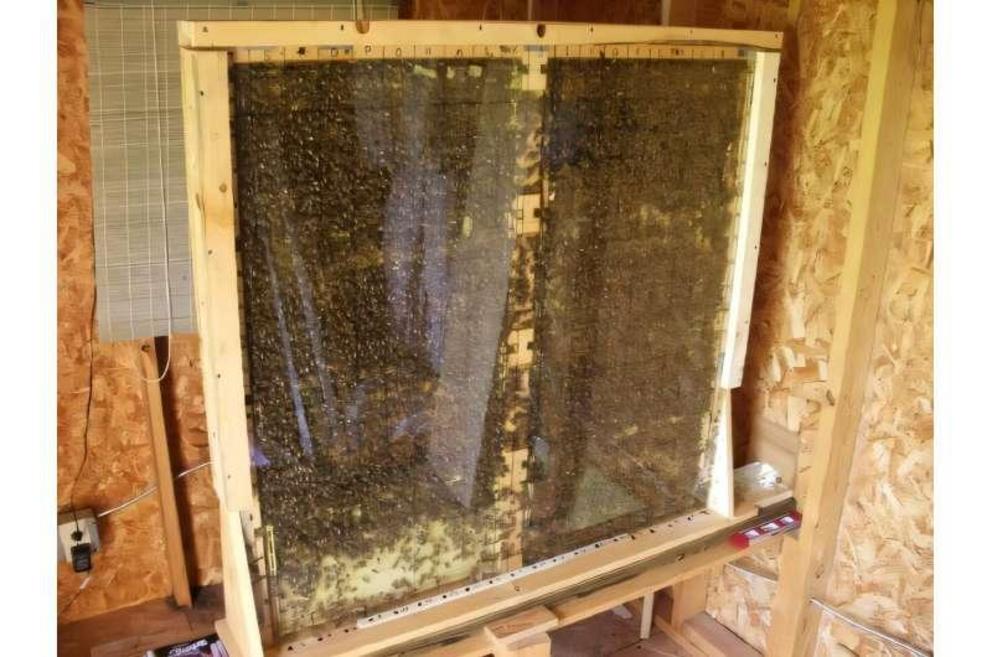
The eight-frame observation hive used in the experiments, with the grid painted on the glass.
When honey bees find a good source of food, they return to their hive and perform a waggle dance. It consists of a series of movements that communicate the direction and distance to nectar, pollen or water relative to the sun. For years, scientists had a vague understanding of where this occurred in the hive, generally describing it as near the entrance. But in a new paper published in the journal PLOS One, researchers have developed a mathematical method to pinpoint the exact boundaries and shape of the region where this form of communication occurs, an area known as the dance floor.
Digital mapping
To map dance floor locations, the research team observed eight bee colonies in glass-walled hives, either four-frame or eight-frame. They recorded the exact locations of 7,444 waggle dances and fed the coordinates into specialized mapping software.
The scientists mapped every waggle dance and drew a line around the outermost dancing bees. A few bees wandered outside this area, so they also drew an oval around the area where most of the bees were dancing. The dance floor was defined as the specific area where these two shapes overlapped, capturing both the main cluster of dancing and the extended reach of activity.
With this information, the scientists discovered that the dance floor is more dynamic than previously thought. It drifts across the honeycomb depending on the time of year, hive size and time of day. In the smaller hives, the dance floor was longer and moved around more as the seasons changed. In the larger hives, the angle of the dancing area shifted throughout the day.
"Our geometric definition of the honey bee dance floor offers a new framework for quantifying spatial organization of recruitment dances," commented the scientists in their paper. "It yields distinct metrics that can be compared across time of day or time of year, among colonies, or across ecological contexts."
Checking bee health
Knowing the boundaries of the dance floor is useful for a variety of reasons. The researchers suggest it can be used to understand how bees respond to stress. If a colony is exposed to pesticides or lacks food, its communication may break down.
Scientists will now be able to measure whether a stressed hive's dance floor shrinks, moves or disappears. Additionally, knowing how much space they need for their waggle dance can help beekeepers and scientists design better hives.
Publication details
N. Van Nest et al, Quantifying the honey bee dance floor: A data-driven method for defining and comparing waggle dance regions, PLOS One (2026). DOI: 10.1371/journal.pone.0341456
Journal information: PLoS ONE