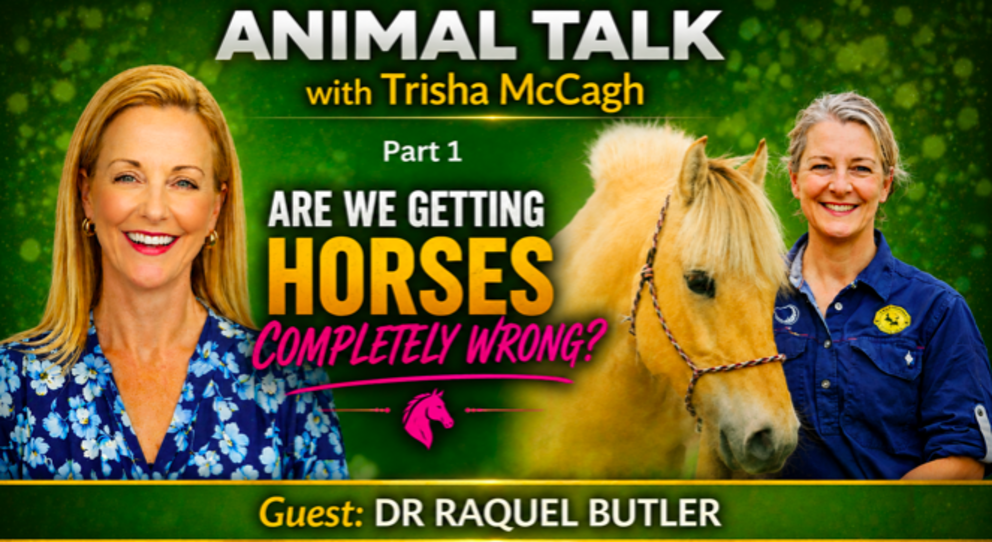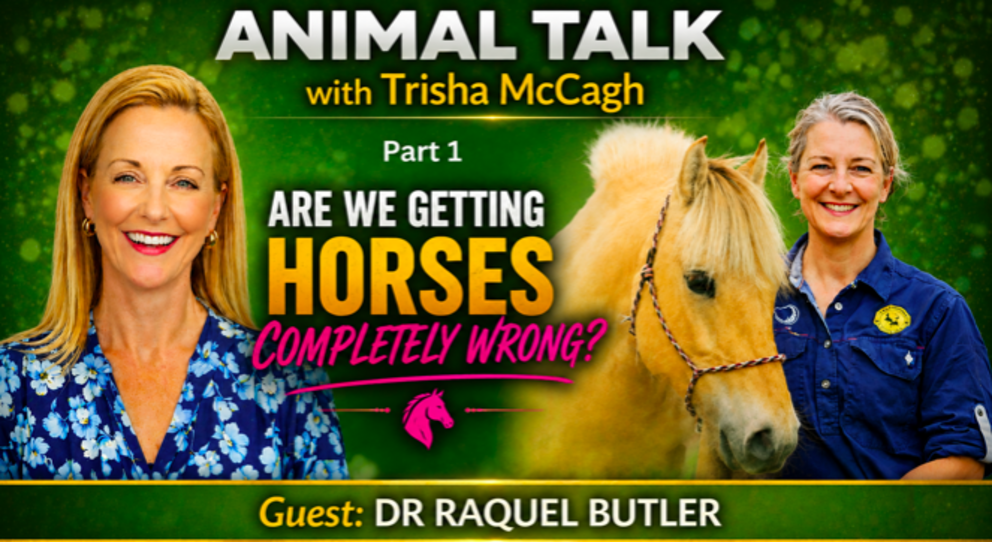
Are we getting horses completely wrong? (Part 1) animal communicator Trisha McCagh with Dr. Raquel Butler
In this episode of Animal Talk with Trisha McCagh, we’re joined by Dr. Raquel Butler—veterinarian, educator, and advocate for equine wellbeing. We explore equine biomechanics and how many “behaviour problems” in horses are often linked to physical discomfort. Dr. Raquel shares how working with challenging horses led her to understand the role of posture, movement, and physiology in overall wellbeing.
Horses communicate constantly through their bodies—how they stand, move, graze, and rest. We discuss functional posture and why there is no one-size-fits-all approach. Every horse is unique, and recognising this can greatly improve comfort, performance, and quality of life.
We also cover preparation, including warm-up and cool-down routines, and how even short targeted exercises can make a big difference. A key focus is the nervous system—horses need time to integrate new movement patterns for lasting change.
In this week’s Animal News, we look at Veronica the cow, who went viral for using a broom to scratch herself. While scientists debate whether this counts as tool use, the bigger question is why we are still surprised by animal intelligence.
Episode Chapters
00:00 – Introduction to Dr. Raquel Butler 01:45 – From difficult horses to biomechanics 04:43 – Misunderstanding horse behaviour 06:43 – Functional posture explained 10:12 – Discipline and physical impact 13:24 – Importance of preparation 16:32 – Warm-up and cool-down 18:56 – Small exercises, big results 22:13 – Observing posture daily 26:16 – Real-world examples 28:30 – Nervous system and learning 31:24 – Integration of movement 32:59 – Wrap-up & Part 2 preview
Animal News
This week we feature Veronica, a cow from Austria who gained global attention after being seen using a broom to scratch herself. She adjusted it to reach different areas, showing clear problem-solving ability. Scientists debate whether this qualifies as tool use, but the deeper question is why such behaviour still surprises us. From her perspective, it’s simply practical intelligence. The story raises broader questions about how we define intelligence. Animals consistently show awareness and adaptability, yet we often measure them against human standards. It also highlights contrast in living systems—animals tend to operate in balance with nature, while humans often overconsume and generate waste. There is much we can learn from observing the natural world more closely.
About the Guest
Dr. Raquel Butler is a veterinarian specialising in equine biomechanics and functional posture. Her work focuses on movement, anatomy, and rehabilitation to improve horse comfort and performance. She provides practical tools to help owners better understand their horses and build stronger, more informed connections. https://www.integratedvettherapeutics...
Coming Up in Part 2
Can a horse's posture reveal what they're feeling emotionally? In Part 2, Dr. Raquel Butler explains the powerful links between movement, behaviour, and emotional wellbeing. We uncover the body language cues many owners miss, discuss how horses communicate through subtle physical changes, and explore ways to develop a deeper, more intuitive partnership with your horse. Plus, we'll look at how greater awareness can help you build trust, improve communication, and better understand the horse standing right in front of you.
Listen, Share & Stay Connected
If this episode resonated, follow, subscribe, and share Animal Talk with Trisha McCagh with fellow horse lovers. Your support helps bring these conversations to more people and improves outcomes for animals everywhere.