
This ancient sea worm has 'bio-metal' jaws unlike anything scientists have seen
A tiny sea worm's metal-like jaws may have revealed an entirely new class of natural materials.
Source:
American Institute of Physics
Summary:
An ancient sea worm may hold the secret to a whole new category of natural materials. Its jaws combine proteins and metal ions in a way that gives them metal-like strength and unusual mechanical behavior, yet they still differ from traditional metals. Researchers believe these "bio-metals" could open new directions in materials science while revealing just how sophisticated nature's designs can be.
FULL STORY
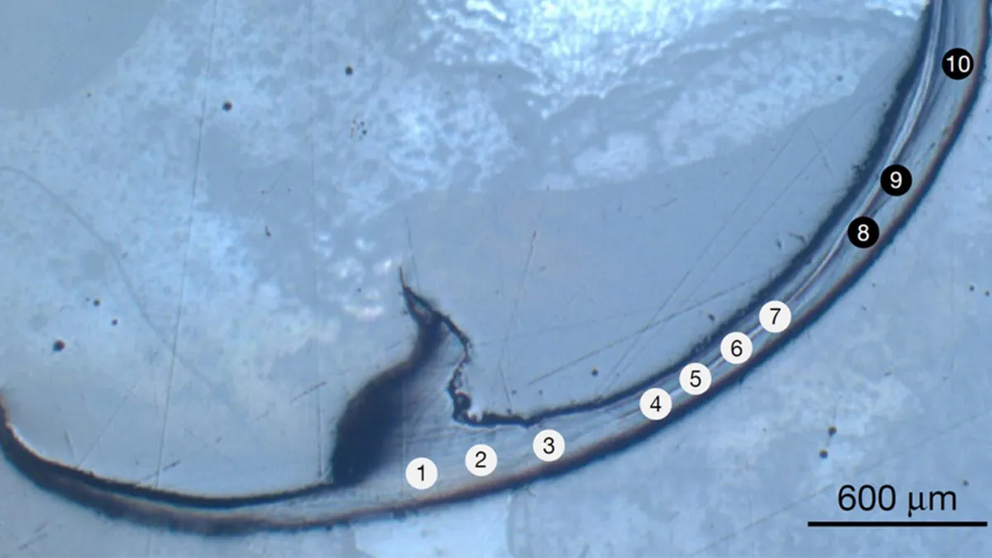 A cross-section of a bristle worm jaw sample with the indentation testing sites labeled.
Imagine playing the game "20 Questions" with the opening question: "Animal, vegetable, or mineral?"
For the ancient sea worm Perinereis cultrifera (which is still around to this day), the answer is surprisingly complicated. Like other predatory bristle worms, this species has jaws built from structural proteins and ions. The animals use these hard mouthparts to bite, crush, and consume their food.
The unusual composition and behavior of these jaws have led researchers to describe them using a new term: bio-metals. The concept is now becoming an emerging area of biophysical research.
What Makes a Bio-Metal Different?
Scientists have previously used phrases such as "metallike biomaterials" or "biomaterials with metallike properties" for biological substances that resemble metals in strength or electrical conductivity.
Bio-metals, however, are defined more specifically. Researchers classify them according to three main features: hardness, the way they respond to strain, and the structure formed by ions and proteins.
In a study published in Biophysics Reviews, by AIP Publishing, scientists from TU Wien (Vienna University of Technology) and the University of Vienna investigated the metal-like behavior of the sea worm's jaws. Their goal was to help clarify what distinguishes bio-metals from other natural materials.
Metal Ions Strengthen the Jaw Tips
The team first measured jaw hardness using nanoindentation, a technique that presses into a material at a microscopic scale. They combined these tests with chemical analysis and detailed imaging.
Their results supported earlier research showing that metal ions are more concentrated at the tips of the jaws than in the central regions. This higher concentration likely helps make the tips harder and better suited for biting and crushing.
The researchers then tested the jaws using several indentation depths. They found an unexpected effect that is also seen in metals such as copper and silver.
Known as the Nix-Gao nanoindentation size effect, this phenomenon means that smaller areas of a material can be more difficult to dent. In the worm's jaws, sharper changes in strain across tiny regions appear to increase the interlocking of defects within the atomic structure, producing the characteristic size effect.
Sea Worm Jaws Do Not Behave Like Ordinary Metals
Although the jaws share several traits with familiar metals, they also have mechanical properties that set them apart.
"Bristle worm jaws also showed size-dependent elasticity. This is a distinguishing feature of bio-metals when compared to standard crystalline metals like copper or silver," said author Christian Hellmich.
The team used mathematical models to explain how these unusual elastic effects may arise at the atomic level. According to Hellmich, however, researchers are only beginning to understand these natural materials.
Nature Could Inspire New Materials
"We plan to extend the experimental database by investigating additional species to refine the theoretical concept and perform dedicated computations, and perhaps most interestingly, to explore the link between genetic interventions and the corresponding material design space," he said. "All this comes with true excitement about the beauty, elegance, and refinement found in and produced by nature."
Journal Reference:
- Luis Zelaya-Lainez, Friedrich S. Schuster, Stefan Manhartseder, Maximilian Landegger, Kyojiro N. Ikeda, Florian Raible, Olaf Lahayne, Stefan Scheiner, Christian Hellmich. “Bio-metals”: Ancient biological materials with nanoindentation size effects: Experiments and elements of manifold micromechanics. Biophysics Reviews, 2026; 7 (3) DOI: 10.1063/5.0325367