The Younger Dryas Impact Hypothesis: A guide for the perplexed
Part I - Preface
This article was written over a period of ~19 months, during which time there have been several developments in the YDIH. In the most significant development, the central group of YDIH critics, corralled by Mark Boslough, chief enforcer for the impact mafia, published a behemoth of a “gish gallop” masquerading as a “comprehensive refutation” to the YDIH. Despite its exhaustive length, (~96,000 words) it suffers from the same issues that all of this group’s previous contributions do: They don’t offer credible alternative explanations for the physical and geochemical evidence for cosmic impact found at the Younger Dryas boundary. Their only relevant arguments (there are plenty of irrelevant ones including dozens of fallacies) are to call into question the YDIH team’s interpretation of the evidence, saying that it may be all caused by other independent processes, but refusing to elaborate. Luckily, this article does not need much of an update, and Dr. Martin Sweatman has written a comprehensive point-by-point rebuttal on his blog Prehistory Decoded that sufficiently addresses some of the more specific points made in their failed refutation. While this article addresses a few of those points, I would appeal to people who enjoy this article to also read Martin’s responses. For those who have not followed the debate closely over the years, and find the 300+ entries of the comprehensive YDIH bibliography intimidating, this article aims to serve as a comparatively concise guide to the YDIH. It provides commentary and analysis of many arguments made against the YDIH over its 16+ year history and demonstrates that, contrary to repeated claims of its demise, it is actually in a stronger position than ever.
Introduction
Since it was first officially proposed in 2007, the Younger Dryas Impact Hypothesis (YDIH) has attracted significant controversy. The hypothesis claims that a major extraterrestrial impact affected much of the world ~12,800 years ago, initiating a ~1,200-year period of cooling called the Younger Dryas that had many environmental consequences. Around the time of the Younger Dryas onset, more than 50 genera of megafauna (animals heavier than 44 kg) disappeared from the fossil record in a geological instant. At the same time, Clovis fluted projectile points also appear to have disappeared, though it is important to note that ‘Clovis’ refers to a specific technology or method of manufacturing stone tools, and not to a culture or a people. The people who manufactured Clovis points were not wiped out. Many different anomalous objects were found in the layer of sediment that dates to the onset of the Younger Dryas in many parts of the world, including:
Magnetic grains and microspherules
Strange carbon spherules
Fragments of melted carbon that resembled glass
Exotic charcoal and soot
Multiple species of nanodiamonds and exotic graphene polymorphs
Fused quartz grains, shocked quartz, and melt glass (limited sites)
Many of these proxies have associated with cosmic impacts and intense wildfires in the past, but some have not, which is one of the reasons for the strong pushback by critics. All this means is that we are dealing with cutting edge science here; airbursts of the type proposed for the YDIH are poorly understood, and all of the diagnostic proxies -can- be produced by airburst events; it is just that they haven’t yet been shown to within the scientific community and the field of planetary science.
The YDIH suffered significant setbacks in its infancy when a few independent groups were unable to replicate key results from the original sites, leading to its premature rejection. Fortunately, over the next decade these early replicability issues were shown to be due to either misunderstandings of the original claims, or methodological flaws, and were largely resolved. Many of these early issues are covered extensively in this article. Over the years we have gained significantly more details and understanding of the proposed impact proxy evidence, and this has gradually convinced a considerable number of scientists of the YDIH’s merit, at least those who aren’t ideologically opposed and who keep up with the literature. For every vocal critic of the YDIH, there are at least a dozen silent supporters within the scientific community, scores of which have reached out to proponents to offer supporting words. It has also received significant attention from the general public, who are primarily introduced to it in popular culture by figures such as Graham Hancock and Joe Rogan, rather than scientific literature. This tends to draw the ire of authoritarian “science communicators” who see themselves as the anointed ones, see people like Graham Hancock as existential threats to their carefully woven narratives. The reality is, many of these “science communicators”, particularly Mark Boslough, are merely science deniers who have devoted their lives to worshipping and enforcing the prevailing paradigm on social media and discrediting novel hypotheses. As explained and cited in my previous article on this website, they see the public as inherently inferior rabble, incapable of properly understanding scientific data, and consider it their duty preach the gospel of scientism. They fancy themselves the priests of scientism, disseminators of the word of science to the unwashed masses. However, not everyone is convinced; pushback mainly comes from a small group of persistent, yet vocal and influential critics insist that the YDIH has no merit and has been conclusively debunked as pseudoscience. This could not be further from the truth; this review examines the evidence for the YDIH in depth, providing commentary on some of the early issues and arguments against the hypothesis, and demonstrating that the YDIH is far from debunked.
Many journalists and non-academic speculators have gone beyond published scientific literature in exploring the consequences of the YDIH, and there is a long history of vague narratives of catastrophe at the end of the ice age. For more than 500 years, well educated people (for their day) such as Edmond Halley, William Whiston, Isaac Newton and Charles Darwin have all agreed that some sort of major catastrophe occurred at the terminal Pleistocene. Contrary to critics’ like John Hoopes’ interpretation of this fact as evidence against the YDIH, this should actually strengthen the argument. All of those people could see the result of the catastrophe as plain as day with their own eyes, and now hundreds of years later, we finally have the instruments and scientific knowledge to examine the direct physical evidence for it.
The formal proposal of the YDIH in the scientific literature, which despite a thematic link is distinct from those vague narratives of catastrophe, marked the development of a specific, coherent, plausible and testable hypothesis based on abductive reasoning. Thus, these narratives are irrelevant to the YDIH. In a similar vein, promotion of the YDIH by controversial figures like Graham Hancock has nothing whatsoever to do with the data and evidence for it. A common tactic of YDIH critics is to incorrectly frame the hypothesis as being primarily driven by people like Graham and various alternative history influencers, rather than the cold hard scientific evidence published in peer reviewed journals. Nothing could be further from the truth, as the debate has generated more than 200 peer reviewed scientific papers and approximately 100 conference presentations. Most people, especially the public, are unconvinced by these tactics.
Thus, analysis throughout this article includes detailed dissections of arguments, evidence and data, historical and chronological context for the YDIH debate, explanations of why many issues pertinent to the YDIH are still unresolved in science or based on shaky paradigmatic foundations. Occasionally, original arguments are made in conjunction with rampant speculation to parsimoniously explain or resolve long-running debates. Such speculation should not be seen as a positive claim, but rather a potential alternative explanation and/or thought experiment. It provides a broad context of peer reviewed literature on issues pertaining to, but distinct from, the YDIH to provide a counter narrative to the critics who seek to claim it has been debunked. It explores the history of the YDIH, the claims, arguments, and evidence for and against its various aspects, and most importantly, details why many of the claims of critics are simply nonsensical quibbling. Many of their claims are unsupportable because they assume a solid understanding of the simplest concepts; the most up to date data has shattered more than 50 years of paradigmatic development concerning the distinction between comets and asteroids. Areas of scientific inquiry study suffering from a significant lack of consensus or uncertainties that the YDIH can potentially help resolve are also periodically examined. Some of the points made will likely fit the definition of various logical fallacies, but there is another type of logical fallacy called the fallacy fallacy, where just because an argument is fallacious, that does not make it wrong. Regardless, the fallacy to page ratio of this article is far lower than Holliday et al.’s ‘comprehensive refutation’. Martin Sweatman is leading a parallel effort to directly respond to that paper in the peer reviewed literature, which I and several other authors are also involved in; this article has a much broader focus than just their paper.
The Younger Dryas
~12,800 years ago, a prolonged cooling event known as the Younger Dryas (YD) occurred throughout the Northern hemisphere and much of the Southern hemisphere, marking a return to late glacial conditions for ~1200 years (Broecker et al. 1988). Since it was first discovered by Scandinavian paleobotanists in the early 1900’s and named for Dryas octopetala, a cold-adapted alpine flower that flourished in the glacial conditions of the YD, it has captured the imagination of countless scientists. Following several thousand years of warming throughout the Bølling-Allerød, temperatures in areas of the Northern hemisphere rapidly plummeted by ~8°C in as little as a few decades, up to a century (Alley 2000). However, while these temperature changes seem to have occurred over a few decades, atmospheric changes occurred more rapidly, and in some places hydrological changes occurred in as little as 1 year or less, as recorded in lake varves (Neugebauer et al. 2012). After this ~1200-year epoch of glacial conditions, temperatures skyrocketed by up to ~10°C in around a decade, a change even more rapid than at the YD onset (Dansgaard et al. 1989; Alley 2000). Similar changes, though less severe, are a normal part of ice age cycles, but they typically occur gradually over hundreds or thousands of years and are poorly understood; such sudden and extreme changes wreak havoc on the ecosystems they affect.
Vegetation species are usually suited for a specific climate; such rapid and significant changes in temperature and rainfall would lead to plant life in a particular region being no longer adapted for that region, meaning it would die off and be replaced with species more suited to the new conditions. The same is true of animals who rely on that vegetation for food or habitat; they would suddenly find themselves without any food, and seasonal behaviours like migration and hibernation would have experienced major interruptions. People would also have been forced to change their lifeways; as the plants and animals they relied on for food were killed off or forced out by the environmental changes, people would have needed to either adapt to the rapid changes or move to new areas where they could survive.
Ice core records show that ice ages, known as glacial periods, are often interspersed with major swings, or oscillations called Dansgaard-Oeschger (D-O) events (Figure 1), where temperatures rise or fall very quickly in a relatively short time. D-O events are characterised by a rapid rise in temperature, typically around ~5°C within a few decades, followed by prolonged cooling over several hundred to several thousand years. While aspects of the YD somewhat resemble previously recognised Dansgaard-Oeschger (D-O) cooling events, it also has some significant differences. Atmospheric methane concentrations fell rapidly from ~680 ppb down to ~460 ppb at the YD onset (Broecker 2006), where it remained throughout the YD before rapidly spiking to ~750 ppb at its termination (Figure 1). This leads some to believe it was likely initiated by an outsized “freak event” (Broecker 2006) unique among past deglacial processes. Furthermore, the YD onset occurred as Earth was receiving more energy from the sun than it had at any time in the previous ~65,000 years; a 1,200-year return to glacial conditions should be difficult to sustain in this scenario, adding to its intrigue.
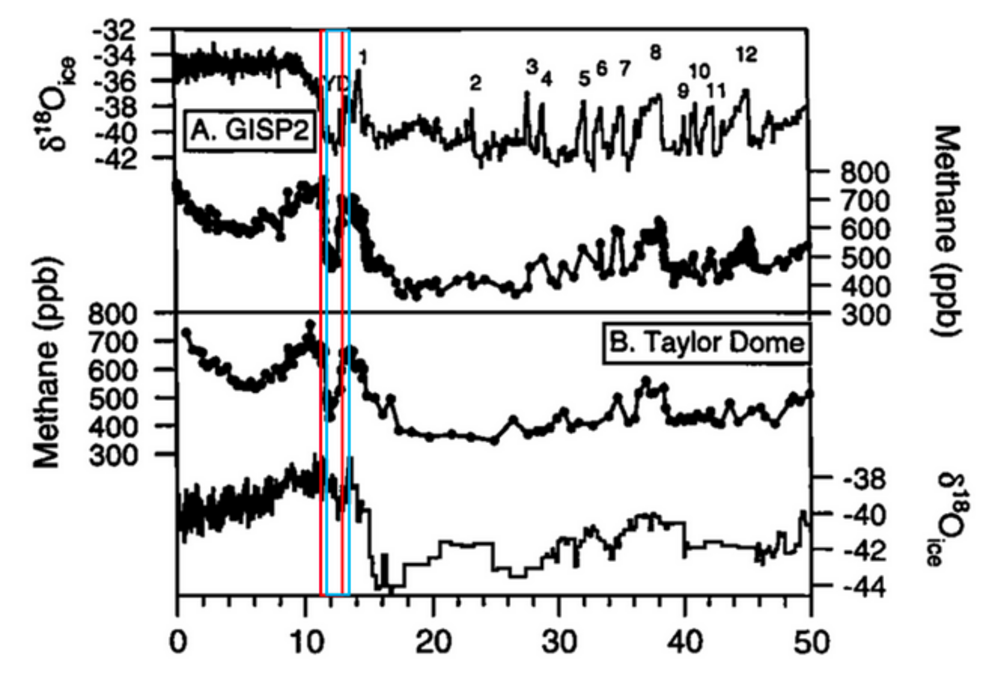
Figure 1: Atmospheric methane concentrations over the last 50,000 years. The largest and most abrupt fluctuations in the record occur at the onset and termination of the YD (Red Box). In Greenland the methane concentration closely correlates with temperature during past climate fluctuations. However, methane was less affected in Antarctica during those same past fluctuations, except for at the YD onset, where the methane event tracks very closely with Greenland. Dansgaard-Oeschger events marked 1-12. Despite the offset between the Antarctic Cold Reversal (ACR) (Blue Box) and the YD, the methane concentrations are not offset. Adapted from Brook et al. 2000.
Early on, the effects of the YD were thought to be global (Schneider et al. 1987; Peteet 1995; Clapperton et al. 1997; Andres et al. 2003), but later work caused this notion to fall out of favour (Lowell & Kelly 2008; Tibby 2012; Mendelová et al. 2020). However, recent data from South Africa and South America has shown it did significantly affect some areas of the Southern hemisphere (Stansell et al. 2010; Truc et al. 2013; Pino et al. 2019). Abrupt warming in the Northern hemisphere is often contradicted by abrupt cooling in the Southern, and vice-versa, an effect known as the ‘bipolar seesaw’ (Pedro et al. 2016; Renssen et al. 2018; Pino et al. 2019; Svensson et al. 2020). The warming of the Bølling-Allerød in the Northern hemisphere was countered in the Southern hemisphere by the cooling of the Antarctic Cold Reversal (ACR), which transitioned to warming just as the YD cooling was beginning in the north (Pedro et al. 2016).
A recent pre-print pioneering a new paleoclimate proxy appeared to support the idea of YD cooling in New Zealand (Holdaway 2021), but the paper was rejected during peer review. Upon reading the peer review records, it appears to have been rejected for ostensibly no reason other than its findings conflict with the prevailing paradigm (McGlone 2021; Jara 2021). In summary, there is still quite a lot of unanswered questions about the nature of the YD period in the Southern hemisphere. For example, when exploring possible research projects for postgraduate studies, it became clear that many climate records for Australia show significant perturbations at the YD onset. In some records, hiatuses, or time skips in the record, larger than the peak of the glacial period are present (Falster et al. 2018), suggesting significant environmental changes were taking place. The result of these hiatuses, which can be caused by erosional events or periods of low deposition, is that we can’t claim to know what occurred in the time the tape recording was paused with any certainty.
As glacial ice melts as a normal part of the cycle, water pools up behind obstructions like mountains, moraines, ridges, or ice dams, eventually forming glacial lakes, of which there were many in North America throughout the ice age. Glacial Lake Missoula in Montana measured around ~7,800 km2 and glacial Lake Agassiz, which covered up to 440,000 km2 between 5 provinces and states (Manitoba, Ontario, Saskatchewan, Minnesota and North Dakota). Around the YD onset, significant volumes of water drained catastrophically from Lake Agassiz into the northern oceans, and this has long been thought to have caused the YD cooling by preventing the exchange of warmth between the ocean and atmosphere. In this scenario, a “freshwater cap” would have formed on the surface, acting as a barrier against the warmer, saltier ocean water, like how oil sits on top of water (Condron & Winsor 2012). This “freshwater cap” would have prevented warm water from the tropics reaching the surface, and cold water from the Labrador & Greenland seas would have sunk to the deep ocean (Broecker et al. 1988; Broecker 2006; Condron & Winsor 2012). However, to date there is no consensus on the route the meltwater took from Lake Agassiz around the YD onset, or even which ocean it drained into, though several potential routes have been explored (Murton et al. 2010; Condron et al. 2012; Rayburn et al. 2017; Leydet et al. 2018, Figure 2). Murton et al. (2010) find that Lake Agassiz was able to discharge north through the Mackenzie River into the Arctic Ocean (Figure 2), and Condron & Winsor (2012) agree. Conversely, Rayburn et al. (2017) find that Lake Agassiz likely discharged eastwards through the St. Lawrence River into the North Atlantic Ocean (Figure 2), and Leydet et al. (2018) agree. In total, at least 3 drainage routes into 3 different oceans are proposed (Figure 2).
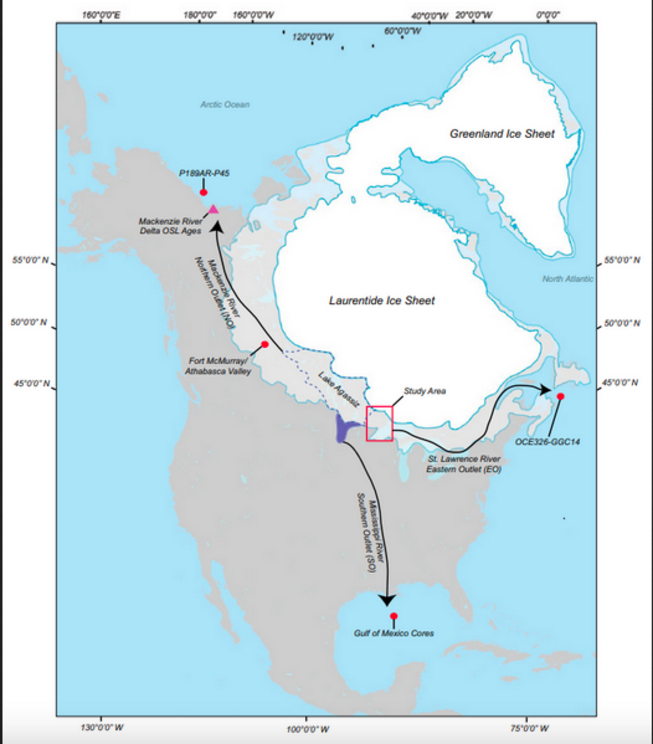
Figure 2: Proposed drainage outlets for Lake Agassiz at the YD onset. Reproduced from Leydet et al. (2018)
These three alternative drainage routes have been intensely studied over the decades and are usually seen as mutually exclusive; the meltwater must have either drained through one or the other, and there is still no consensus as to which route is correct, because there is evidence supporting all. To further confuse things, a recent study compared a newly obtained suite of radiocarbon dates to a database of older ones (with “outliers” pruned out) in a statistical analysis; they concluded that the proposed drainage of Lake Agassiz occurred several hundred years after the YD onset (Norris et al. 2021; Young et al. 2021). Their conclusions are disputed by experts (Teller 2021) for various reasons, another example of the disagreement over almost every aspect of the draining of Lake Agassiz and its relation to the YD cooling. Teller (2021) cautioned that several of the dates pruned by Young et al. (2021) are only seen as anomalous because of limited dating resolution from around that time, not because they are invalid. In other words, they may have been improperly excluded, which would skew the statistical analysis. Notably, the academic supervisor who no doubt helped design the study and prune the dates is a published critic of the YDIH; make of this what you will.
In order to resolve the long-running dispute over the chronology and drainage route of Lake Agassiz around the YD onset, perhaps an alternative explanation should be sought. Consider this: What if meltwater was flowing out of all outlets simultaneously? But where did that much water come from you might ask? Perhaps it could have come from some sort of catastrophic event affecting the ice sheet? This scenario on a shallow level unifies the divergent hypotheses held by different groups of Agassiz experts as to the drainage route out of Lake Agassiz at the YD; if all three routes were flowing simultaneously, there is no need to argue over which one flowed when. The idea, as proposed by Young et al. (2021), that meltwater drained from Lake Agassiz during the Younger Dryas defies logic; the onset of rapid cooling in North America caused a well-documented glacial advance; if glaciers began to advance again, would this not reduce the volume of available meltwater, or cut off the supply? If glaciers were advancing and providing a steady supply of ice to reinforce ice dams holding back the meltwater, what would cause them to fail? After decades of disagreement and debate over hypotheses with insufficient explanatory power, alternative explanations must be considered. When examined in the context of a catastrophic impact event that may have affected the stability of the ice sheets, the idea that all routes drained simultaneously becomes more reasonable. If there was no overland meltwater pulse from Lake Agassiz at the YD onset, as Young et al. (2021) suggest, perhaps supraglacial or subglacial flows into the ocean in other locations were responsible. A large impact into the Laurentide ice sheet could certainly have triggered subglacial and supraglacial meltwater flows from the ice sheet in sufficient volumes, as originally proposed by Firestone et al. (2007). As it happens, a large impact crater of sufficient size was found near the margin of the Greenland ice, which will be discussed later in this review.
Firestone et al. 2007
In 2007, a multidisciplinary team of scientists published a suite of geochemical evidence supporting a major cosmic impact event at the YD onset, which they call the Younger Dryas Boundary (YDB). Collectively, the authors published works from before and after this paper has been cited by other scientists more than 150,000 times, meaning that the YDB team are influential and well-respected in their fields. Biographic information for some prominent authors of Firestone et al. (2007) is shown below (Figure 3). In 2016, many of these scientists became the core of the Comet Research Group (CRG) and were joined by other proponents of the YDIH.
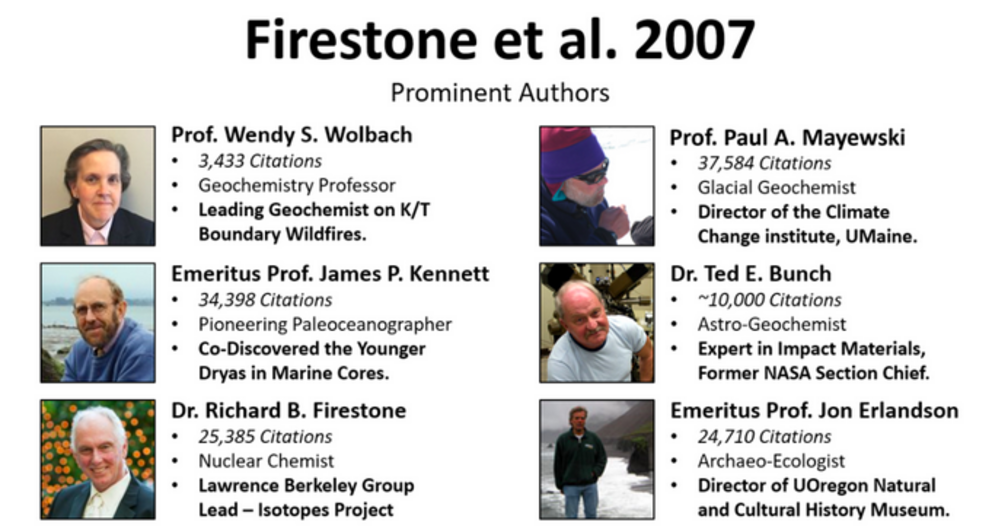
Figure 3: Infographic of several prominent authors of the Firestone et al. 2007 paper. Produced by Marc D. Young
The evidence presented in Firestone et al. (2007) to support their claims of a cosmic impact event at the YDB included elevated concentrations of the following geochemical signatures:
A peak in magnetic grains at the YD onset, irregularly shaped, often subrounded, more abundant in northern sites than southern ones, enriched in titanomagnetite.
A peak in spherical and sub-spherical magnetic grains, termed magnetic microspherules (Figure 4), of between 10 and 250 microns in diameter were reported in concentrations ranging from 97 per kg at Topper, South Carolina, up to 2144 per kg at Gainey, Michigan.
An iridium peak ranging from 2 ppb, ± 90%, to 117 ppb, ± 10% in magnetic grains at the YDB, with the largest peak being >5000 times the crustal abundance. At 9 of the 14 sites they tested, the only Iridium peaks were at the YD onset and inside the black mat.
Bulk sediments at the YD (not the magnetic fraction) were modestly enriched in nickel and contained detectable levels of iridium.
In 14 of 15 sites, the largest charcoal peak occurs at the YD onset, with peaks ranging from 0.06 to 11.63 g/kg between sites.
Aciniform soot, a geochemical marker found at the K-Pg boundary, peaks at 21 ± 7 ppm at the YD onset at Murray Springs, and at Carolina Bay T13 soot peaks at 1969 ± 167 ppm at the same time.
Another K-Pg boundary marker, polycyclic aromatic hydrocarbons (PAHs) were found in the YDB layer, but nowhere else at Daisy Cave, Murray Springs, and Blackwater Draw.
Black, highly vesicular, subspherical to spherical carbon between 150 microns and 2.5 mm were found only at the YD boundary at 6 of 9 archaeological sites, and 13 of 15 Carolina bays, reporting that work is ongoing to confirm early reports that they contain nanodiamonds.
Fullerenes, which are nanoscopic ‘spheres’ of carbon lattice, containing extraterrestrial helium are associated with many ET impacts, including the K-T (now K-Pg) boundary, and were reported from 3 of the 4 archaeological sites analysed.
Fragments of glass-like carbon up to several cm in diameter, examples of which have since been shown to contain nanodiamonds, recovered from all sites they examined in concentrations ranging from 0.01 to 16 grams per kg at the YD boundary.
Geochemical signatures from multiple ice cores around the YD onset; a peak of iridium in the GRIP (Greenland Ice Core Project) ice core, and large spikes of ammonium and nitrate, geochemical markers of biomass burning, in the GISP2 (Greenland Ice Sheet Project 2) ice core reported by prior studies.
A widespread sedimentary layer called the “Black Mat” (Figure 4), which is present at >60 sites across North America at the YD onset, directly above the layer containing impact proxies.
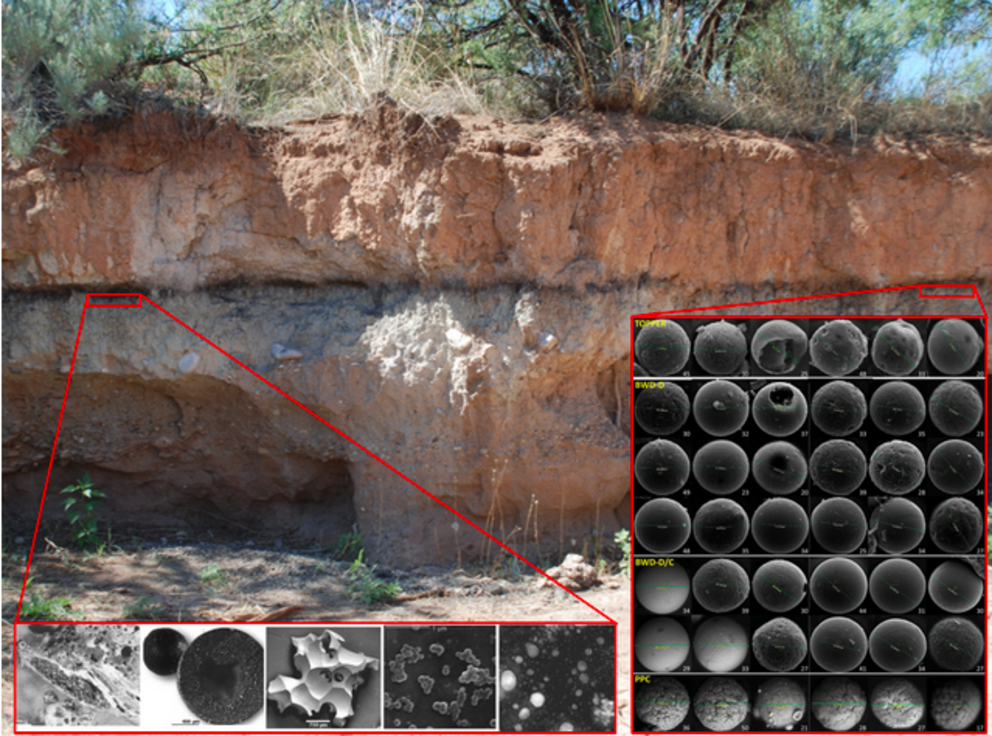
Figure 4. The black mat and various impact proxies that were found in direct contact with the bottom of it. Adapted from Firestone et al. 2007, LeCompte et al. 2012 & Firestone 2019.
In addition to the above geochemical evidence, they also connected the well-accepted extinction of more than 30 genera of megafauna and the disappearance of the Clovis technocomplex to the impact event; both occurred abruptly at, or very close to, the YD onset. The discovery of Big Eloise, a fully articulated mammoth (except for her back legs) at Murray Springs closely associated with Clovis points is interpreted as representing the day the impact event occurred, in the same way as the Tanis fossil site with the Chicxulub impact (DePalma et al. 2021; During et al. 2022). On that fateful day ~12,800 BP, a Clovis hunter dragged a mammoth haunch to a nearby campfire to cook it but was interrupted by a major cosmic event unfolding in the sky above. Eloise’s leg remained next to that hearth until it was uncovered by a team of archaeologists at the Murray Springs Clovis site in 1966. Eloise’s black-stained bones were found draped in the organic-rich black mat, untouched by scavengers and in direct contact with the layer containing the impact evidence. While Firestone et al. (2007) does not reference Eloise by name, she is mentioned briefly in the final paragraph before the conclusion.
In their paper, Firestone et al. (2007) propose two hypothetical impact scenarios that could potentially explain the evidence they were finding; because no crater has been linked to the YDIH, all they could do was provide potential scenarios. One scenario proposes that a large (>4 km diameter), low-density comet struck the Laurentide ice sheet, which cushioned the blow and minimized or prevented crater formation. The other is an interaction with a particularly dense and violent region of one of the many annual meteor showers that still occur today; fragments of cometary debris of various sizes orbiting within meteor streams rained down all over the planet causing smaller-scale local impacts and airbursts over vast areas, a so-called comet swarm. This rain of cometary debris remains the preferred impact scenario by most proponents of the YDIH to this day. These two scenarios, and arguments around them, will be examined in more detail later in this review. It is worth noting that Firestone et al. (2007) was not written in a tone that states “this is the evidence, this is what happened, everyone else is wrong, we’re right, come and get us”, but rather more like “this is the evidence, we think it is interesting and worthy of further investigation, here are some potential scenarios that might explain it”.
An important factor that is often overlooked, ignored, or significantly downplayed, is the utility of YDB impact proxies as a geochemical datum that can be correlated over vast distances as a very precise method of absolute dating; currently, significant uncertainties between hundreds and thousands of years are built into radiocarbon dating, and the proposed geochemical datum could be used for absolute, very high-resolution stratigraphic calibration. These layers, known as “spherule layers”, are used to correlate many other impact layers over vast distances (Simonson & Glass 2004; Glass & Simonson 2012). The uncertainties inherent to radiocarbon dating are especially pronounced at the YD boundary, where a major perturbation in atmospheric radiocarbon resulted in an anomaly of ~400 radiocarbon years in the space of ~100 calendar years (Fiedel 2011). This is another feature of the YD that is unique amongst previous D-O climate oscillations. A synchronous deposition of impact material across North America & other continents should allow direct stratigraphic correlation over vast distances, overcoming the need for reliance on radiocarbon dating alone for establishing chronostratigraphic relationships.
It is fair to say that various aspects of the Younger Dryas impact hypothesis (YDIH), just as with any scientific hypothesis, have evolved substantially since the original 2007 paper as new evidence has come to light. Additional lines of evidence have been added, existing evidence has been expanded and reinforced, and some original lines of evidence have fallen out of favour. One major development in the form of the discovery and extensive replication of a global platinum anomaly at the YDB has become one of the strongest lines of evidence supporting the YDIH (Petaev et al. 2013; Moore et al. 2017, 2019; Thackeray et al. 2019; Pino et al. 2019; Moore et al. 2020). Another significant development was the discovery of a major Y-chromosome genetic bottleneck in humans around the YDB (Karmin et al. 2015; Sepulveda et al. 2022); the ratio of males to females was reduced to as low as 1:17, meaning some sort of event reduced the male population significantly at the YDB. The geographic extent of much of the initial evidence has been expanded, such as microspherules, nanodiamonds, wildfire evidence, and megafaunal extinctions. In addition to geographic expansion, much work has been done on resolving questions pertaining to how this evidence relates to an impact event. As mentioned, some evidence from the original paper has been put on the backburner, with no attempts made to replicate it, namely the radiation anomalies and polycyclic aromatic hydrocarbons (PAHs).
Unfortunately, despite being mentioned in Firestone et al. (2007) and presented at the AGU conference where the YDIH was announced, the fullerenes containing ET helium have never been published, and no attempt has been made to replicate them. This evidence was brought to the table by Dr. Luann Becker, an early member of the YDB team, who has never published it, and has since disappeared entirely from the scientific community. The reasons for this strange occurrence are unknown, but it does cast a shadow of doubt on the YDIH and has left room for critics of the YDIH to spread claims of malfeasance. Thus, the fullerene & ET helium evidence should not be considered as evidence supporting the YDIH and will not be discussed in this review. Because the hypothesis has evolved over time, this has enabled critics to pick and choose from a variety of claims made by various people since 2007 and manufacture the least charitable Frankenstein of a strawman to attack. Consequently, the use of arguments against a hypothesis or individual claims that are unrelated to the YDIH as it stands today is a major component of attacks on the YDIH (Boslough 2012; Holliday et al. 2023). Contrary to their claims that the evolution of the YDIH since 2007 is a major weakness, progression and refinement of a hypothesis is an entirely expected, if not mandatory, component of good science. Unfortunately, people like Mark Boslough don’t live in the real world, instead substituting reality for the models they have spent their career producing, like pathological liars who begin to believe their own lies are absolute truth.
Debate Summary
Since 2007, almost 200 papers in peer-reviewed journals and ~100 conference presentations have directly addressed the Younger Dryas impact hypothesis (Young & Howard 2018). Many of these papers are critical of the YDIH or attempt to refute or debunk it. Since a “requiem” was declared for the YDIH in 2011 based on several failed replications (Pinter et al. 2011a), more than 100 papers, including extensive replication and additional evidence, have been published. At the very least, this demonstrates that Pinter et al. (2011a) sought to bury a hypothesis that was far from dead. In response to the firestorm of criticism, YDIH proponents have had become increasingly rigorous with their science, often exceeding the standards of evidence that would be required for their claims within the practice of Kuhnian ‘normal science’ (Kuhn 1962) within the prevailing paradigm. Much of the latest work in the last 5 years has yet to receive a single negative response from critics, even after the “comprehensive refutation”. The standards of evidence for these recent studies has garnered a resurgence of support throughout the academic community for the YDIH. A recent review of the impact evidence by Sweatman (2021a) in Earth-Science Reviews, the same journal that declared the requiem for the YDIH just 10 years earlier, opines that:
“Probably, with the YD impact event essentially confirmed, the YD impact hypothesis should now be called a ‘theory’.”
James Lawrence Powell is an eminent geoscientist renowned for his expansive reviews of published literature on important geoscience issues like anthropogenic climate change and the K-Pg (Cretaceous-Paleogene) boundary impact hypothesis. In a recent peer-reviewed summary, Powell (2022a) chronicles the controversial history of the YDIH, with a particular focus on early criticisms and failed replications. He concurs with Sweatman (2021) that the YDIH was prematurely rejected early in its history and should be re-examined and taken seriously as a legitimate hypothesis. Nevertheless, the most vehement critics of the hypothesis persist in their claims that the YDIH has been debunked, and that continued debate over it is a waste of time and effort (Holliday et al. 2023).
Following the recent publication by the Comet Research Group (CRG) of evidence that an unrelated airburst destroyed the Bronze Age city of Tall el-Hammam around ~3650 BP (Bunch et al. 2021), attacks on the YDIH have switched gears. Due to the air-tight nature of the impact proxy evidence, critics have pivoted to attacking the affiliations and integrity of some CRG members, such as Drs. Allen West and Malcolm LeCompte (Boslough 2022a). This abhorrent behaviour has been criticised by Powell (2022b), who resigned in protest from the Committee for Skeptical Inquiry (CSI) following Mark Boslough’s non-peer-reviewed attack on the CRG in their tabloid magazine, Skeptical Inquirer (Powell 2022c). According to Powell, Boslough’s ad-hominem laden smear piece violated almost every tenet of proper skepticism, and ultimately amounts to an ethics violation (Powell 2022b). Funnily enough, Powell’s article in Research Ethics denouncing Boslough’s conduct only served to further enrage him, changing his relationship with the YDIH from one of mild yet persistent frustration to an all-consuming hatred. He has since devoted his entire existence to doing as much damage as possible the YDIH by any means, which is why the recent comprehensive refutation is so extensive and bitter; they threw every argument possible, including the kitchen sink, hoping one or a few might stick. Further adding fuel to the fire, the tentative association between the TeH airburst and the destruction of Biblical Sodom has added a whole new dimension to the attacks, and significantly amplified the level of hatred and vitriol directed at the study; perhaps the most prolific and normalized form of hatred today is anti-religious bigotry. The way that Boslough in particular talks about this tentative association, it would not be surprising to learn that he has a jumbo-sized signed portrait of Richard Dawkins in his living room. The ‘PubPeer’ page for the TeH paper has been vandalized by Boslough and various anonymous tier 2 critics frequently over the past year with a myriad of garbage arguments attacking Christianity rather than the actual impact evidence.
Boslough is the most dedicated and vehement critic of the YDIH; in his mind, it is entirely without merit and even downright fraudulent. Though he contributed to multiple critical peer-reviewed papers between 2008 and 2015, his criticisms have devolved to such an extent that they are unfit for peer-reviewed literature (Powell 2022b). He was in the crowd for the first press conference teasing the 2007 publication and participated in several panel discussions over the next few years with proponents, and he has always maintained a negative stance. Boslough is an expert on computer simulations of airbursts, and opposes the idea that airbursts were responsible for the impact at the YDB. However, as any scientist knows, models and simulations are not reflective of reality, and are only as good as the data that is fed into them (Wit et al. 2012; Saltelli & Funtowicz 2014; Welsing 2015). The only major airburst for which sufficient data has been collected is the 2014 Chelyabinsk event; any input parameters for simulating other types of airbursts can only be considered useful for predictive purposes, not for refuting a hypothesis. Outside of an ever-shrinking community of Kuhnian ‘paradigm holdouts’ (Kuhn 1962), the evidence for YDIH is steadily changing the minds of legitimate scientists and commentators all over the world. As the nomological network of cumulative evidence from a wide range of disciplines, not just the geosciences, steadily grows in strength and breadth, the early damage inflicted by biased and fundamentally flawed studies is slowly being undone. Michael Shermer, editor-in-chief of Skeptic Magazine found a recent publication on the YDIH at Abu Hureyra (Moore et al. 2020) so compelling that he publicly apologised to Graham Hancock and “adjusted his priors” concerning Graham’s theories (Shermer 2020). Likewise, volcanologist & Skeptic Magazine contributor Marc Defant initially was very critical of the YDIH, but made a spectacular about-face after taking the time to understand the claims being made about it (Defant 2020):
“… I read a recent book by James Lawrence Powell entitled Deadly Voyager: The Ancient Comet Strike that Changed Earth and Human History (2020). It is a superb book and has absolutely convinced me there were comet airbursts at the Younger Dryas. And the airbursts probably killed the megafauna which in turn, caused the Clovis culture to cease existence (partly by diminishing human numbers but also because there was no need to have Clovis spearheads that could kill nonexistent megafauna). I have not been keeping up with the debate since 2017, and so I was thrilled to see the new evidence that has come to light and the lack of scientific merit in the studies that attempted to dismiss the hypothesis.”
Dr. Annelies van Hoesel, at the time a Ph.D. candidate, published multiple scathing criticisms of the YDIH containing many problems and inconsistencies, perhaps due to pressure from her academic supervisors (van Hoesel et al. 2012, 2013, 2014, 2015). However, after subsequent collaboration with third-party independent researchers (Andronikov et al. 2016a), she coauthored a paper presenting evidence in support of the YDIH and has not addressed it since. She deserves major kudos for this; like Shermer & Defant, she rightly approached the YDIH from a position of skepticism but remained open-minded and was willing to adjust her prior viewpoint in the face of new evidence. Unfortunately, this is not the case for many YDIH skeptics. In a personal communication with the author, she claimed she never had a strong stance on the YDIH and has not kept up with the literature since she finished her Ph.D. in 2014 (Annelies van Hoesel, Pers. Comm. 2019). Clearly this suggests that she was not particularly interested in the subject but was assigned the project by her academic supervisor. At least one coauthor of her papers has published other work denouncing the YDIH, with fatally flawed methods, explored in detail later. The capacity of a scientist to change their mind when presented with new evidence is of vital importance; ideologues like Mark Boslough have demonstrated they are incapable or unwilling to do so.
Today, the YDB ejecta layer extends throughout much of the western hemisphere (Figure 5); there has been no supporting evidence found in east Asia or Oceania, mostly because it has not been sought there using appropriate methods. Very few, if any, peer-reviewed arguments against the YDIH have not been sufficiently dismantled or refuted. However, due to the premature rejection stemming from damage inflicted by early studies and associated media reports, most scientists do not keep up-to-date with the latest work (Annelies van Hoesel, Pers. Comm. 2019; Defant 2020; Powell 2022a).
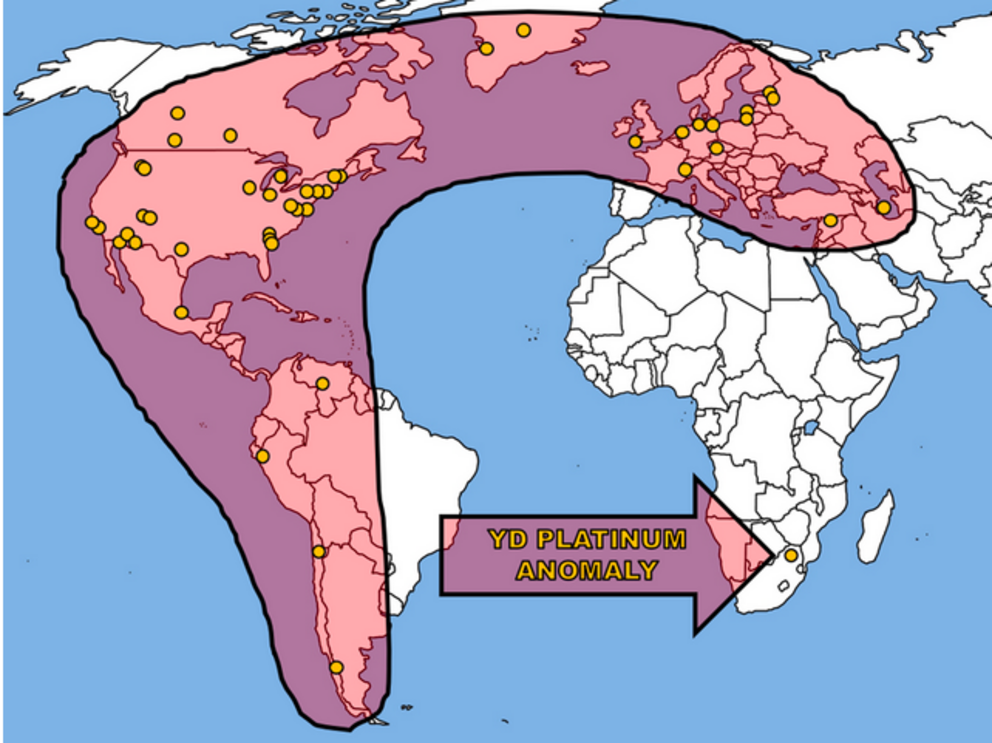
Figure 5. Rough extent of the YD Ejecta Layer as of November 2022. Image by Marc D. Young.
In the author’s view, had Firestone et al. (2007) taken a different approach, their evidence may have been easier to swallow by the scientific community. While the megafaunal extinctions and human population effects are to be expected in the event of such a catastrophe, these were already intensely debated issues within the sciences. Many scientists participating in debates over these issues may have perceived the extraordinary claims of Firestone et al. (2007) as particularly disruptive; while this did make some groups pay attention, much of the attention was negative, and a few small groups of critics have never gotten over what they see as an affront to the paradigms they have devoted their careers to forging. Had the YDB team focused more on establishing that the impact event occurred, without venturing into its environmental and ecological consequences, it would have been better received by critics; encroachment into dogmatic paradigms like overkill and Clovis-first only served to steepen the slope of their uphill battle. Even though these consequences are indeed strong evidence for a catastrophe, in the author’s opinion, debate over the implications of the impact may have been more palatable once the impact itself had come to be widely accepted. Incorporating all of these events from day one conjures a mental image in the minds of critics of an outsized, ‘one-and-done’ impact event that destroyed the whole world in a few short seconds; this is far from what the YDB team were claiming and does not reflect the reality of the YD impact event, wherein a ‘rain’ of smaller impacts which were dispersed throughout time and space caused local or regional destruction.
Results obtained during the practice of ‘normal science’ that fail to conform to the dominant paradigm are treated as outliers, or even mistakes made by the researcher, rather than as refuting the prevailing paradigm (Kuhn 1962). However, as these ‘anomalous’ results accrue to the point that they can no longer be ignored, a ‘crisis’ occurs, wherein the old, discredited paradigm is replaced by a new one that incorporates the anomalies into its framework. This process is called ‘revolutionary science’ and it is playing out in real time with the YDIH, just as with the K-Pg impact ~3 decades ago, and countless hypotheses throughout history. Far from being ‘debunked’, cracks in the paradigmatic dam are spreading and widening as increasing numbers of scientists become proponents of the YDIH, discovering its merits after reexamining the evidence and taking the time to understand the claims.
So, did the YD impact event (YDIE) really happen? Can it really be invoked as a parsimonious explanation for the vast evidence of catastrophe at the terminal Pleistocene that has been gradually compartmentalized over decades by disparate, uniformitarian explanations? The following sections examine the arguments and evidence for the YDIH by incorporating a diverse breadth of literature from many disciplines to determine whether the YDIH has truly been debunked, or whether it has merit.
For the rest of this article please use source link below