
Huge ancient undersea wall dating to 5800 BCE discovered off the French coast
In waters off the coast of Brittany, archaeologists have identified an impressive set of submerged stone structures that reveal the presence of a remarkably sophisticated coastal society more than 7,000 years ago. The findings, which were made near the Île de Sein in western France, include a massive granite wall and at least a dozen smaller constructions now located several meters beneath the surface.
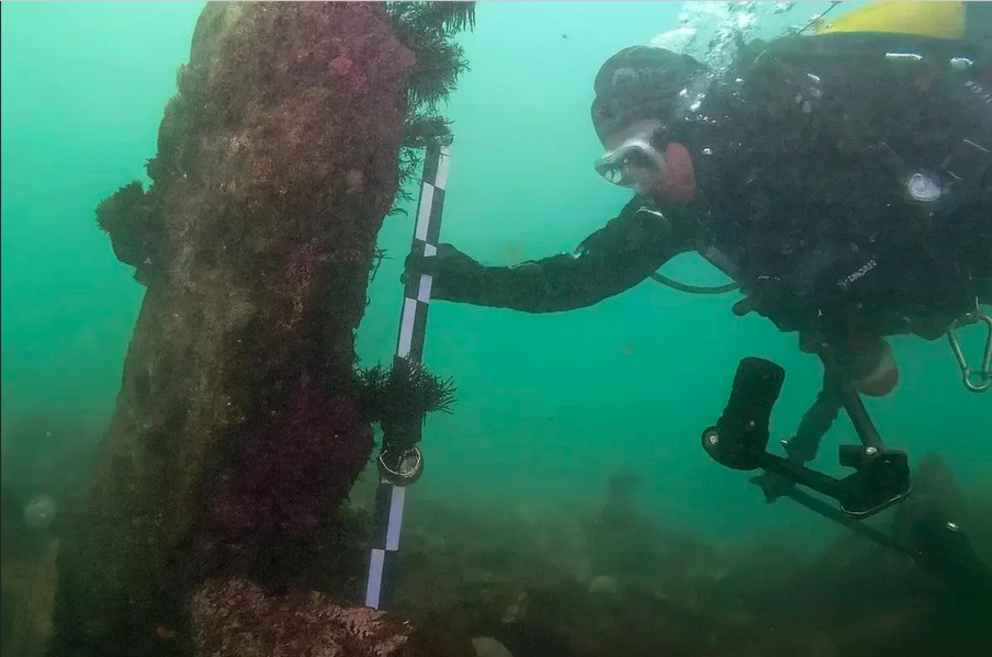
The largest structure is a wall measuring 120 meters long, which spans a submerged valley. Divers investigating it between 2022 and 2024 discovered stacked blocks of granite, reinforced by more than 60 upright monoliths and slabs nearly two meters high. Other structures, labeled TAF2A, TAF2B, and TAF3, appear to use the same construction methods, while a second group—identified during the dives of 2024—is characterized by narrower walls composed of smaller stones that were arranged to block natural depressions in the terrain. One of these later discoveries, YAG3C, consists of a 50-meter-long line of closely spaced small monoliths, sometimes set in parallel rows.
The site was first noticed in 2017 when seabed mapping using laser-based imaging suggested the presence of linear features on the ocean floor. Subsequent LIDAR work and underwater surveys showed that these were not natural features. Based on their depth, the structures are believed to have been built between 5800–5300 BCE, when sea level was considerably lower and the area formed part of the coastal landscape during the Late Mesolithic and Early Neolithic transition.
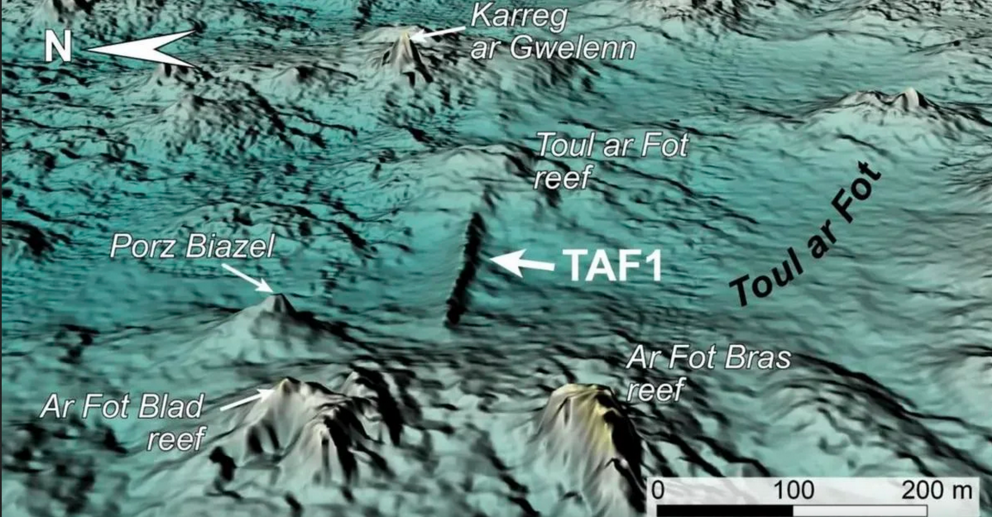
3D view of TAF1 structures. View to the east showing the linearity of the structures and the dissymmetry of the north (left) and south (right) flanks. Vertical exaggeration = 3. The brown colour visualizes the reefs permanently emerging above the current sea level. Credit: Yves Fouquet et al. International Journal of Nautical Archaeology (2025)
According to researchers, the small formations resemble fish traps, while the scale of the bigger constructions suggests additional purposes, possibly coastal protection or boundary markers. Their size and engineering are unlike anything previously documented in France for this period. The labor required to extract, transport, and erect multi-tonne slabs testifies to advanced technical skills and a structured community capable of organizing large building projects centuries before the region’s first known megalithic monuments appeared.
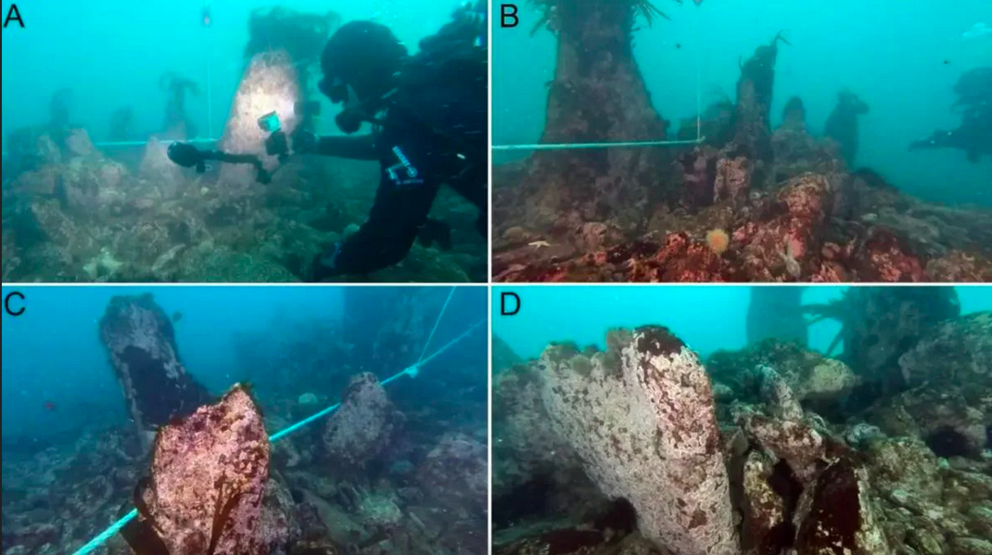
Photos taken on the TAF1 structure during winter 2023. Note the total absence of algae compared to the summer period. The green rope, deployed along the E-W orientation of the structure, makes it possible to visualize the top as well as the orientation of the monoliths and slabs. A and B: general view of the rows of monoliths at the top of the structure. C and D: double row of monoliths at the top of the TAF1 structure. The two rows parallel to the axis of the structure are about 1.5 m apart. In photo C, the rope is placed between the two rows. Credit: SAMM, 2023 / Yves Fouquet et al. International Journal of Nautical Archaeology (2025)
The find also puts an archaeological twist on local folklore. Legends from Brittany speak of a drowned city west of the Bay of Douarnenez, not far from the discovery site. While there is no evidence of any lost urban center, researchers note that memories of an abandoned coastal landscape, later submerged by rising seas, may have contributed to such stories over millennia.
Beyond the regional implications, the structures add to a growing body of underwater evidence demonstrating that complex stone-building traditions existed among coastal hunter-gatherer groups long before agriculture spread across Europe. Similar submerged constructions have recently been documented in the Baltic, where prehistoric communities built long stone alignments to channel migrating animals. The French team plans to further refine the dating, study construction techniques, and search for additional traces of early settlement along the now-submerged coast.