
Cosmic rays to shed light on tomb guarded by the Terracotta Army
For more than 2,000 years, the secret of the mausoleum of the first Chinese emperor Qin Shihuang was guarded by his terracotta army. Thanks to state-of-the-art technology using cosmic rays, archaeologists could soon discover what treasures were buried together with this ruler.
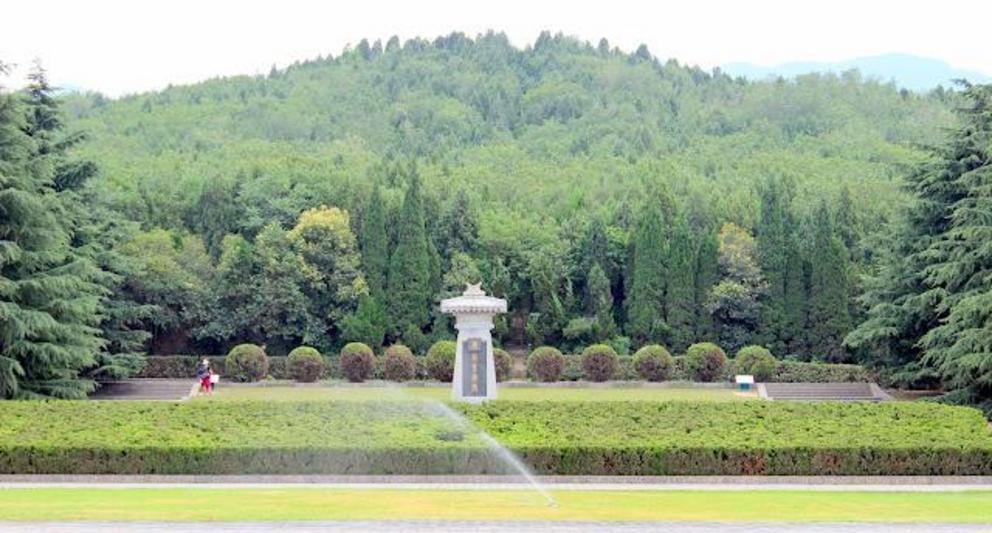
Buried under a 249-feet-high pyramidal mound, the Tomb of the First Emperor Qin Shi Huang Di lies at the heart of a necropolis in Xi'an's Lintong District, one famously guarded by the Terracotta Army [Credit: Aaron Zhu/WikiCommons]
The huge burial ground, located in the city of Xi'an in the northwest of the country, covers an area almost seventy times larger than the so-called Forbidden City. It took almost four decades to build, with hundreds of thousands of workers working on it, but it was never fully discovered archaeologically. In the vast necropolis is a terracotta army, which is thousands of statues depicting Chin's army built to protect the emperor in the afterlife.
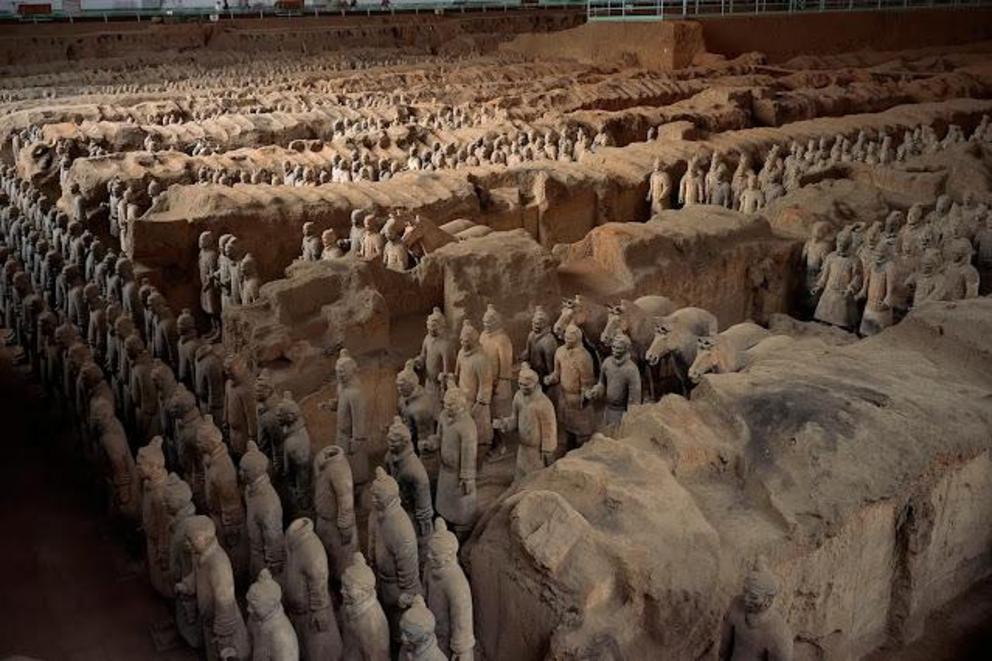
The tomb complex of Emperor Qin Shi Huang Di contains an estimated 8,000 lifelike clay soldiers, as well as mass graves and evidence of a brutal power grab [Credit: O. Louis MAazzatenta, National Geographic]
Beijing has said some time ago that it will not allow the internal rooms of UNESCO World Heritage sites to be dug up unless it can guarantee proper protection for the artifacts. The Chinese government has long lamented the loss of the original vibrant colours of terracotta fighters after their first excavation in the 1970s, as a result of which they were exposed to the atmosphere.
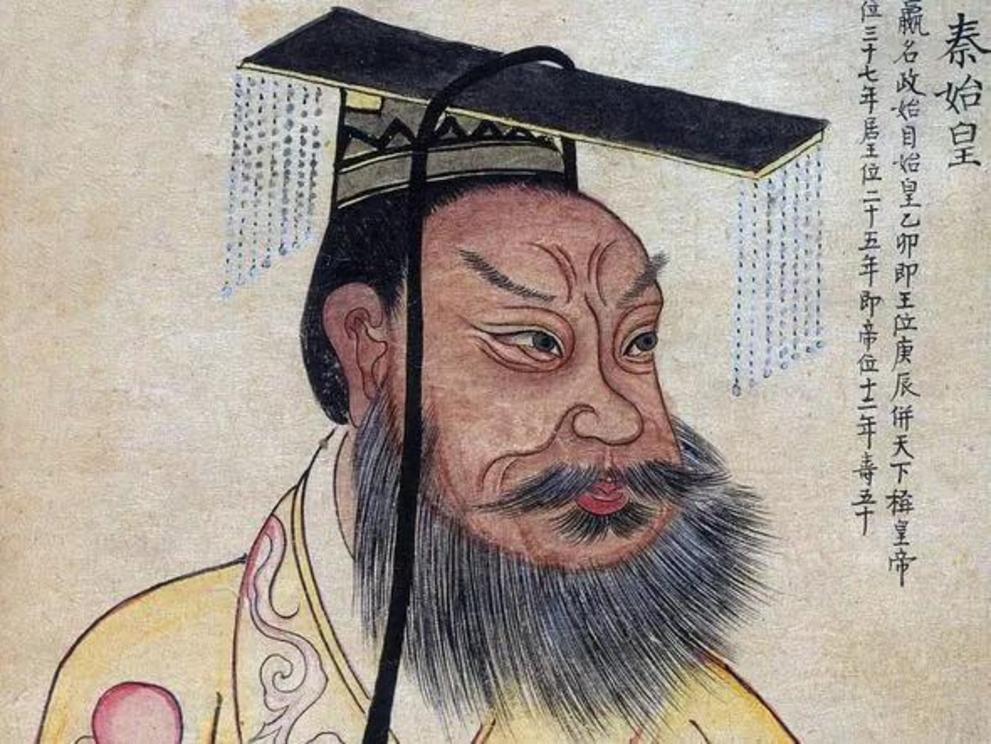
Qin Shi Huang illustration [Credit: Getty]
The chamber in which Qin Shi Huang's coffin is located seems to remain intact after more than two millennia. And scientists are proposing the use of subatomic particles (smaller than an atom) called muons to map the interior of this underground chamber.
Credit: National Geographic
Muons are formed when cosmic rays collide with atoms in the Earth's atmosphere. Like X-rays, they are absorbed by strong and dense objects, but pass through lighter materials. Archaeologists can use muon detectors to map structures and search for sites to excavate buried monuments. They have previously used them to explore pyramids, volcanoes and caves.
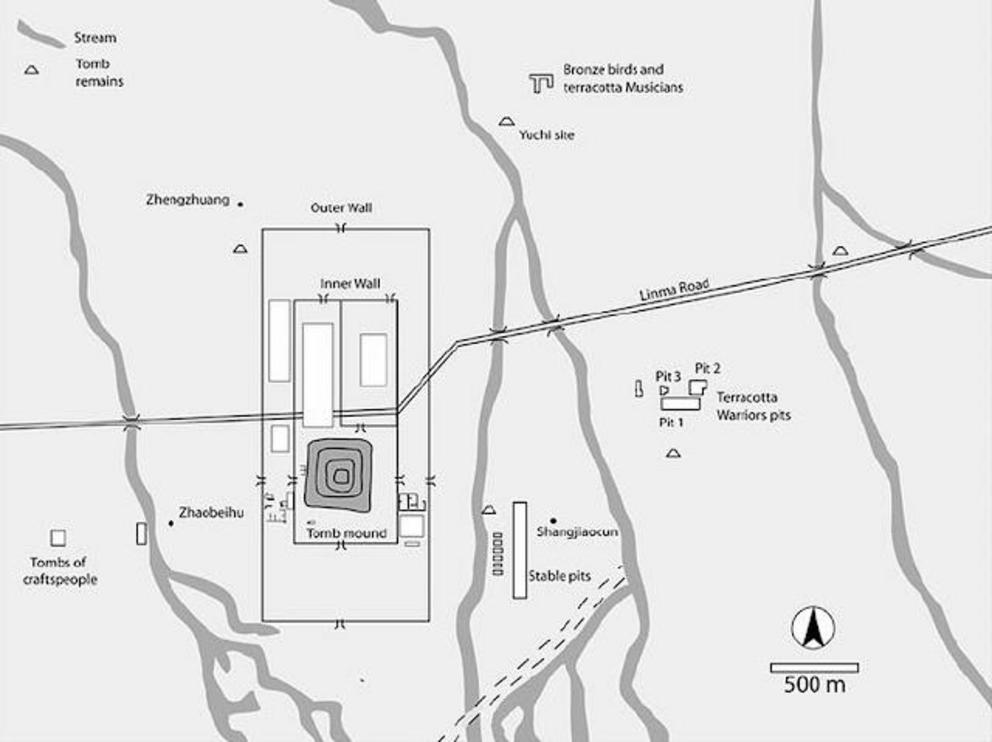
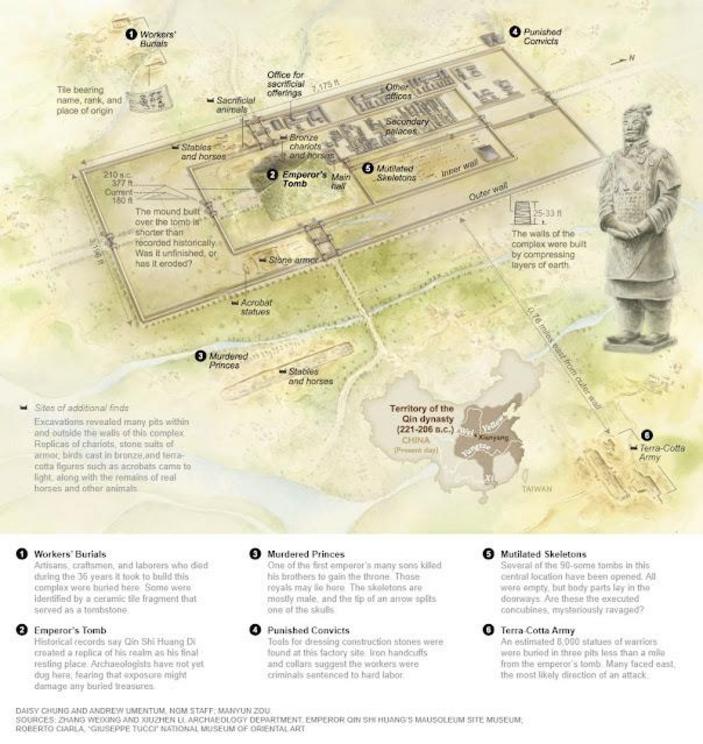
Site plan of the First Emperor’s Mausoleum showing the location of the emperor’s tomb towards the centre, the Terracotta Army to the east, and other elements of the complex [Credit: Martinon-Torres et al., 2014]
"China, as an ancient civilization with a long history, has a large number of cultural monuments that need archaeological research," said scientists at Beijing Pedagogical University (BNU). "The traditional geophysical methods used in archaeology have certain limitations for the non-invasive detection of the internal structure of some large artifacts, such as the imperial tombs," they say. "The use of muon absorption sensing in the archaeological area can be an important complement to traditional geophysical methods," he believes.
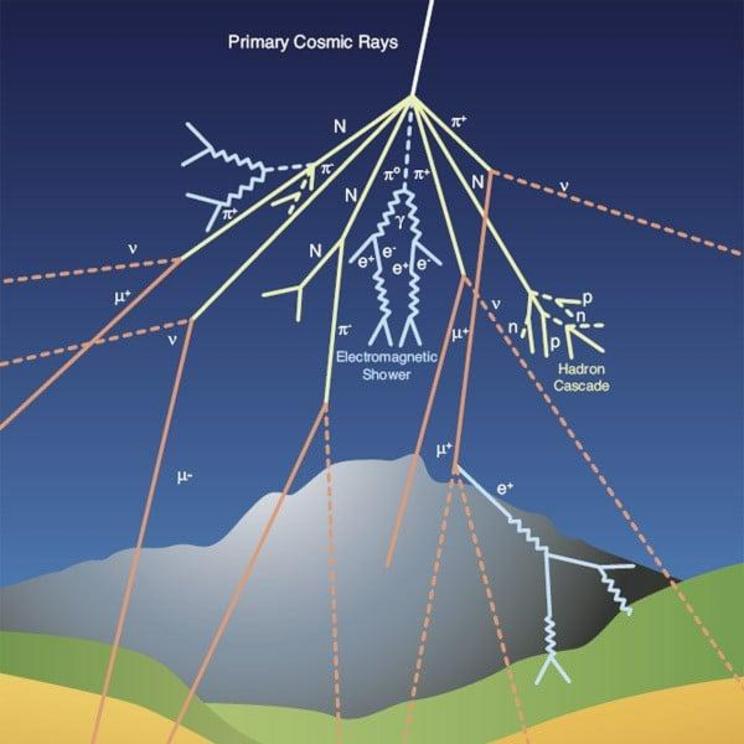
When high-energy cosmic rays (white line) from space interact with Earth's atmosphere, they create a shower of subatomic particles — including some called 'muons' (solid orange lines)
which form from the rapid decay of pions (solid yellow lines) [Credit: CERN]
A group of scientists used existing archaeological data to test and bury burial chamber models. She hid two detectors under them. "Preliminary results prove the feasibility of sensing the absorption of muons for the underground chamber in the mausoleum of the first emperor (dynasty) Qin," the researchers report.
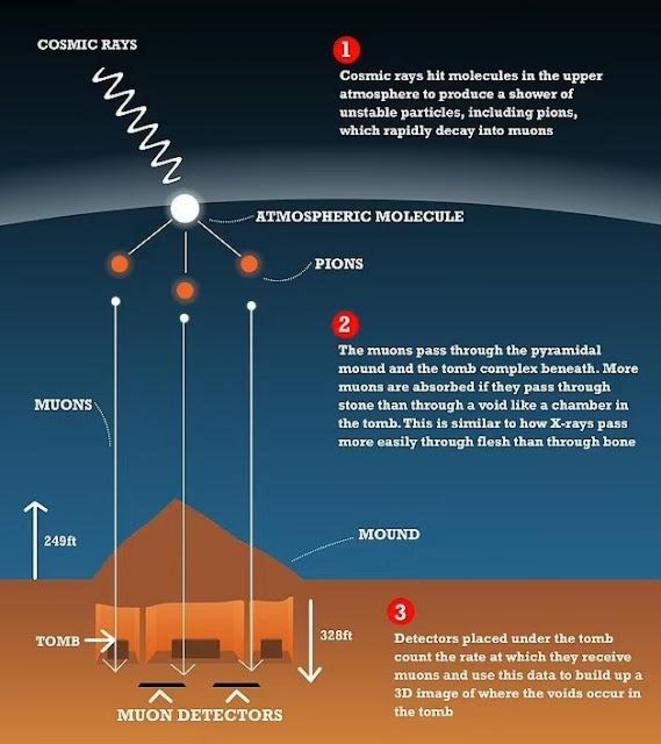
How scientists propose to scan the sealed tomb [Credit: Holly Aldridge-Ball/DailyMail]
Tikun Yang from the South Shenzhen University of Science and Technology told the South China Morning Post that the project was feasible. "The muon detector we built and used in the field work is so small that it can be worn by a child. According to him, the detectors must be placed at the appropriate depth without damaging the artifacts above them. However, according to him, obtaining enough data for analysis it will take a long time.