
Before Karahan Tepe: The most ancient of solstices
The winter solstice sunrise discovery at the Pre-Pottery Neolithic site of Karahan Tepe1 may not have been the first time the use of solar astronomy was recorded in stone. Observing the solstices is part of a much longer legacy dating back deep into the Upper Palaeolithic era (50,000 to 12,000 Before Present). The interiors of caves were being used as rock canvases in Western Europe, some with astronomical symbols, and often with entrances precisely aligned to the rising and setting sun on the solstices. Hunter-gatherer groups are now thought to have had a detailed understanding of the solstices and astronomy in general. This knowledge continued into the Pre-Pottery Neolithic in the Fertile Crescent, with sites such as Göbekli Tepe c.9600 BC, Karahan Tepe c.9400 BC, Jericho c.8300 BC and Atlit Yam c.7400 BC incorporating the solstices into their design. Furthermore, in Mesolithic Britain just over 10,000 years ago, the earliest inhabitants of the Stonehenge area in Wiltshire and Warren Field in Aberdeenshire studied the movements of the moon and the solstices, long before any ‘megaliths’ were put in place. This article looks at all these examples and questions why the solstice was so important to hunter-gatherers before agriculture was established, and re-evaluates the meaning of the Karahan Tepe winter solstice alignment.
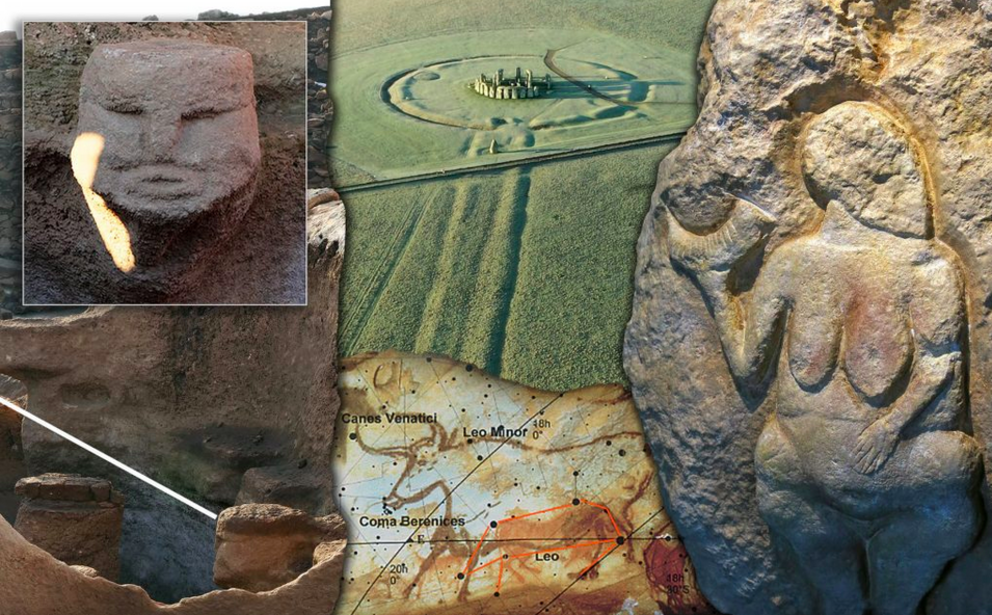
Stonehenge (top middle), Lascaux (bottom middle), Karahan Tepe images (Left), images: Hugh Newman. Laussel Venus, c.25,000 BP Venus (right) image: Don Hitchcock (used with permission).
Counting and the Moon
In The Roots of Civilisation (1972)2 Alexander Marshack studied hundreds of Upper Palaeolithic carved bone plaques, which displayed ‘time-factored’ notation systems, many linked to lunar calendars. His controversial book proposed that early hunter-gatherers were much smarter than the ‘savages’ they were usually depicted as. He found evidence of the tracing of the rhythms of the moon and sun, and other numerical calculations from the Upper Palaeolithic to the Mesolithic era. His research was much criticised, but opened the door for further investigations into who these people really were and how they thought. He believed their art contained narratives, symbolism and astronomical features, displaying an early form of science. Included in his research were perforated bone and ivory discs that may have acted as time-keeping devices. One reconstructed example was found to have 72 notches around the edge, 5° between each notch. 72 is a number linked to the precession of the equinoxes (see image further below).3 Although he stayed away from analysing the more famous cave paintings, his research had a lasting influence, highlighting the capabilities of people in this era and their fascination with recording the workings of the sun and the moon.
The notational systems that Marshack researched may also be present at Karahan Tepe. On top of the hill, a 6-foot-wide section of bedrock is decorated with multiple parallel lines in layers, with a notable serpent head at its base. It looks much like what he found on the numerous bone plaques, yet it has not been fully investigated or deciphered. Bahattin Celik first noted it in a paper in 2011, where he described what he saw as a “tally-like description”.4 If Karahan Tepe was a place to record the winter solstice, counting the days may have been an important part of time-keeping at the site. The section of bedrock is badly worn, so it is hard to determine the exact number of carved lines, yet it is has obvious similarities to numerous Palaeolithic and Mesolithic examples that Marshack interpreted as “notations made for calendrical record-keeping” or even ‘tallies’ for feasting gifts and debts often given away at large events centred around the solstices.5 This could well have been what was happening at Karahan Tepe.
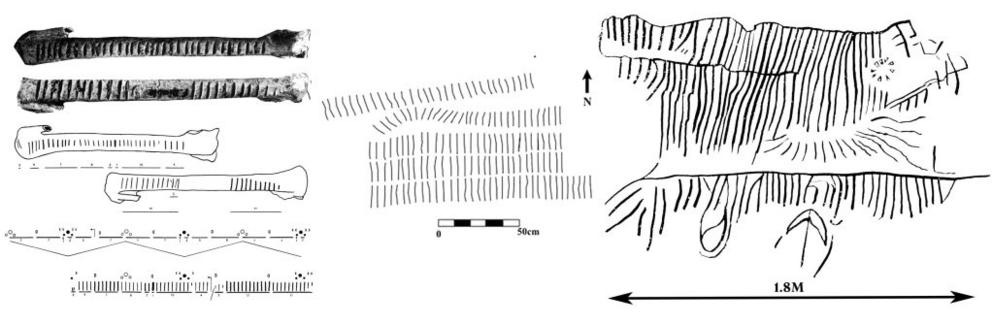
Left: A bone engraved on two sides from Fourneau du Diable, Dordogne, France. Dated to the Solutrean, c.21,000 to 17,000 years old. The engraved marks indicate possible lunar phasing. Image: Alexander Marshack. The Roots of Civilization: the Cognitive Beginning of Man’s First Art, Symbol and Notation. New York: McGraw-Hill. 1972 Middle: Lines and symbols carved into the bedrock at the peak of Karahan Tepe, reported by Bahattin Celik, 2011. Image: Bahattin Celik. Karahan Tepe: a new cultural centre in the Urfa area in Turkey. p.250 Right: Hugh Newman’s illustration adapted from a 3D lidar scan.
Sefer Tepe lies a few miles north of Karahan Tepe and was in use during the Pre-Pottery Neolithic B (c.8500 BC). Numerous T-shaped pillars have been found in situ along with dozens of beautifully crafted artefacts. One of these pieces is a 6cm-wide limestone disc discovered in 2022, which has 13 circular peck marks in different configurations on both sides, possibly representing the number of full moons or new moons in a calendar year.6 Linear notches are also carved between these circles on the flat side of the disc.
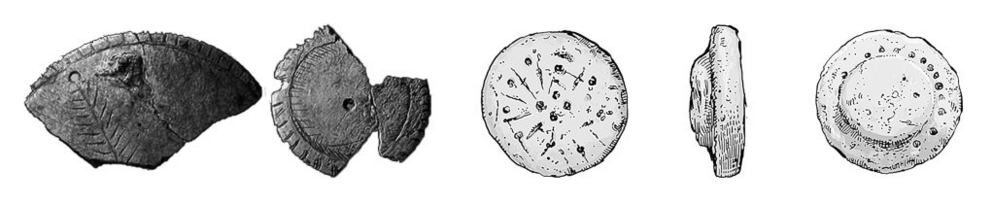
Left: Engraved and perforated discs from Mas d’Azil, France, 19,800 years old, between 8cm and 10cm wide. The example on the left would have had a total of 72 notches around the circumference. Image: Chantal Jègues-Wolkiewiez – Paleolithic techniques and tools used to calculate space and time, Part 3. 2012 Pleistocene coalition news, VOLUME 4, ISSUE 1 JANUARY-FEBRUARY 2012. Right: Small limestone disc from Sefer Tepe, 6cm diameter, with 13 circles on both sides in different configurations. Artwork by Dan Lish (used with permission).
Cave Art
The Upper Palaeolithic cave paintings of Western Europe give a fascinating glimpse into the artistic mindset of the creators. Lascaux is one of the later-occupied caves, dated to approximately 17,000 years old, although evidence of human activity reaches 21,000 BP.. It was discovered in 1940 by four local boys and investigated by archaeologist Henri Breuil, nicknamed the ‘Pope of Prehistory’ (as he was also a Catholic priest). Breuil initially believed that the symbols could be representing constellations.7 This idea was further developed in the 1990s when Spanish prehistorian Luz Antequera Congregado noticed that the seven dots, along with the auroch image, could represent the Pleiades cluster and the Taurus constellation.8
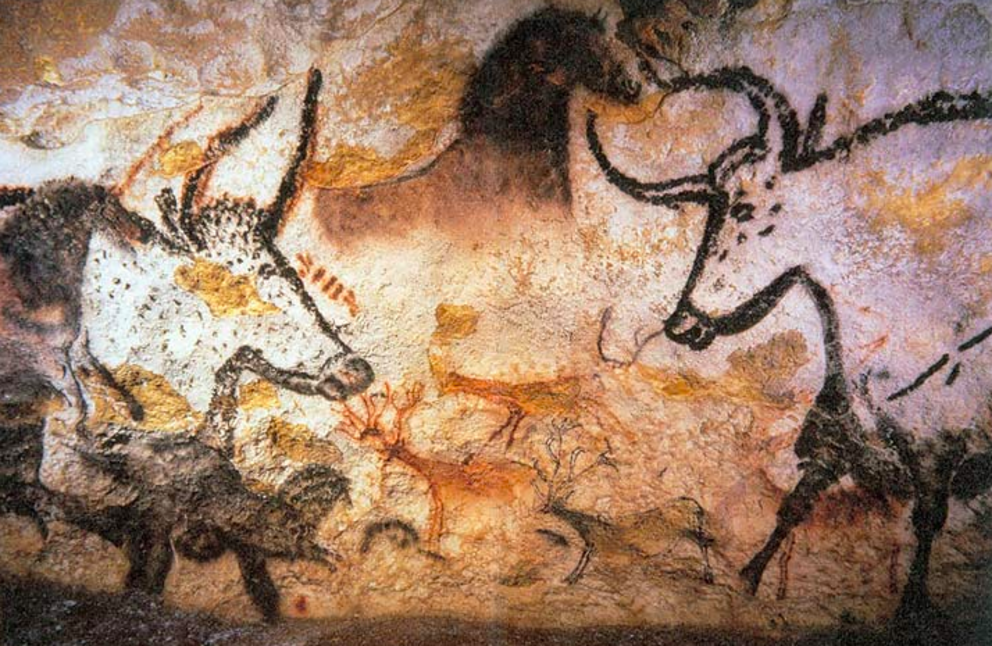
Lascaux Aurochs, Horses and Deer, photo Prof saxx (CBYSA3.0)

The depictions of certain astronomical features in Upper Palaeolithic cave art have been noted by several other researchers over the last few decades. French archaeoastronomer Chantal Jeguès-Wolkiewiez proposed that the ‘Hall of the Bulls’ was a primitive ‘Zodiac,’ and more recently, Dr Martin Sweatman of Edinburgh University has found correlations between the cave art of the Lascaux ‘shaft scene’ and symbols on Pillar 43 at Göbekli Tepe, which he published in his book, Prehistory Decoded (2017).9
Enter the Solstice
The symbolism of the cave paintings is hard to decipher, but when Chantal Jeguès-Wolkiewiez continued her studies of Lascaux, finding specific solar alignments in relation to cave entrances and their interior paintings, a new line of enquiry was opened. Over a seven-year period, she visited 130 caves and found that 122 of them aligned to the solstices or equinoxes, which is well beyond the realm of chance.10 The comparison to later Neolithic and Bronze Age megalithic sites is of interest here, because it was for a long time thought that such orientations were primarily used for agricultural purposes, but this has now been turned on its head. The solstice, it seems, had another function for hunter-gatherers.
None of the caves that were studied had a clear view of the sky above (as though they were roofed), yet in some cases, their entrances allowed light in on these particular turning points of the year, which would illuminate the paintings. For example, the Abri Castanet Rock Shelter (37,000 BP), and Bison Cave (33,000 BP) are illuminated during the winter solstice sunset; Lascaux and Bernifal Caves on the summer solstice sunset, and Blanchard and Combarelles Cave-I on the equinoxes, although a majority of the studied caves orient to the winter solstice sunrise.
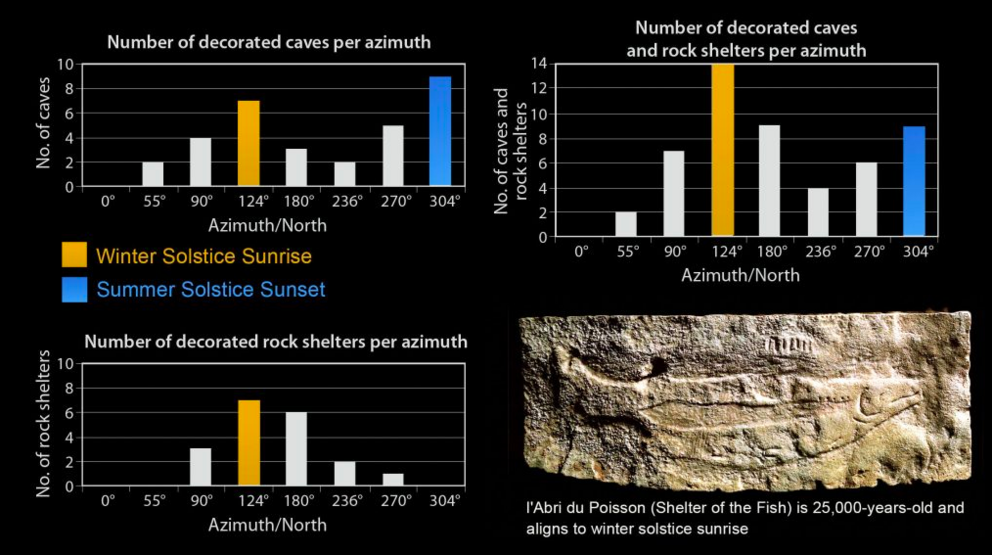
Data obtained by Jègues-Wolkiewiez indicate that the entrance orientations of decorated caves and rock shelters in the Les Eyzies-de-Tayac, Dordogne region strongly cluster towards the rising or setting positions of the sun at solstices. Inset: l’Abri du Poisson Cave aligns to the winter solstice sunrise. Photo Heinrich Wendel (CCBYSA4.0)

“Chantal Jeguès-Wolkiewiez has argued that certain caves and rock shelters in the Upper Palaeolithic were decorated and used for rituals because their entrances were aligned with solstice and equinox positions of the sun. In her sample, undecorated caves and rock shelters show no such preferential orientations.”11
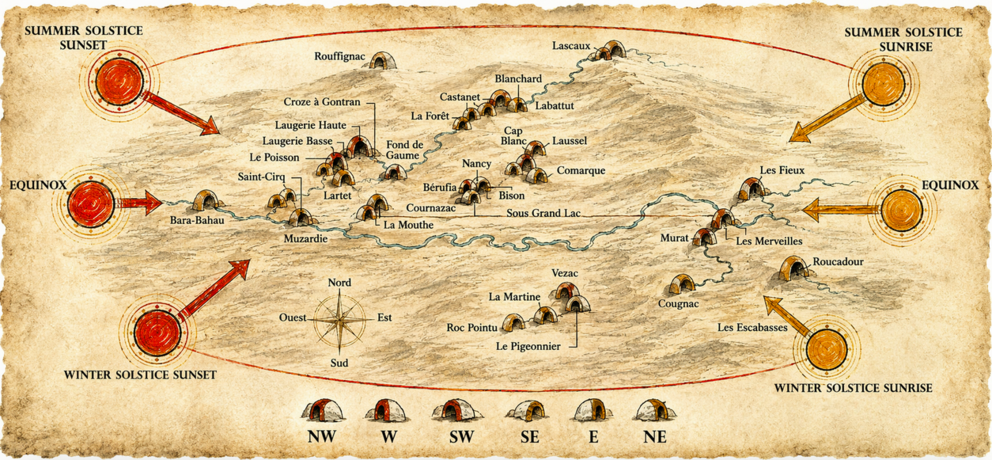
Map adapted showing the solstice and equinox orientations of painted cave entrances in the Dordogne region of France. Adapted from Chantal Jeguès-Wolkiewiez by Hugh Newman
The obliquity of the ecliptic has slightly altered the sunrise and sunset positions over the millennia, but the Lascaux alignment still works, as it is only just over 1° difference. The summer solstice sunset still illuminates the cave entranceway, which leads to the ‘Hall of the Bulls.’ It has also been noted that the orientation of the entrance is 3° south of the summer solstice sunset position. However, when taking into account the slight slope at the entrance, it was found to give a clear illumination lasting for 50 minutes, and could be viewed for several days over the summer solstice (due to the ‘standstill’ of the sun during this period). Jeguès-Wolkiewiez also confirmed from a visit in December 1999 that light from the full moon during midwinter would also illuminate the paintings (the moon follows the same path of the sun at the opposite side of the year).12
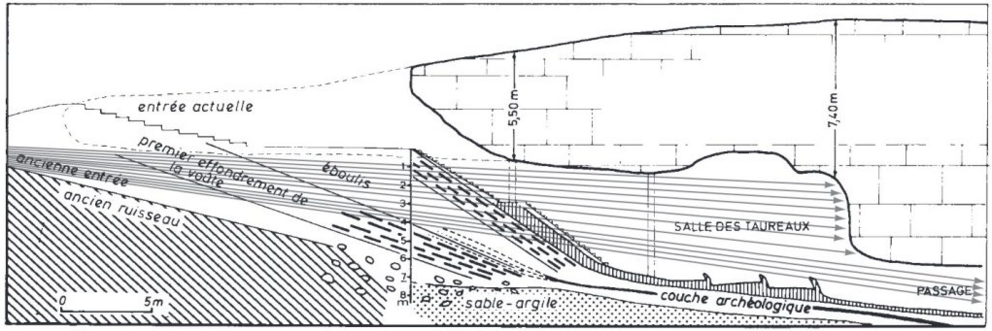
Lascaux lateral section drawing showing the slope angle that the sun shines through to illuminate the painted areas. Image by Brian Hayden and Suzanne Villeneuve, 2011 (https://doi.org/10.1017/S0959774311000400), after Leroi-Gourhan, 1979 and Chantal Jeguès-Wolkiewiez, 2000.
L’Abri du Poisson (Shelter of the Fish) was discovered in 1892 and is located on the banks of the Vézère River in Dordogne. A low-relief of a salmon nearly 1 metre long (3.2ft) was found engraved on the ceiling, with its lower jaw appearing to be ‘pulled back’. This unique characteristic is, in fact, what happens to male salmon in the breeding season, which takes place in December. This cave is 25,000 years old and is aligned to the winter solstice sunrise when the interior gets illuminated.13 Marshack found further calendrical motifs that appeared to reflect the seasonality of fish mating, and also deer molting and vegetation sprouting.14
Furthermore, the stunning 3D relief of the Venus of Laussel from the same era was found carved in a cave that orients to the winter solstice sunrise. This goddess carving has in its right hand an unusual ‘horn’ with 13 markings on it, perhaps representing the number of full or new moons in a solar year.15 Further goddess figures were found in the cave, as well as the Laussel Priapus, from a Gravettian layer (22,000 BP); a male fertility idol with a large, erect phallus. These 3D relief carvings were not only placed in a cave that orients to the winter solstice sunrise, like at Karahan Tepe, but they also echo the stone carving style that dominated Taş Tepeler sites thousands of years later.
Further north, similar astronomically oriented caves highlight how widespread this knowledge was: “Long-distance movements and a dispersal of cultural influences were clearly present during this [Magdalenian 17,000 – 12,000 BP] period… On the Russian plain … there were summer and winter sites along [the network of rivers that flow toward the Black Sea], including riverside sites that were specialised for seasonal resource exploitation and for seasonal symbolic performance and production.”16
Throughout the world, hunter-gatherers understood the extreme north and south rising points of the sun on the horizon. Their observations eventually enabled them to align their cave entrances, record the ecliptic, depict constellations, and even develop a ‘zodiac’, all painted accurately on the ceilings of caves during this era. These traditions reached far and wide before influencing the Pre-Pottery Neolithic zone of Southern Turkey.
“Recognition of the ecliptic and the construction of a zodiac to monitor solar, lunar and planetary movements entails fairly sophisticated astronomical concepts and has often been considered the hallmark of complex literate societies.”17
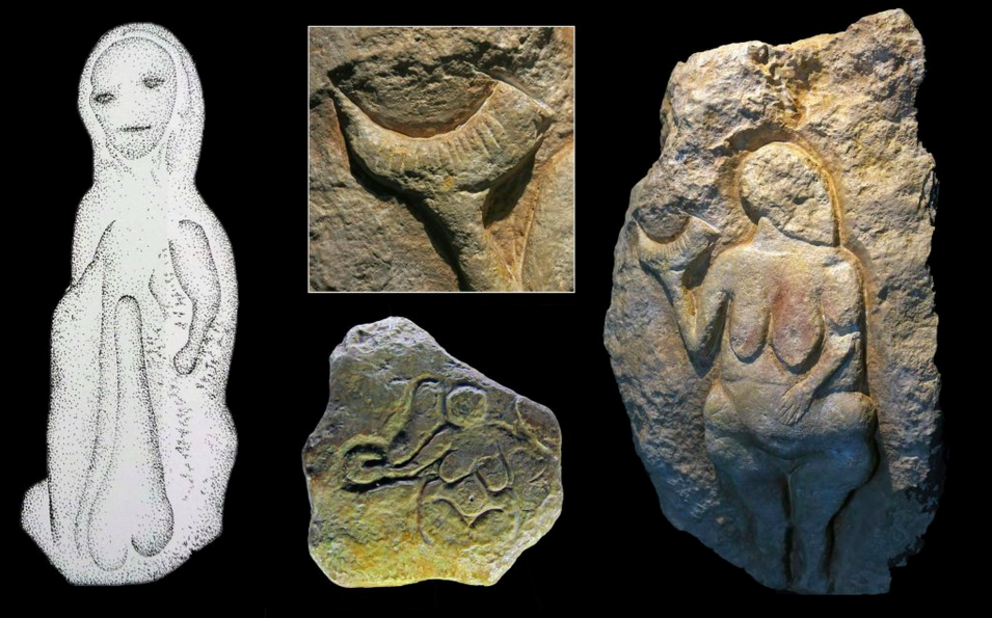
Artefacts from the Laussel Cave, including the Laussel Priapus (left), a goddess figure c.32,000 BP (bottom) and details of the Laussel Venus, c.25,000 BP (right). Images: Don Hitchcock (used with permission).
For the rest of this article please use source link below