
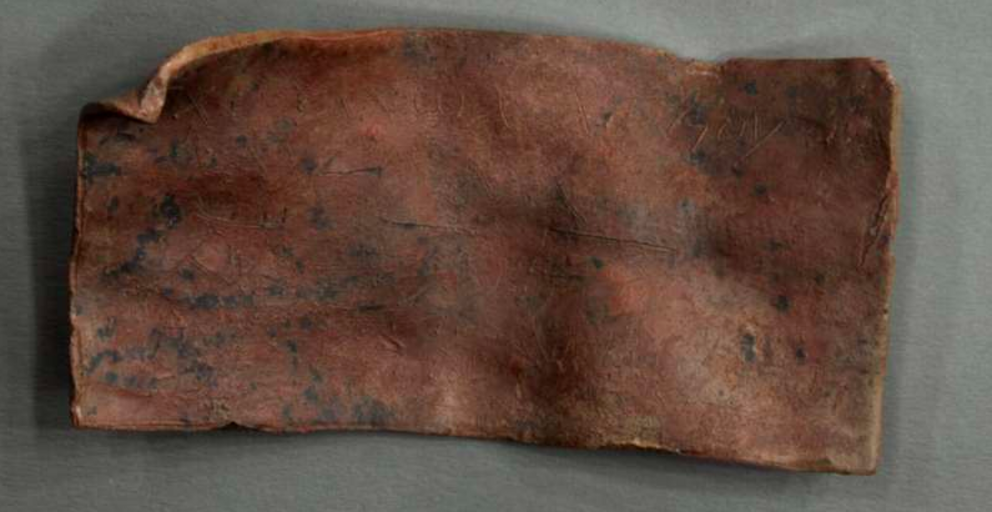
Ancient curse tablet bears rare Greek inscription with binding spell intended to harm enemies
The lead tablet from Heerlen, the site of the former Roman military settlement of Coriovallum, was discovered by a team of Dutch archaeologists in a pit beneath the Town Hall square. The artifact, which measures 9.3 by 4.8 centimeters (3.7 by 1.9 inches), contains three distinct groups of characters, as revealed by an analysis conducted at the Institute for Papyrology using reflectance transformation imaging (RTI).
This computer-assisted photographic technique involves taking multiple images of the inscription using variable lighting. The individual photos can then be digitally combined into a single image with adjustable lighting that allows even the smallest surface features to stand out.
What is particularly noteworthy about the tablet is the invocation of various deities and demons in the Egyptian style, composed in ancient Greek, since most curse tablets found in Northern Europe are written in Latin. In addition, the Heerlen curse tablet contains a group of three magical symbols, known as "Characteres."
According to Ast, these were likely used to convey the desired message to the supernatural powers. They are followed by the names of two men and two women, who are referred to as fellow slaves. "The tablet served either as a curse against these four slaves or as a curse in their name against an unnamed person," according to the Heidelberg papyrologist.
The composition of the group of people on the tablet is also unusual, according to the researcher, because it includes two men with Latin names and two women with Greek names. "It cannot be ruled out that one of the two women was the author of the inscription and had brought the supposed ability to communicate with divine powers through such curses with her from Roman Egypt," says Dr. Julia Lougovaya, research associate at the Institute for Papyrology.
In the advanced civilization along the Nile, magic played an important role, as Prof. Dr. Joachim Quack, director of the Institute for Egyptology at Heidelberg University, points out. Some practices, particularly those related to protection and healing, were officially recognized and were an accepted part of religious life. Others, in which one's own interests were pursued at the expense of others, tended to be carried out in secret.
"In the early centuries A.D., Near Eastern, Egyptian, Jewish, and sometimes even Christian traditions increasingly merged and spread throughout the entire Roman Empire of that time—a development that the discovery from Heerlen impressively underscores," says the Egyptologist.
The curse tablet is to be displayed at the Heerlen Museum in the future. The inscription, which was deciphered at the Institute for Papyrology of Heidelberg University, will be made available as part of a scholarly publication, thus making it accessible to researchers for further study.
Edited by Lisa Lock, reviewed by Robert Egan