
6000 years ago, billions of pounds of copper vanished from the American wilderness
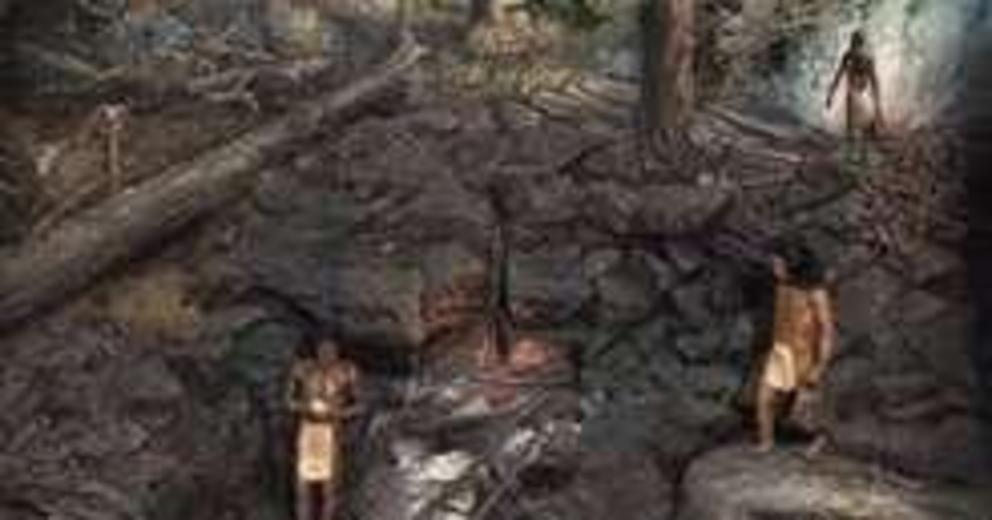
Top Image: Artist's reconstruction of prehistoric native copper mining (Old Copper Culture).
The Indigenous people near Lake Superior established pre-mining industries thousands of years before the pyramids of Egypt were constructed, and centuries before iron changed the military powers of the ancient world.
The World’s Largest Prehistoric Copper Mining District
Rich deposits of copper lie on the Keweenaw Peninsula of modern-day Michigan and on nearby Isle Royale, where veins and large masses of pure native copper emerge naturally near the surface. Archaeologists have documented approximately 10,000 prehistoric mine pits on Isle Royale, with thousands more scattered across the Keweenaw Peninsula. Excavations have also uncovered massive hammerstones, wooden levers, abandoned extraction pits, and fire-cracked bedrocks - evidence of organized mining on an extraordinary scale.
Today, many of these same ancient mine pits remain visible beneath the forests of Isle Royale National Park, where they serve as silent guardians for generations of
.%20Available%20through%20the%20mus-1783848895165.png?w=992&h=744) Wisconsin prehistoric timeline (Old Copper Culture chronology).
Wisconsin prehistoric timeline (Old Copper Culture chronology).
The Old Copper Culture: Among the World’s Earliest Metalworkers
The people who created the copper industry are known among archaeologists as the Old Copper Culture, a specific archaic tradition that flourished around the Great Lakes between 7,500 and 9,500 years ago. Rather than practicing metallurgy by smelting ores, Indigenous communities took advantage of the region's unique deposits of native copper, a naturally occurring metal pure enough to be worked without melting. By repeatedly hammering the copper into shape and reheating it over time, a process known as annealing, they produced a wide range of durable tools and ornamental objects. Archaeological excavations have uncovered copper spear points, axes, knives, adzes, awls, fishhooks, bracelets, chisels, beads, and pendants, demonstrating how copper served both practical and ceremonial functions in everyday life.
The influence of the Old Copper Culture extended far beyond the shores of Lake Superior. Geochemical tracing has located copper artifacts in the broader Great Lakes region, ranging from the upper Midwest to the Southeast. Such broad dispersal shows that early metalworkers participated in exchange networks linking diverse Indigenous communities across North America. Archaeologists continue to debate how these networks actually operated, but there is little doubt that Great Lakes copper became one of the continent’s most sought-after materials. Therefore, the achievements of the Old Copper Culture represent one of the earliest examples of metalworking on the American continent and one of the most sophisticated technological traditions of the prehistoric world.
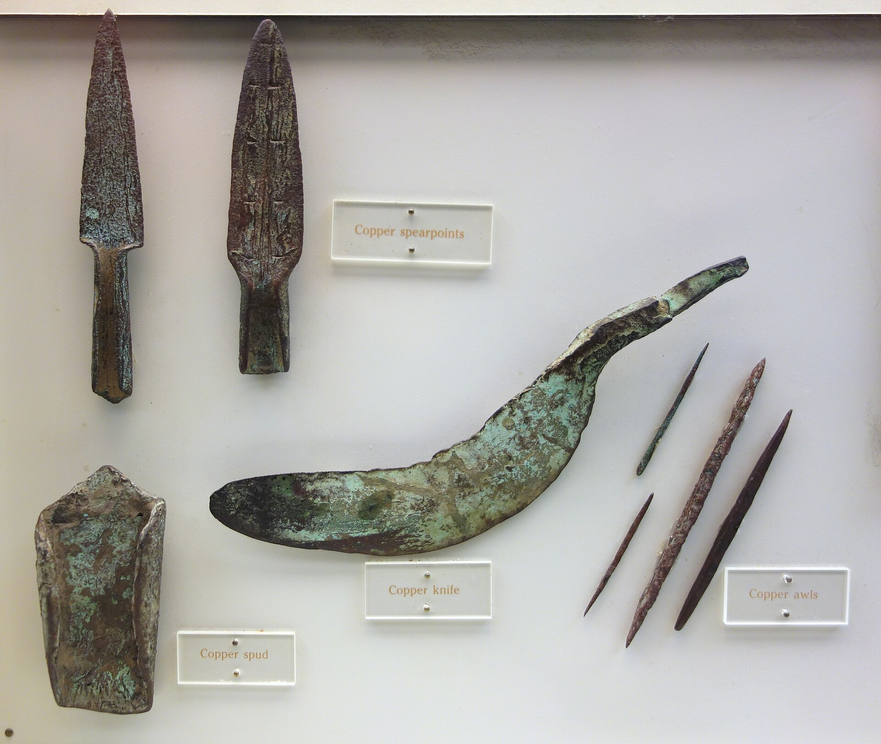 Copper knife, spearpoints, awls, and spud, Late Archaic period, Wisconsin, 3000 BC–1000 BC, Wisconsin Historical Museum.
Then the Mining Suddenly Stopped
For thousands of years, the copper mines of the Lake Superior Region echoed with the sounds of hammerstones striking bedrock as generations of Indigenous miners extracted copper from the Keweenaw Peninsula and Isle Royale. Approximately three thousand years ago, this intensive mining activity abruptly ended. Archaeologists have found little evidence that new mine pits were opened on the same scale after this period, and the distinctive mining tradition that had once flourished in the Lake Superior Region gradually faded from the archaeological record. The disappearance is quite striking because the veins were far from exhausted. Vast quantities of native copper were left in the ground, prompting researchers to ask why Indigenous communities abandoned one of North America's richest mineral resources.
There is broad agreement that intensive prehistoric mining declined around 1000 BC, but why this occurred remains actively debated. The archaeological record shows numerous abandoned mine pits, hammerstones left in place, and unfinished workings that were abandoned without explanation. Due to the lack of evidence for this period, the end of North America’s great prehistoric copper industry remains one of archaeology’s unanswered questions, one that inspires advanced technological research, including radiocarbon dating, geochemical analysis, and Indigenous archaeological analysis.
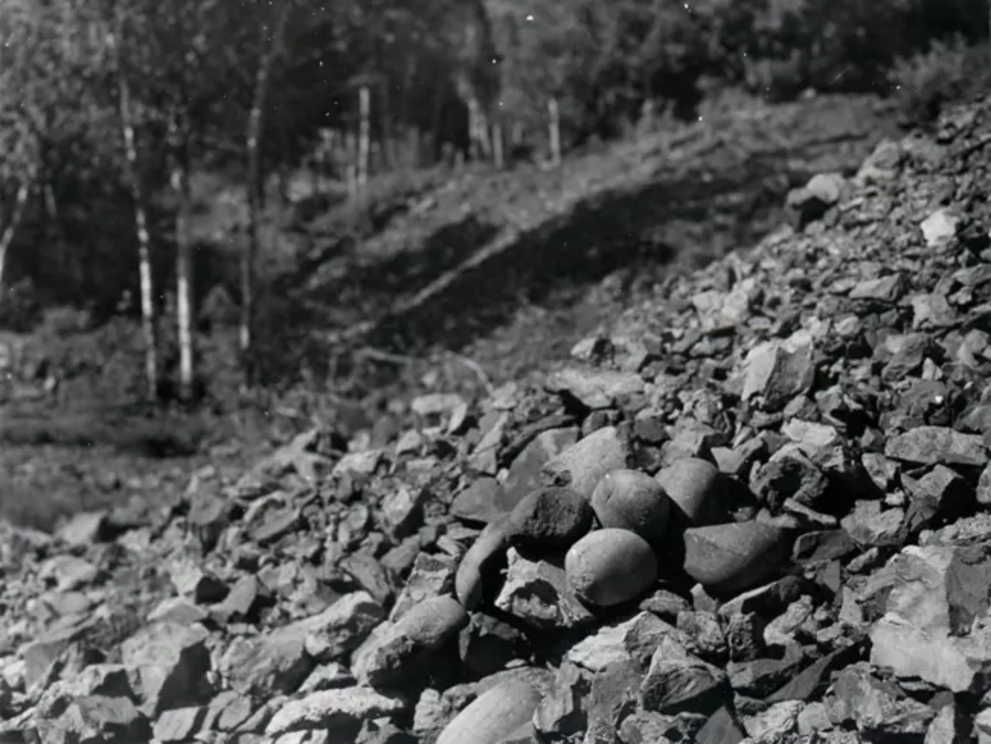 Hammerstones atop the poor rock pile near McCargoe Cove, photographed in July 1954.
Conclusion
One of the most important technological advancements has come directly from geochemical and lead-isotope analyses. Researchers can compare the elemental composition of copper artifacts with that of known geological sources. Because the native copper deposits in the Lake Superior region exhibit distinct chemical signatures, researchers can determine whether an artifact originated on the Keweenaw Peninsula or Isle Royale. Recent studies confirmed that Great Lakes copper was distributed throughout eastern North America, appearing at archaeological sites hundreds of miles from its source. Combining radiocarbon dating with microscopic analysis of manufacturing techniques, researchers can trace the evidence of the sophisticated Indigenous exchange networks that connected prehistoric communities across the continent.
The greatest mystery remains unsolved. While scientific analyses continue to improve estimates of active mining activity and chart Lake Superior copper circulation, many archaeologists suspect that a significant portion of ancient copper work remains undiscovered in unexcavated archaeological sites, buried ceremonial caches, submerged landscapes, and settlements that still haven’t been investigated. Others caution that historical estimates of the total quantity of copper mined may require further refinement as new data comes in. A new technological breakthrough has only generated new questions about the organization of prehistoric mining, the scale of long-distance exchange, and the social importance of copper within Indigenous cultures. The search for answers goes on, demonstrating that archaeology isn’t solely dedicated to uncovering ancient objects. Researchers are using scientific techniques to reconstruct forgotten economies, human connections, and technologies stretching back thousands of years.