
First Nations family's 'winged alien encounter' shot from a tree, then vanished without a trace in rural British Columbia
Sometime during the late 1950s or early 1960s, on a wooded family acreage in British Columbia, Canada, a First Nations grandfather reportedly confronted something perched high in the trees above his property. The incident followed animal disappearances, a terrified horse, a foul carrion odor, and an injured dog. What makes this account especially unsettling is what happened after the man fired a rifle at the winged being, because no body, blood, or trail was ever found.
CASE FILE:
Date: Likely late 1950s to early 1960s
Location: Rural wooded acreage in British Columbia, Canada, after the family had settled near the Vancouver area
Primary Witnesses: First Nations grandfather, grandmother, mother as a child, family dogs
Reported Entity: Tall winged humanoid or “winged alien” perched in a tree
Estimated Size: At least 6 feet tall, possibly taller
Associated Phenomena: Rotten garbage or meat odor, animal distress, livestock disappearances, dog injury, sudden disappearance after being shot
Source: Account relayed by the witness’s grandson
WITNESS REPORT
“My grandfather was a real badass.
He was born in Alberta, Canada, during the early 1930s and was raised on a reservation with his three brothers. When he was only 9 years old, his parents left for British Columbia with their only daughter. They promised they would return, but none of the boys ever saw them again.
To survive, my grandfather learned carpentry, worked as a laborer, and bare-knuckle boxed older men for extra money. He learned to track and hunt, and when work was scarce, he still came home with something to eat.
When he was 14, he put the second-oldest brother in charge of the household, left the reservation, and went in search of his parents and a better life. He never went back. That was the last time he saw any of his family members.
He spent months riding the rails, befriending some transients, and using his fighting skills to defend himself against others. Eventually, he made his way to Vancouver, the last known whereabouts of his parents and sister, and began working in a pulp mill. At 17, he met my grandmother. They eventually married, and he gave up his search for his missing family.
They bought land, and in his free time, my grandfather built several houses. Some of those houses still stand today. One of them was on the land he bought with my grandmother. The property included acres of wooded land, and they kept horses and small farm animals for eggs and meat.
My aunt was born in the early 1950s, and my mother came along near the end of that decade. As far as I know, nothing bad or strange happened until my mother found an old Ouija board and played with it alone. I do not know whether that had anything to do with what happened later.
When my mother was around 8 years old, she was riding her horse through the wooded part of the acreage. Suddenly, the horse stopped dead in its tracks. My mother tried to spur it forward, but the animal was frozen in fear.
Then she smelled something like rotting garbage and meat.
She pulled back on the reins, and the horse instantly turned and bolted back toward the house. It almost threw her several times along the way.
After that, the horse was never the same. It would try to kick her. If she managed to get on it, the horse would fall backward, trying to crush her beneath it.
One day, the horse started acting like its old self again and allowed her to climb on. But once she was mounted, it ran toward the road, stopped abruptly, and bucked her forward into the path of an oncoming car.
My grandfather saw it happen. He put a shotgun to the horse’s head, but the animal just stood there breathing heavily and staring straight ahead. My mother was nearly hit by the car, but the driver swerved just in time. My grandmother begged my grandfather not to shoot the horse. When he saw that my mother was not badly injured, he decided to give the animal away instead.
That same horse later fell on the next person who rode it and broke her collarbone. That rider’s father did what my grandfather said he should have done the first time.
After that, animals began disappearing from the property. One of the hunting dogs was injured by something during a nighttime attack. My grandfather set traps and began sleeping in the hayloft above the barn with a shotgun and rifle beside him.
He stayed out there for several nights.
He thought it might be foxes, coyotes, wolves, or even a desperate bear. He also believed a bear could explain the smell my mother noticed in the woods, and why the horse had gone mad with fear.
But nothing came while he was watching.
Eventually, he assumed whatever it was had moved on to easier prey or had died.
The day after he stopped sleeping in the barn, my mother was outside near the tree line, playing with the injured dog as it healed. Out of nowhere, the dog began sniffing the air. Then it moved between my mother and the trees, growling and barking.
My grandfather heard the commotion and came outside. He stopped in his tracks and called back to my grandmother to bring his rifle. Then he whistled for the dogs.
My grandmother came out, handed him the gun, and asked what was happening. As the dogs began reacting like the first one, my grandfather pointed toward one of the treetops.
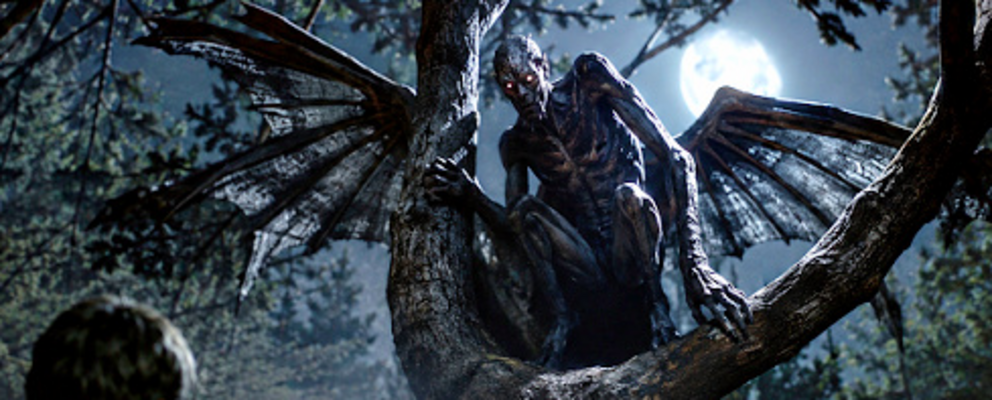
At first, it looked like the top of the tree was longer and thicker than the others around it. But then it moved slightly.
He later told me the thing was at least 6 feet tall, and probably taller.
He took aim and fired just as he saw a pair of wings beginning to open. Whatever was up there had been watching them, but he beat it to the punch.
He said it was a kill shot, directly in the chest with a high-powered rifle.
The thing dropped.
He immediately ran toward the impact site with the dogs following him. He said the sound of branches breaking as the thing fell was unmistakable.
When he reached the spot, he raised the rifle again and ordered the dogs forward to flush it out. But the dogs just stood there, spinning around, trying to catch a scent that had somehow vanished.
There was a pile of broken branches where the thing had landed, but there was no body. No blood. No trail.
It had either disappeared or somehow gone straight back up the way it came.
My grandfather searched those woods for several days, but he never found any sign of what it was. After that, the family did not see it again, and the trouble with the animals stopped.
Decades later, when my grandfather was dying, he kept talking about something he had seen. In his delirium, he called it an alien and said it was coming back for him.
I had never seen that man scared of anything in my life, but there was real panic in his voice.
A few nights before he died, he had already been too weak to stand on his own for several days. My grandmother woke to the sound of a gunshot. She ran outside, fearing the worst, and saw my grandfather lowering his rifle and staring into the distance.
She took the gun from him and helped him back inside.
That was it.
I do not know whether whatever he saw had really come back to him, or if it was only a hallucination of an old memory. But I like to think he went out with one final act of defiance against the thing that had tormented his family all those years before.”
COMMENTARY
This report contains several recurring Fortean markers: animal panic before visual confirmation, a rotting odor, livestock or small-animal losses, a dog injured by an unknown predator, and a large winged figure that uses tree cover before revealing its wings. The most important behavioral detail is that the family animals reacted before the human witnesses fully understood what was present.
The emotional tone of the account is also notable. The grandfather is described as a hard, disciplined, survival-tested man, someone experienced with hunting, tracking, violence, and wilderness hardship. That background makes his later deathbed fear significant. Whether the final “alien” reference was literal, symbolic, or delirious, the memory retained power over him for decades.
The regional context is worth noting. British Columbia and the broader Pacific Northwest have deep Thunderbird traditions among Indigenous cultures, and Thunderbirds are widely present in Native traditions across North America. Audubon notes that Thunderbird traditions appear among numerous Native groups, including Pacific Northwest peoples, and are represented extensively in ethnographic records. Britannica also identifies the Northwest Coast culture area as a Pacific coastal region extending from southern Alaska to northwestern California, a region with long-standing Indigenous cultural continuity and symbolic traditions tied to powerful beings and natural forces.
There are also Western Canadian “giant bird” reports in the broader record. One often-cited account from the Canadian Rockies describes hikers in July 1925 reporting an enormous bird near the Tower of Babel, southeast of Lake Louise, Alberta. That case is usually framed as a Thunderbird-style sighting rather than as a winged humanoid, but it shows that reports of oversized flying creatures have persisted in the same general western Canadian corridor.
This case, however, does not read like a simple encounter with a giant bird. The entity was described as tall, upright, perched in a tree, watchful, and winged. The lack of blood, body, or scent trail after an apparent rifle strike pushes the account into stranger territory. Possible interpretations include a misidentified large predator or bird, a folkloric Thunderbird-related encounter, a winged humanoid event, an interdimensional manifestation, or an ultraterrestrial intrusion that left only physical disturbance at the impact site.
CASE NOTES
• The original encounter likely occurred when the narrator’s mother was about 8 years old, placing it around the late 1950s or early 1960s.
• The family property was described as wooded acreage in British Columbia, following the grandfather’s move from Alberta to the Vancouver area.
• The first warning sign was the horse freezing in fear and reacting to a strong odor of rotting garbage and meat.
• The horse’s behavior changed permanently after the wooded encounter, becoming dangerous and seemingly uncontrollable.
• Small animals later disappeared, and one hunting dog was injured during a nighttime attack.
• The grandfather initially suspected known predators, including foxes, coyotes, wolves, or a bear.
• The entity was reportedly perched high in a tree, appearing at first like an unusually thick or elongated treetop.
• The being opened its wings just as the grandfather fired.
• Broken branches marked the apparent impact site, but there was no body, blood, scent trail, or physical remains.
• The activity reportedly stopped after the shooting incident.
• Decades later, the grandfather referred to the being as an “alien” while dying, suggesting the event remained unresolved and frightening to him.
For readers following ongoing reports of winged humanoids, the Thunderbird, and anomalous flying entities, this British Columbia case belongs alongside other accounts involving large, tree-perched beings, sudden animal terror, carrion-like odors, and entities that appear to interact with the physical environment before vanishing without conventional trace evidence. Visit the Phantoms & Monsters Winged Humanoid Reports Master Index for related cases, regional comparisons, and continuing updates. Lon
FAQ
Was this a Thunderbird report?
Possibly, but not in the standard giant-bird sense. The entity was described as tall, upright, winged, and watchful, perched in a tree. That makes it closer to a winged humanoid report, though the broader Thunderbird tradition is relevant to the region.
Could it have been a bear, owl, eagle, or other known animal?
A known predator could explain the odor, livestock losses, and animal fear. However, the reported height, upright tree position, wing opening, impact sounds, and total absence of blood or remains after a rifle shot make a conventional explanation difficult based solely on the account.
Why is the horse’s reaction important?
Animals often react before human witnesses understand what is occurring in anomalous encounter reports. In this case, the horse’s sudden terror, later aggression, and refusal to behave normally suggest a severe fear imprint or trauma response.
What is the strongest anomalous detail in the case?
The disappearance after the shot. The grandfather reportedly heard the being fall through branches and found the impact site, but there was no body, blood, or trail.
Did the entity return near the grandfather’s death?
That remains unclear. His final experience may have been a hallucination, a memory resurfacing under physical decline, or, as the family feared, a final encounter with the same presence.
NOTICE: Witnesses Sought for Upcoming TV and Film Project
If you have ever seen a winged humanoid in Chicago or the surrounding region, including the O’Hare corridor, nearby suburbs, forest preserves, Lake Michigan shoreline, or northwestern Indiana, I would like to hear from you.
I am currently assisting with an upcoming television and film project focused on the ongoing Chicago Winged Humanoid phenomenon and am seeking credible eyewitnesses, both past and recent, who may be willing to share their experiences.
If you have previously contacted me or are a new witness who has not yet come forward, please consider reaching out. All serious inquiries will be treated with respect and discretion.
If you would like to discuss your sighting, you can reach me through the 'CONTACT' link at the top of the page.
Your account may help document an important part of this continuing mystery. Thanks. Lon Strickler