
New discoveries reveal Tell Abraq's role in ancient Persian Gulf trade
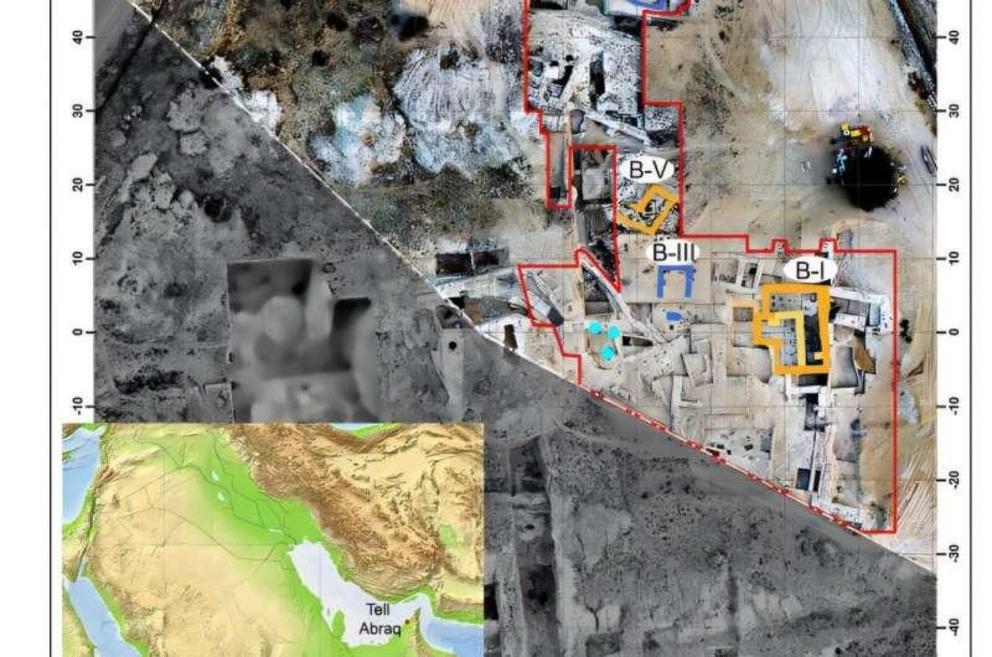
Tell Abraq at the end of the 2024 season, and a chronology for the region and site. The red line delimits the area investigated by the IAMUQ.
If there were a place that could be called the archaeological almanac of Saudi Arabian culture, it would be Tell Abraq, located on the west coast of the United Arab Emirates. This area contains traces of every cultural phase of southeast Arabia's history, covering a period from about 2500 BC through possibly the fourth century AD.
In a study published in Antiquity, researchers found evidence of over 3,000 years of human activity at Tell Abraq, including buildings and imported items that clearly point to two major periods when the region was strongly connected to other cultures.
From the first phase, which occurred during the Late Bronze Age (c. 1600–1300 BC), the researchers discovered a massive stone building (B-I) from that era that is unlike anything else in the region. Inside the building made with its unusually tough mortar, the team found storage jars stamped with seals from southern Mesopotamia and Elam. These items hint at powerful outsiders closely overseeing trade at Tell Abraq.
The second key phase was the Late Pre-Islamic period (first–third centuries AD). From this era, researchers uncovered a small shrine (B-III) with an open-air altar. By this time, the settlement was no longer inhabited by local residents, the shrine was likely used by traveling merchants as a stopping point to worship or give thanks to deities for safe passage across the Persian Gulf.
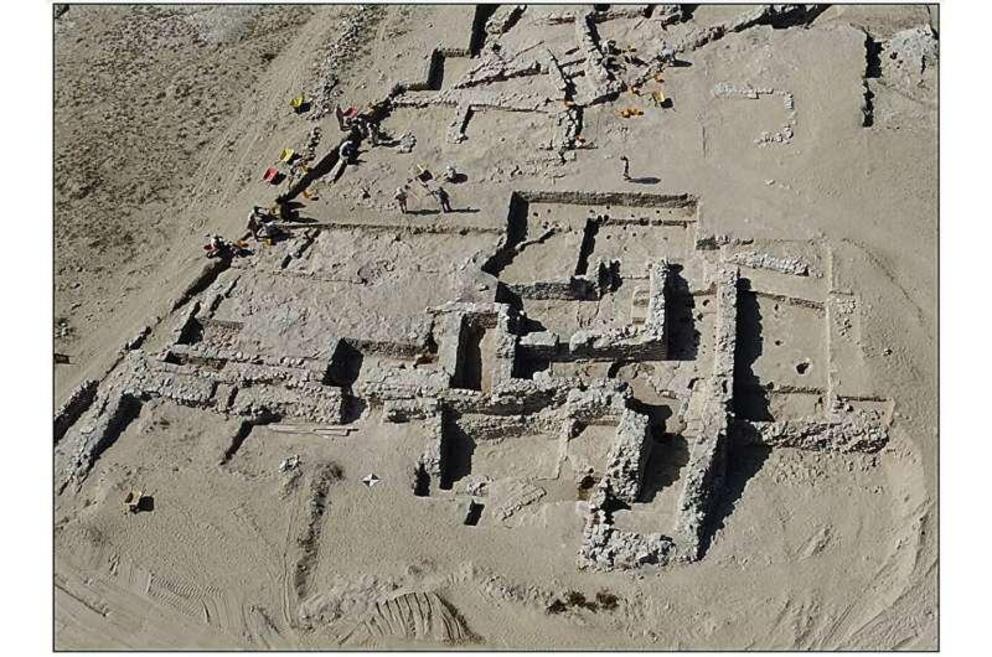 B-I and adjacent structures, looking west.
Filling in the gaps
Over the thousands of years, the southeast Arabian region served as home to people that saw the rise and fall of distinctive local cultures. While these societies were complex and part of international trade networks, they never developed into states with centralized power like that of their neighbors.
Previous research on this region raised several questions regarding the site's evolution and how it connected to regional and international trade. The Italian Archaeological Mission in Umm al-Quwain (IAMUQ), which has been excavating at the Tell Abraq site since 2019, is on a mission to fill in the gaps.
In this study, the team reported finding large stone buildings, shrines, and artifacts like clay and bronze figurines, stone statues, local bronze coins, and fake Roman gold coins.
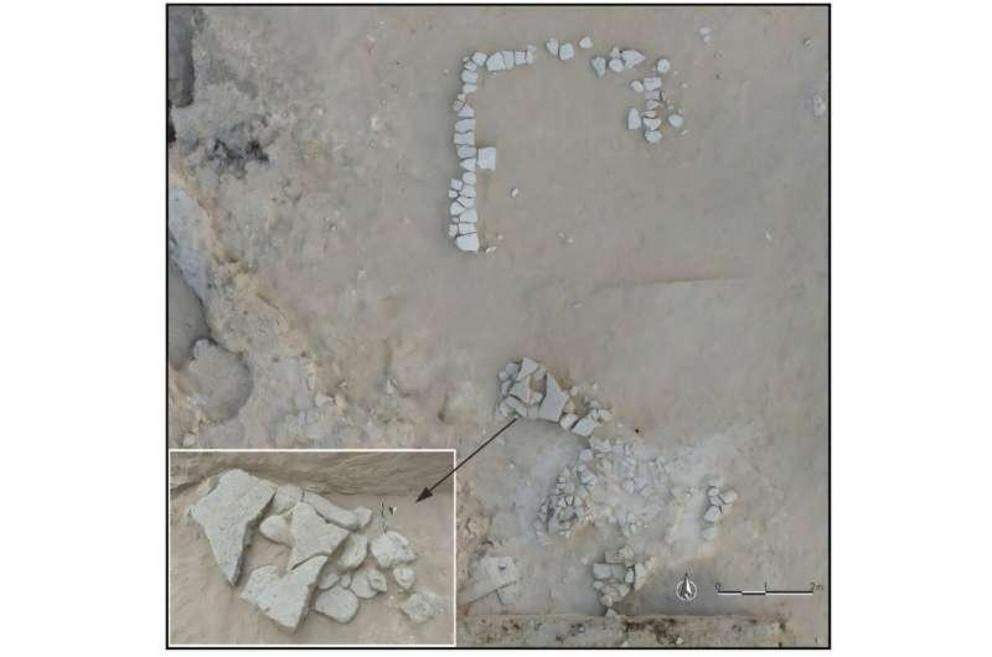 B-III with inset detail of the collapsed altar.
Analyzing these objects helped researchers piece together changes in the region over time, as well as its foreign trade and relations. They suggested that the unusual construction of the Bronze Age stone, especially its heavy use of hard mortar, rare for the region, pointed to foreign influence and control over trade goods.
The imported religious objects from the Late Pre-Islamic period indicated that Tell Abraq had become a stop along busy maritime trade routes linking India, Rome, and southern Mesopotamia.
The researchers believe the site shifted from being tightly controlled by outside powers to becoming an active hub within these wide-reaching trading networks.
These insights give us a better picture of how people and goods once moved across the ancient Persian Gulf.
More information: Michele Degli Esposti, Tell Abraq: cross-cultural connections in the Persian Gulf from the Late Bronze Age to the early centuries AD, Antiquity (2025). DOI: 10.15184/aqy.2025.10246
Journal information: Antiquity